
The Genealogist's Complete Guide to Obituaries and Death Records
An end-to-end resource covering every aspect of obituary and death record research — from locating archives to citing sources and resolving conflicts in your family tree.
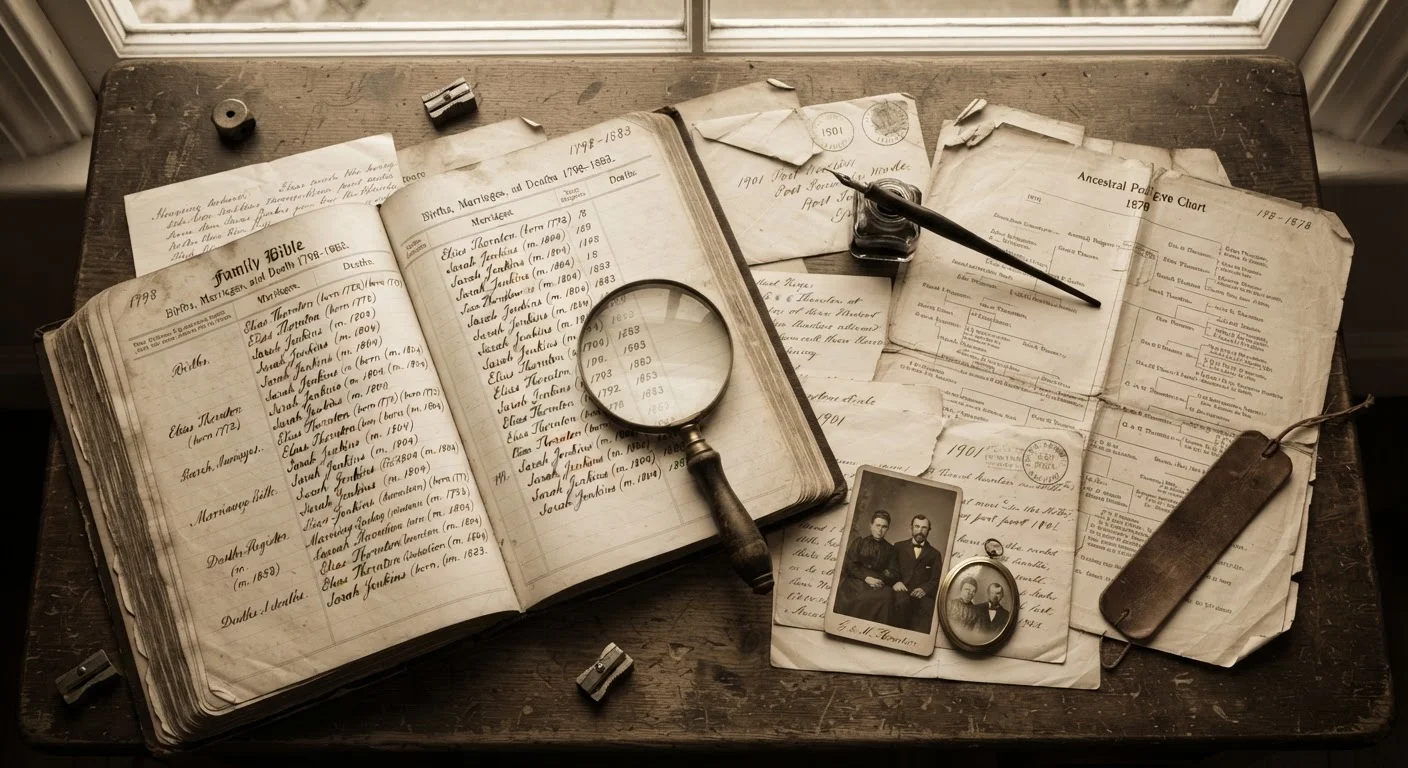
Photo: searchopenrecords editorial
—— In This Article
- Why Obituaries Matter in Genealogical Research
- Understanding the Death Record Ecosystem
- Locating Obituaries and Death Records
- Reading and Interpreting Obituary Information
- Resolving Conflicts Between Sources
- Citing Obituaries and Death Records Properly
- Building Outward: Connecting Obituaries to Your Family Tree
Key Takeaways
- Obituaries are secondary sources that often lead to more authoritative primary death records.
- Death certificates, Social Security Death Index entries, and obituaries each supply different — and complementary — details.
- Inconsistencies between sources are normal; resolving them requires weighing each record's proximity to the event.
- Proper citation of every obituary and death record protects the integrity of your family tree.
- Newspaper archives and genealogy databases have distinct strengths — using both maximizes coverage.
- Names, survivor lists, and place references in obituaries can unlock entirely new research branches.
Why Obituaries Matter in Genealogical Research
Genealogy research rests on a simple promise: follow the paper trail and the family reveals itself. Obituaries occupy a unique place in that trail. Unlike bare vital statistics, a well-written obituary can name a spouse, list surviving children, identify a home congregation, cite a hometown, and gesture toward immigration origins — all within a few paragraphs. For researchers who hit brick walls in census or land records, that density of detail is invaluable.
At the same time, obituaries are secondary sources. They were typically compiled by grieving family members or funeral home staff shortly after a death, which means dates, spellings, and relationships can contain errors. Treating an obituary as a starting point rather than a final verdict is a foundational habit of careful genealogical work. See our comprehensive starting guide to obituary research for genealogy for a fuller orientation to this framework.
When an obituary names survivors with unfamiliar surnames, search for marriage records in the county listed as the survivor's current residence — not just the deceased's home county.
Survivors often married and settled in different counties or states, so limiting searches to a single jurisdiction misses the marriage record that links the family lines.
Always record the full masthead information of the newspaper — including edition and page number — at the moment you find an obituary, even if you plan to print or save it digitally.
Digitized newspaper databases are periodically restructured, and URLs or catalog numbers can change; capturing the full print citation at the time of discovery guarantees you can relocate the source.
Cross-check the age given in an obituary against census records from two or three different decades to identify which stated age — and therefore which birth year — appears most consistently.
People frequently rounded or misremembered ages across different life stages; a pattern across multiple census snapshots is more reliable than any single reported figure.
Understanding the Death Record Ecosystem
No single document tells the whole story of a death. The US public record system generates several distinct record types, each created by a different authority and containing different information:
- Death certificates — issued by state vital records offices; considered primary records for cause of death, exact date, and place. Informants vary in reliability for biographical details like birthplace or parents' names.
- Social Security Death Index (SSDI) — a federal database derived from Social Security Administration records; useful for post-1936 deaths and for locating last known ZIP codes.
- Obituaries — published by newspapers or funeral homes; rich in family relationships and community context but editorially prepared rather than legally certified.
- Cemetery and burial records — sexton records, plot maps, and funeral home archives can confirm burial dates and locations not always captured elsewhere.
- Probate records — filed with county courts; often name heirs and beneficiaries, corroborating survivor information found in an obituary.
Understanding which record type serves which research question prevents over-reliance on any single source — a cornerstone principle described in our complete family tree research walkthrough.
~3.3M
US deaths registered annually
The CDC National Center for Health Statistics reports approximately 3.3 million deaths are registered in the United States each year, each generating at minimum one official death certificate.
1936
Earliest year covered by SSDI
The Social Security Death Index generally covers deaths from 1936 onward, reflecting when Social Security record-keeping began in the US.
50+
Years before many state death records become public
State access restrictions vary widely, with some states imposing waiting periods of 25 to 75 years before death certificates are available to the general public.
Locating Obituaries and Death Records
Finding the right record is half the research battle. The most productive approach layers multiple source types:
- State vital records offices — Most states release death certificates after a statutory waiting period (commonly 25–75 years). Some offer online indexes; others require mail or in-person requests. Access rules and fees vary by state.
- Newspaper archives — Historical obituaries live in digitized newspaper collections held by state libraries, the Library of Congress Chronicling America project, and subscription genealogy databases. Local public libraries frequently provide free access to regional archives.
- Genealogy databases — Large platforms aggregate obituaries, death indexes, and cemetery records. Each has different coverage strengths; see our comparison of newspaper archives vs. genealogy databases for obituary research to match the source to your search.
- Funeral homes — Many retain records decades old and may share information with researchers upon request.
- Library and historical society collections — Local institutions often hold clipping files, church bulletins, and death notices not digitized anywhere else.
For a method-by-method breakdown of every access route, our complete roadmap to locating obituaries online and off covers both digital and physical pathways in depth.
Reading and Interpreting Obituary Information
An obituary rewards close reading. Beyond the headline name and date, look carefully at:
- Survivor lists — Children listed by married name reveal maiden names; in-laws named in full can open entirely new family lines.
- Geographic references — Towns mentioned as birthplaces, earlier residences, or the sites of military service point toward census records, land deeds, and draft registrations in those jurisdictions.
- Religious and fraternal affiliations — Church membership suggests parish registers; lodge membership may mean separate death benefit records.
- Occupational clues — Employment history can lead to employer pension records, union archives, or occupational licensing files.
- Age at death vs. stated birth year — Calculating backward from an obituary's age-at-death figure and checking it against a stated birth year frequently reveals discrepancies worth investigating further.
The Reading Obituaries hub offers detailed guidance on extracting the full research value from every section of a notice. Building a habit of systematic extraction — rather than skimming for obvious facts — significantly increases how much each record contributes to your tree.
Resolving Conflicts Between Sources
It is common — and expected — to find that an obituary states a birth year of 1887 while a death certificate shows 1889, or that a survivor list omits a sibling documented in census records. Conflicts do not mean your research has failed; they mean you have more evidence to weigh.
A practical framework for resolution:
- Assess informant proximity
- Who supplied the information, and how close were they to the original event? A death certificate informant who was present at the death is more reliable for cause-of-death details than for the deceased's parents' birthplaces.
- Count corroborating sources
- When two or more independent records agree on a detail, that agreement carries more weight than a single contradicting source.
- Note, don't discard
- Document every conflicting detail in your research log with source citations. Future evidence may resolve what is currently ambiguous.
- Prefer primary over derivative records
- For legally certified facts (date of death, place of death), a death certificate generally outranks an obituary. For relationship details, the obituary may actually be more reliable, since family members rather than clerks typically provided that information.
Obituary Dates Are Not Legally Certified
Dates printed in an obituary — including birth year and date of death — were typically provided by family members under emotional stress and were not verified by any government authority. Always obtain the corresponding death certificate before treating a date as confirmed for legal, estate, or immigration purposes. If records conflict, document both versions with full citations and note the discrepancy rather than arbitrarily choosing one.
Citing Obituaries and Death Records Properly
A genealogical conclusion unsupported by citations is an anecdote, not a finding. Every obituary and death record you consult should be cited with enough detail that another researcher — or your future self — can locate the same source independently.
A complete obituary citation typically includes: the full name of the deceased as it appears in the notice, publication name, publication date, page and column number (for print), access URL or database name (for digital), and date accessed. For death certificates: state, county, certificate number, year filed, and whether you consulted the original or a transcription.
Established genealogical citation standards, such as those described in Evidence Explained by Elizabeth Shown Mills, provide templates for virtually every record type. Following a consistent standard prevents citation gaps that undermine otherwise solid research.
The habits that experienced researchers apply to source evaluation and record citation are explored further in our guide to proven research habits for obituary searching.
Building Outward: Connecting Obituaries to Your Family Tree
Each obituary is not just an endpoint — it is a hub of outward connections. A single notice may name four or five individuals whose own vital records, obituaries, and community documents remain unfound. Approaching each obituary as a list of future research subjects, rather than a single data point, is what separates methodical genealogists from casual searchers.
Practical next steps after locating an obituary:
- Search for obituaries of each named survivor to gather dates and further family details.
- Use place references to pull relevant census years, city directories, and local newspaper archives for that geographic area.
- Request the corresponding death certificate from the issuing state office to cross-verify facts and retrieve informant details.
- Check probate indexes in the county of death for any estate filings that name additional heirs.
Our article on tracing a family tree using obituaries as your starting point maps this branching process in detail, showing how a single obituary can anchor weeks of productive research across multiple record sets. The Finding Obituaries hub also catalogs additional source types as your search expands.

Obituary Search Editorial Team
Obituary Search Editorial Team is the collective byline for our editorial team and contributor network. Articles published under this byline or an editorial pen name are researched, written, and reviewed according to our editorial standards for clarity, consistency, and independence before publication.
View author profile