
Social Media Footprints and Email Tracing: How Profiles Connect to Addresses
Public social profiles often contain or link to email addresses. Learn how these digital footprints factor into people-search and email lookup research.
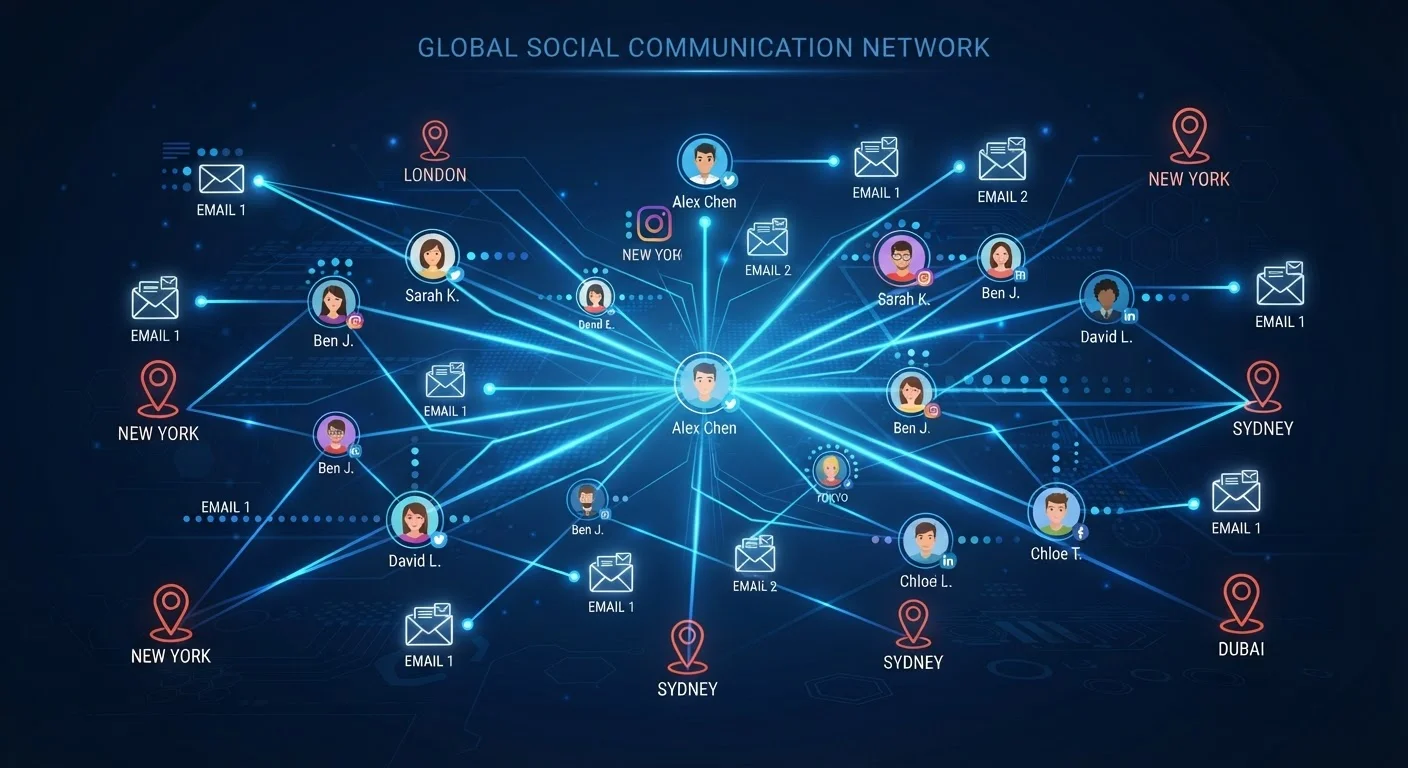
Photo: searchopenrecords editorial
—— In This Article
Key Takeaways
- Public social profiles frequently display or link to email addresses, creating traceable connections.
- Email lookup tools work by cross-referencing an address against aggregated public data, not private systems.
- A single shared username can link multiple profiles to one email address across different platforms.
- Results from email tracing vary widely in accuracy and should be verified through additional sources.
- Legitimate email lookup research is governed by fair-use principles and applicable privacy laws.
How Social Profiles Become Searchable Data Points
Every time someone creates an account on a social platform, registers for a forum, or signs up for a newsletter, they leave a small but potentially persistent data trail. This trail — collectively called a social media footprint — includes the username chosen, the email address supplied during registration, and any contact information voluntarily added to a public-facing profile.
Many platforms allow, or even encourage, users to display their email addresses openly. Business profiles on LinkedIn, creator pages on platforms like YouTube or Patreon, and even personal blogs frequently list contact emails as a convenience for collaboration or networking. Once that information is publicly indexed, it can be harvested by data aggregators and incorporated into searchable records databases.
The practical result is that an email address typed into a people-search tool can surface the platforms where that address — or a username strongly associated with it — appears. As the digital footprint mapping process shows, a consistent username is often the thread that stitches disparate profiles together into a recognisable identity.
Check Your Own Footprint First
Before researching others, consider searching your own email address in a people-search tool. The results will show you exactly what publicly aggregated data exists about you — and may prompt you to review the privacy settings on accounts you've long forgotten. Many platforms allow you to remove or hide contact information from public-facing profiles.
The Mechanics Behind Email Lookup Tools
Email lookup tools don't tap into private servers or intercept communications. Instead, they query large datasets assembled from publicly accessible sources: social profile pages, domain registration (WHOIS) records, data from defunct websites preserved in web archives, and publicly posted contact information. When a match is found, the tool returns associated names, usernames, or geographic indicators that appeared alongside that email in the source data.
The quality of a result depends entirely on how much public information was linked to that address at the time of aggregation. An address used to register a business domain with a public WHOIS listing may yield a name and mailing address. An address used only for private personal communication is unlikely to surface anything meaningful. For a detailed account of which specific record types contribute to these results, see what public records can actually reveal about an email address.
4.9B+
Global social media users generating public data
Statista estimates put global social media users above 4.9 billion as of recent years, each potentially contributing publicly visible profile data to aggregated records.
~30%
Business profiles displaying a public contact email
Industry analyses of LinkedIn and similar platforms suggest roughly a third of professional profiles include a visible email address in their public contact section.
Varies widely
Accuracy of aggregated email-to-address matches
Data quality researchers consistently note that people-search aggregator records can be months to years out of date, with accuracy rates differing significantly by data source and record age.
Connecting the Dots: From Email to Address
The link between an email address and a physical location is rarely direct. More commonly, it is built through a chain of associations: an email connects to a username, the username appears on a social profile listing a city, the profile links to a personal website, and that website carries a contact address. Each hop introduces a new opportunity for the data to be outdated, misattributed, or simply incomplete.
Domain WHOIS records have historically been a reliable bridge between email and address data, since registrants were once required to supply verifiable contact information. Privacy-protection services now shield many registrants, so this route is less productive than it was a decade ago. Other pathways — such as email addresses appearing in scanned public documents, court filings, or property records — can still yield location-adjacent data when searched through dedicated address lookup tools.
Researchers working on genealogy projects sometimes encounter the reverse challenge: starting from an address and trying to confirm the email or online identity of a past resident. The process of tracing family roots increasingly intersects with digital-era records, though reliability drops sharply for records predating widespread internet adoption.
Limitations, Accuracy, and Responsible Use
Understanding what email tracing cannot do is just as important as understanding its capabilities. Aggregated data is a snapshot, not a live feed — an email address may be linked to an address the person moved away from years ago, or to a name that belongs to a different individual who once shared a device or account. For a grounded look at how often popular assumptions about email tracing fall short, the article on common misconceptions about email tracing provides useful counterweights to overconfident expectations.
Email lookup is also one piece of a larger research puzzle. As explored in how email lookup fits the bigger picture, combining an email search with phone lookup, name search, and address verification produces a substantially more reliable result than relying on any single data point alone.
Finally, purpose matters. Researching your own digital footprint, reconnecting with a lost contact, or verifying a business identity are all generally legitimate uses. Using lookup results to monitor, harass, or harm someone is not — and may expose a researcher to civil or criminal liability under state and federal law. When in doubt about the legality of a specific use case, consulting a qualified attorney is the appropriate step.
This article is for informational and educational purposes only. It does not constitute legal advice. Readers should consult a qualified legal professional regarding the permissible use of personal information in their jurisdiction.
Frequently Asked Questions

People Search Editorial Team
People Search Editorial Team is the collective byline for our editorial team and contributor network. Articles published under this byline or an editorial pen name are researched, written, and reviewed according to our editorial standards for clarity, consistency, and independence before publication.
View author profile