
Submitting a Claim Online vs. by Mail: What the Process Looks Like Either Way
Most states now offer both digital and paper claim routes. See how they compare in speed, documentation requirements, and ease of tracking.
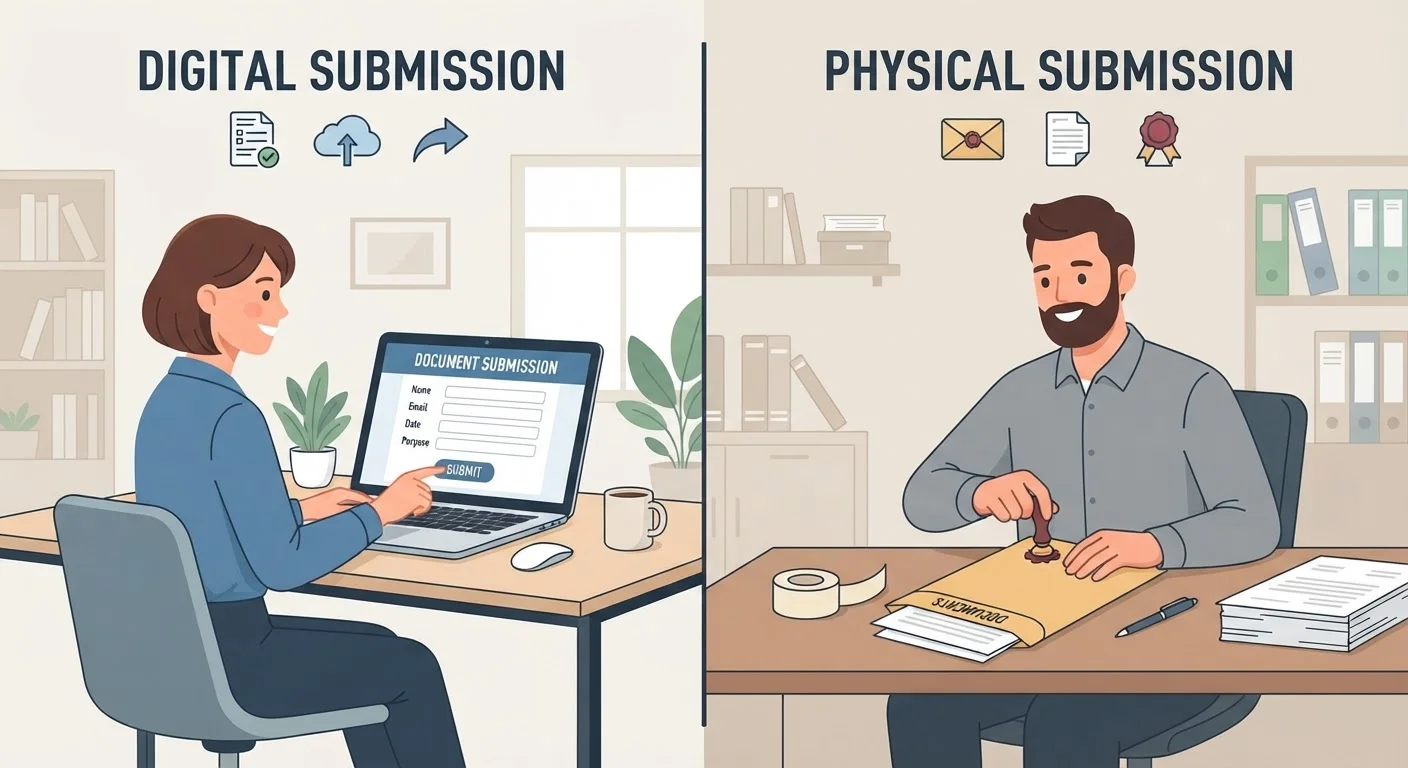
Photo: searchopenrecords editorial
—— In This Article
Key Takeaways
- Most state unclaimed property offices now support both online and mail-in claim routes.
- Online claims typically process faster and allow real-time status tracking through the state portal.
- Mail-in claims are better suited for complex estates or cases requiring original notarized documents.
- Both methods require the same core identity and ownership documentation — only the delivery differs.
- Regardless of method, incomplete documentation is the leading cause of claim delays.
How Each Method Actually Works
Before comparing speed and documentation, it helps to understand what both processes actually look like from start to finish. To learn the broader context of how unclaimed property is held and eventually paid out, see how unclaimed money works.
Online Submission
- Search the state treasurer's portal or MissingMoney.com and locate your property record.
- Click the claim link attached to that specific record — this creates a pre-populated claim form tied to the property ID.
- Complete the online form with your contact details, relationship to the original owner, and any co-owner information.
- Upload scanned copies of required documents (government-issued ID, proof of address, ownership evidence).
- Submit electronically and receive a confirmation number for tracking.
Mail-In Submission
- Download or request a paper claim form from the state's unclaimed property office.
- Complete the form by hand and gather original or certified copies of required documents.
- For claims requiring notarization, have relevant forms signed before a licensed notary public.
- Mail the complete packet — ideally via certified mail with return receipt — to the address listed on the form.
- Record the tracking number and expected receipt date; contact the office if no acknowledgment arrives within 2–3 weeks.
For a comprehensive look at each stage, the unclaimed property claims process walkthrough covers what happens after submission through to payment.
Side-by-Side Comparison
The table below contrasts the two submission methods across the factors that matter most to claimants.
| Criterion | Online Submission | Mail-In Submission |
|---|---|---|
| Average processing time | Typically faster; no postal delay | Longer; add 1–2 weeks for transit |
| Status tracking | Real-time via state portal | Manual follow-up required |
| Document format | Scanned PDF or JPEG uploads | Paper copies; originals for some states |
| Notarization handling | Some states accept e-notary | Traditional notary; original signature |
| Best for estate claims | Often limited; check state policy | Generally preferred or required |
| Confirmation of receipt | Immediate confirmation number | Certified mail tracking recommended |
| Accessibility | Requires internet access | No internet needed |
One point worth noting: both methods carry the same legal weight. A mail-in claim is not inherently more or less valid than a digital one — the difference is purely operational.
State Portals Vary Significantly
Not every state offers a fully self-service online claims portal. Some states use a hybrid model where you complete an initial form online but must mail original documents separately. Always verify the exact procedure on your state treasurer's official website before starting. The National Association of Unclaimed Property Administrators (NAUPA) maintains a directory of all state programs at unclaimed.org.
Documentation: Where the Real Work Happens
Regardless of which channel you use, the documents you provide are what determine whether your claim is approved. The submission method changes the format of delivery, not the substance of what's required. Before you submit by either route, use the pre-claim document checklist to avoid the most common delays.
Core documentation typically includes:
- Government-issued photo ID (driver's license, passport, state ID)
- Proof of current address (utility bill, bank statement, lease agreement)
- Ownership evidence specific to the property type — for example, an old bank statement, insurance policy, or pay stub matching the original account
- Name-change documentation if your name differs from the original owner's records (marriage certificate, court order)
- Estate or probate documents if you are claiming on behalf of a deceased relative
Online portals accept high-quality PDF or JPEG scans. Mail requires paper copies — and some states mandate originals or certified copies for notarized materials. Check your specific state's requirements before preparing your packet, as these vary.
If this is your first time filing, the first-timer's complete guide to filing explains document standards in detail.
After You Submit: Tracking and Follow-Up
What happens after submission is where the two methods diverge most noticeably. Online claimants can typically log back into the state portal at any time and see a status update — whether the claim is under review, pending additional documents, approved, or paid. This transparency reduces the need for follow-up calls.
Mail-in claimants generally receive a written acknowledgment within a few weeks, then must proactively contact the office — by phone or email — to check on progress. If the office requests additional documentation, the back-and-forth adds time to an already longer timeline.
Either way, state processing times vary considerably. Simple claims on small cash balances may resolve in four to six weeks; complex estate claims or large-dollar properties can take several months. Neither method guarantees a specific timeline. For best practices on monitoring your claim after submission — regardless of which route you used — see keeping your claim on track.
This article provides general informational guidance about the unclaimed property claims process. It is not legal or financial advice. For questions about your specific situation — particularly estate claims or large-value properties — consider consulting a licensed attorney or financial professional.

Unclaimed Money Editorial Team
Unclaimed Money Editorial Team is the collective byline for our editorial team and contributor network. Articles published under this byline or an editorial pen name are researched, written, and reviewed according to our editorial standards for clarity, consistency, and independence before publication.
View author profile