
Things That Can Complicate a Title Record Search
From missing odometer disclosures to out-of-state gaps, several factors can obscure a vehicle's title history. Here's what to watch for.
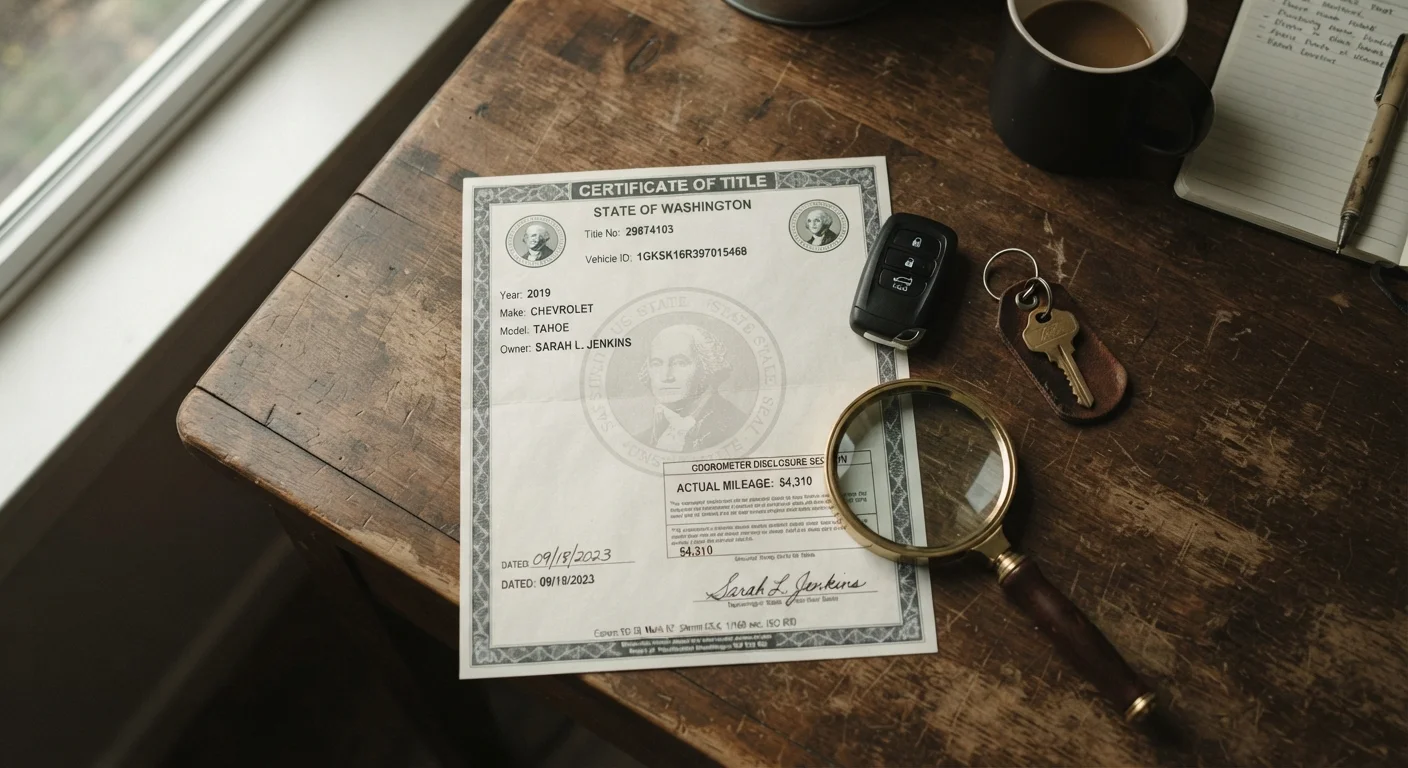
Photo: searchopenrecords editorial
—— In This Article
Key Takeaways
- Out-of-state transfers can introduce gaps in a vehicle's title history that no single DMV database captures.
- Missing odometer disclosures are a major red flag for potential mileage fraud on older or heavily traded vehicles.
- Open liens, unresolved brands, and title washing can make a vehicle's legal ownership status difficult to confirm.
- Private-party sales often generate fewer paper records, leaving stretches of ownership history undocumented.
- Cross-referencing a VIN search with multiple data sources helps identify inconsistencies a single record may conceal.
Why Title Record Searches Aren't Always Straightforward
A vehicle title is a legal document that establishes ownership — but the public record trail behind that title is rarely a single, clean line. It is assembled from filings across multiple state agencies, lenders, insurers, and salvage facilities, each operating under its own rules and timelines. The result is a patchwork system where important details can fall through the cracks.
Understanding where complications arise puts you in a much stronger position when evaluating any vehicle's history. The list below identifies the most common factors that cloud a title record search and explains what each one means for buyers, sellers, and anyone relying on public VIN data.
Out-of-State Title Transfers
Each U.S. state maintains its own title database, and those systems do not automatically share data in real time. When a vehicle crosses state lines — through a sale, relocation, or dealer auction — the receiving state issues a new title based on whatever documentation the previous owner presents. If certain history was recorded only in the originating state's records, it may not carry forward.
This is one mechanism behind title washing, where a branded title — such as a salvage designation — can be obscured by re-titling in a state with different branding criteria or looser verification requirements.
State title databases don't automatically sync, so a vehicle's history can fragment every time it crosses a state line.
Missing or Incomplete Odometer Disclosures
Federal law under the Truth in Mileage Act requires sellers to provide a written odometer disclosure at the time of transfer for most vehicles under ten years old. However, exemptions exist — including for vehicles over a certain age — and not every jurisdiction enforces compliance uniformly.
When those disclosures are absent or inconsistent with other mileage records, it raises the possibility of odometer rollback. Our detailed look at odometer rollback and public VIN data explains how to spot the red flags in a history report.
Gaps in odometer disclosures are among the most actionable fraud signals visible in a VIN record trail.
Open or Unreleased Liens
A lien recorded against a vehicle — typically by a lender who financed the purchase — should be formally released when the loan is paid off. In practice, lien releases are sometimes filed late, filed incorrectly, or not filed at all, leaving the record in an unresolved state. A buyer who doesn't catch this can inadvertently take on a vehicle that a creditor still has a legal claim against.
See our explainer on open liens on a vehicle title for guidance on how lien records work and what steps to take when one appears in a search.
An unreleased lien can follow a vehicle into a new owner's hands even after the underlying loan is fully paid.
Private-Party Sale Gaps
When a vehicle changes hands between private individuals rather than through a licensed dealer, the documentation trail is typically thinner. Dealers are required to handle title assignments, tax filings, and odometer statements as part of their transaction process. Private sellers and buyers may not complete all steps promptly — or at all — leaving stretches of ownership history with no formal public record.
Our article on what happens to a title record in a private sale walks through what records are generated, who is responsible for filing them, and what can go wrong when steps are skipped.
Private sales create stretches of ownership history that may never appear in any public DMV or VIN database.
Unbranded Salvage or Damage History
A vehicle can sustain significant damage — from a collision, flood, or fire — without ever receiving a formal salvage or rebuilt title brand if the damage was not reported to an insurer or was repaired before an insurance claim was filed. In those cases, the title record shows no brand, even though the vehicle's structural or mechanical condition may be materially affected.
Checking the VIN lookup basics alongside any available service or accident records can reveal discrepancies that a title-only review would miss. Understanding every field on the title document also helps — our field-by-field guide to reading a vehicle title explains what each entry means.
Damage repaired without an insurance claim often leaves no brand on the title, making it invisible to a standard record search.
Dealer Reassignments and Auction Chains
Vehicles passing through wholesale auctions or multi-dealer chains can accumulate a series of title reassignments before any single buyer takes retail delivery. Each reassignment should be documented on the title itself, but errors, missing signatures, or gaps in the chain can make it difficult to establish a clear line of legal ownership. A title with several dealer reassignments warrants careful scrutiny of each transfer date and party.
Multiple dealer reassignments on a single title increase the chance of paperwork errors and ownership ambiguity.
Using This Information Before You Commit
No title record search is guaranteed to surface every detail of a vehicle's past. State databases are not universally interconnected, reporting timelines vary, and some events — particularly those from private sales — may never generate a formal public filing. As our guide on why a clean title doesn't always mean a clean history explains, a title free of brands or liens can still belong to a vehicle with a complicated story.
The practical approach is to treat a VIN search as a starting point, not a final verdict. Cross-reference the vehicle history report with the physical title document, the seller's stated history, and, where possible, an independent mechanical inspection. When something in the record trail looks incomplete, that gap itself is informative — it warrants follow-up rather than assumption.
Start With the VIN, Then Verify Offline
Run a VIN search first to identify any recorded flags — brands, liens, odometer inconsistencies, or ownership gaps. Then compare those findings against the physical title document. Discrepancies between the two are worth investigating before any ownership transfer is finalized.
This article is for general informational and educational purposes only. It does not constitute legal or financial advice. Consult a qualified professional for guidance specific to your situation.

Vin Search Editorial Team
VIN Search Editorial Team is the collective byline for our editorial team and contributor network. Articles published under this byline or an editorial pen name are researched, written, and reviewed according to our editorial standards for clarity, consistency, and independence before publication.
View author profile