
Reading a Court Docket: A Plain-Language Breakdown
Docket entries use legal shorthand that can be hard to parse. This guide decodes the most common terms and entry types.
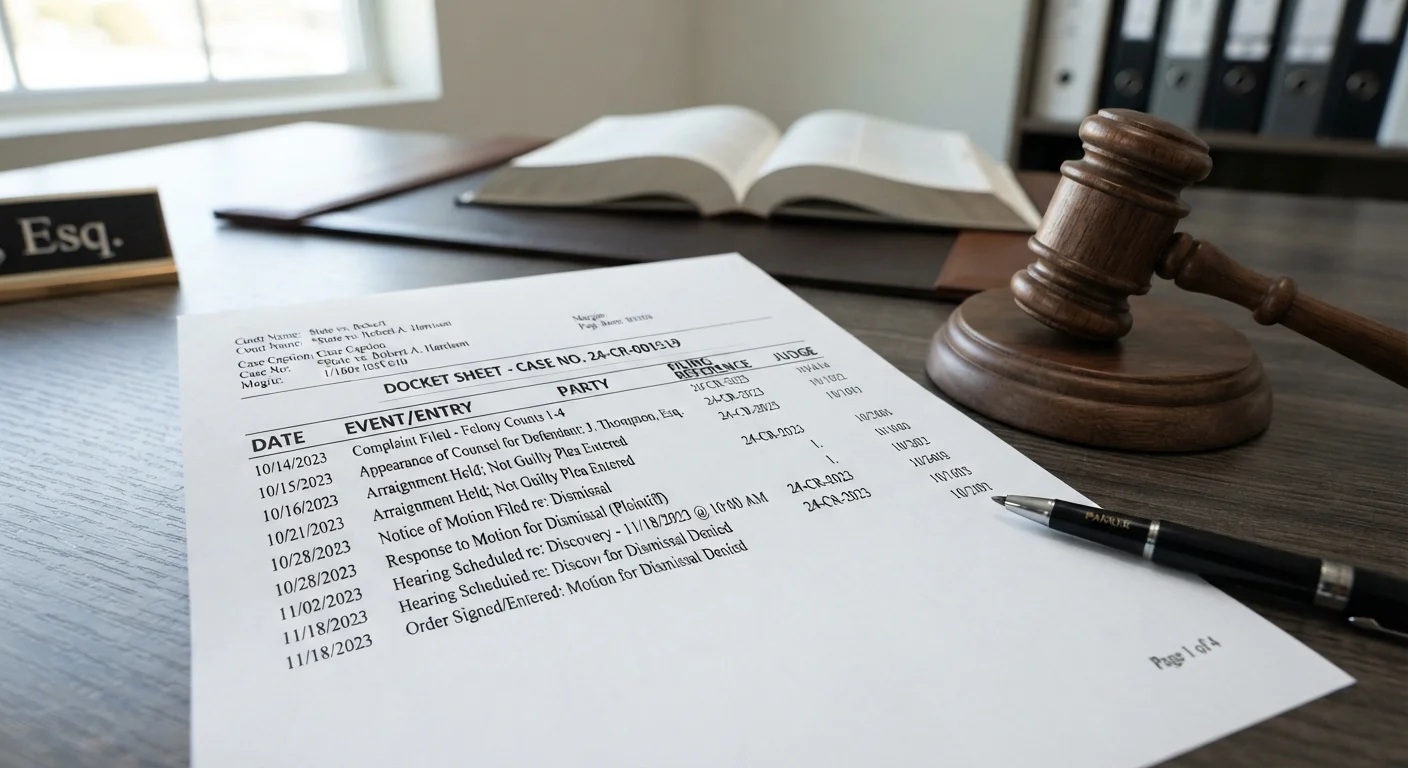
Photo: searchopenrecords editorial
—— In This Article
What a Court Docket Actually Is
A court docket is the official index of everything that has happened in a legal case. Think of it as a running timeline — every filing, every hearing, every court order gets its own numbered entry with a date and a brief description. The docket itself does not contain the full text of those documents; it points to them.
Dockets are maintained by the clerk of court and are generally considered public records unless a judge has ordered them sealed. When you search public court databases — whether a state portal or the federal PACER system for finding records online — what you retrieve first is almost always the docket, not the underlying documents.
If you are new to navigating these systems, Your First Court Records Search: A Ground-Up Guide covers how to locate the right court before you start reading entries.
Docket
The official chronological log of all filings, orders, and actions in a court case. Each entry is time-stamped and numbered, creating a complete procedural record.
Case Number
A unique identifier assigned to a case when it is filed. It typically encodes the court, year, case type, and sequential filing number (e.g., 2023-CV-00412).
Plaintiff / Petitioner
The party who initiates a lawsuit or legal proceeding. In criminal cases, the government (state or federal) is listed as the prosecuting party.
Defendant / Respondent
The party against whom the legal action is brought. In civil matters, this is often labeled 'respondent' rather than 'defendant.'
Motion
A formal written request asking the court to take a specific action, such as dismissing a case, compelling discovery, or granting summary judgment.
Disposition
The final outcome of a case or a specific charge — for example, dismissed, guilty, not guilty, settled, or judgment entered.
Pro Se
Latin for 'on one's own behalf.' A pro se litigant represents themselves in court without an attorney.
Summons
An official court document notifying a defendant that a lawsuit has been filed against them and requiring their response within a set timeframe.
Decoding the Header: Case Number, Parties, and Court
Before the numbered entries begin, a docket displays a header block. Here is what each field typically means:
- Case number: A structured code such as
2023-CV-00412. The year comes first; the middle segment identifies case type (CV = civil, CR = criminal, PR = probate); the trailing digits are a sequential counter assigned by the clerk. - Court and division: Identifies the specific court (e.g., U.S. District Court, Southern District of New York) and sometimes a sub-division or judge assignment.
- Parties: Listed as Plaintiff v. Defendant in civil cases, or State/United States v. Defendant in criminal matters. Multiple parties on each side are common in complex litigation.
- Filed date: When the initial complaint or indictment was submitted — not when the incident occurred.
- Judge assigned: The presiding judge's name, which can change if the case is reassigned.
| Who maintains court dockets | The clerk of court for each jurisdiction |
| Common case type codes | CV (civil), CR (criminal), PR (probate), FA (family) |
| Federal docket access portal | PACER (Public Access to Court Electronic Records) (U.S. Courts, pacer.uscourts.gov) |
| State docket availability | Varies by state; many offer free online portals |
| Typical docket entry fields | Entry number, date filed, document type, brief description |
Reading Individual Docket Entries
Each line in the docket log shares a standard structure:
- Entry number — Sequential, starting at 1. Higher numbers are more recent.
- Date filed — The date the clerk received or docketed the item.
- Document type and description — A short label such as Motion to Dismiss, Answer, Scheduling Order, or Notice of Appeal.
- Filed by — Which party submitted it (plaintiff, defendant, or the court itself for orders).
Common abbreviations you will encounter include MSJ (Motion for Summary Judgment), TRO (Temporary Restraining Order), and CMC (Case Management Conference). For a comprehensive list, the Court Record Glossary is the most efficient reference.
Dockets Reflect Procedure, Not Guilt
A docket entry showing a criminal charge was filed does not mean the person was convicted. Cases may be dismissed, result in acquittal, or end in a plea to a lesser charge. Always read the disposition entry before drawing any conclusions about the outcome. For a fuller picture of what different document types reveal, see Types of Court Records and What Each One Reveals.
Finding the Outcome — and Not Misreading It
The disposition — the final resolution — is usually found near the last entries in the docket. Look for terms like Judgment Entered, Order of Dismissal, Verdict, or Sentencing Hearing. In civil cases, a settlement often appears as a Stipulation of Dismissal with Prejudice, meaning the case cannot be refiled.
A dismissal without prejudice means the case ended but could potentially be refiled. A case marked nolle prosequi (often abbreviated nol pros) means the prosecution chose not to proceed — it is not an acquittal, but no conviction resulted.
Docket entries differ from the compiled reports produced by background check services, which summarize and reformat underlying data. If you encounter a background check report referencing court activity, Reading a Background Check Report Without Misinterpreting It explains how to compare report language against original docket records accurately.
This article provides general educational information about public court records and is not legal advice. For guidance specific to your circumstances, consult a licensed attorney.

Background Checks Editorial Team
Background Checks Editorial Team is the collective byline for our editorial team and contributor network. Articles published under this byline or an editorial pen name are researched, written, and reviewed according to our editorial standards for clarity, consistency, and independence before publication.
View author profile