
Background Check Timelines: Why Some Reports Take Minutes and Others Take Weeks
Processing time varies widely depending on check type, jurisdiction, and data availability. Here's what drives those differences.
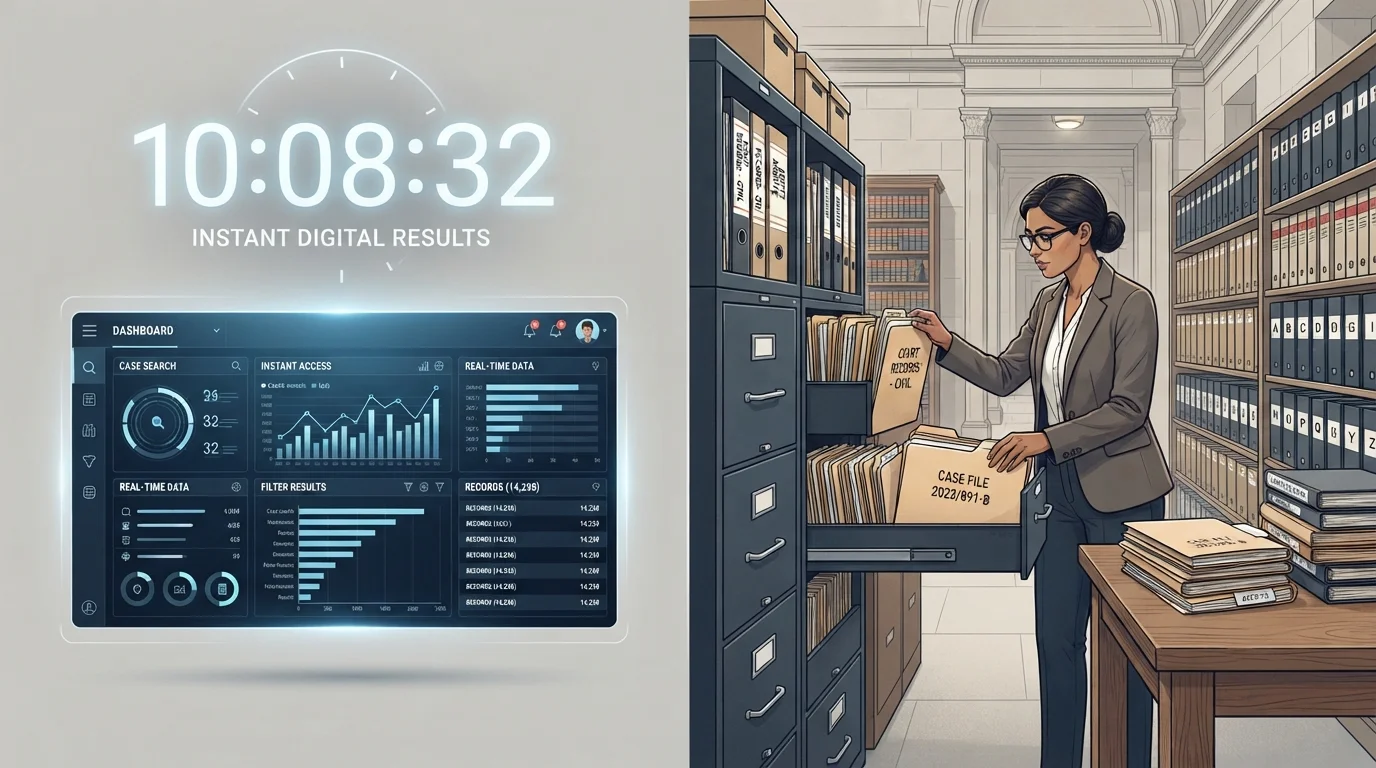
Photo: searchopenrecords editorial
—— In This Article
Key Takeaways
- Instant checks pull from pre-aggregated digital databases; manual checks require human retrieval from courts or agencies.
- Criminal record searches vary most in speed because courthouse digitization levels differ significantly by jurisdiction.
- Identity verification, employment history, and education checks each involve separate data pipelines with distinct timelines.
- Incomplete or inconsistent subject information is one of the most common causes of delays.
- FCRA compliance requirements can add review time when adverse information is flagged for potential dispute.
Why Timelines Differ So Dramatically
A background check is not a single lookup — it is a coordinated series of data requests sent to multiple sources simultaneously. Each source operates on its own schedule, governed by its own technology infrastructure, staffing levels, and legal requirements. The total time to complete a report is determined by whichever source takes the longest to respond.
Inside a background check, every stage after submission involves a distinct pipeline: identity verification, criminal history searches, employment confirmation, education verification, and in some cases credit or driving record pulls. Each pipeline connects to different data custodians with different response times.
The clearest dividing line is between automated database searches and manual record retrieval. Automated searches query pre-compiled digital records and return results in seconds to minutes. Manual retrieval requires a human — typically a court clerk or agency employee — to locate, review, and transmit a physical or locally stored record. That human step introduces variability that technology cannot eliminate.
The Speed of Criminal Record Searches
Criminal history is usually the most time-consuming component of any background check, primarily because the U.S. has no single, unified criminal database. Records are maintained at the federal, state, county, and municipal level — and the digitization of those records varies enormously.
3,000+
County-level criminal court jurisdictions in the U.S.
The U.S. Department of Justice has noted that criminal records are decentralized across thousands of state, county, and municipal courts with no single national repository.
2–5 days
Typical turnaround for standard employment background checks
Industry guidance from background screening professionals generally places standard multi-component employment checks in the two-to-five business day range under normal conditions.
~50%
Courts estimated to have incomplete digital record access
Research by background screening industry groups has indicated that a significant portion of U.S. court jurisdictions still lack fully digitized or remotely accessible criminal records.
Some counties maintain fully searchable electronic dockets that return results instantly. Others still rely on paper-based filing systems where a clerk must physically pull and review a file. When a background check covers multiple jurisdictions — which is standard practice for employment checks — the report cannot finalize until the slowest courthouse responds.
Instant versus manual background checks represent two genuinely different operational processes, not just speed preferences. Understanding which method applies to your situation sets realistic expectations from the start.
Identity, Employment, and Education Checks
Beyond criminal records, other check components follow their own timelines. Identity verification — confirming that a Social Security number, name, and date of birth match — typically completes in seconds by querying credit header data or Social Security Administration records.
Employment verification requires contacting past employers directly. If a former employer uses an automated employment verification service, confirmation often arrives within a day. If HR must be reached by phone or email, response times vary widely and are entirely outside the consumer reporting agency's control.
Education verification operates similarly. Institutions that participate in national clearinghouse systems respond quickly. Smaller institutions, international schools, or those with limited administrative staffing may take considerably longer.
The types of records included in a report directly determine which pipelines must complete before a final report can be delivered.
What Slows Checks Down Most
Several recurring factors account for the majority of background check delays:
- Common or similar names: When a search returns multiple potential matches, a human reviewer must examine each record individually to determine whether it belongs to the subject — a process called adjudication.
- Incomplete subject information: Missing middle names, inconsistent date of birth formats, or absent prior addresses force researchers to cast a wider net and verify more carefully.
- Courthouse schedules: Some county courts only release records on specific days, or only accept requests by mail. These procedural constraints are set by the courts, not by background check providers.
- High request volumes: Courts and agencies that receive high volumes of record requests may queue them, adding days regardless of the requester's urgency.
FCRA compliance procedures can also add time. If a consumer reporting agency identifies potentially adverse information, the FCRA requires steps — including providing pre-adverse action notices — before that information can be formally reported. For more on the records that drive these reviews, see how long records stay on a background check report.
Reduce Delays With Complete Information
The most common source of avoidable delay is incomplete subject data. Providing a full legal name, all addresses from the past seven to ten years, a verified date of birth, and a Social Security number eliminates the most frequent reasons researchers must pause and seek clarification. Double-check all submitted information before confirming your request.
Setting Realistic Expectations
For most standard employment or tenant background checks, a timeline of two to five business days is typical when the check includes criminal history, identity verification, and prior employment confirmation. Checks that add professional license verification, education confirmation, or multi-state criminal searches may extend to seven to ten business days.
Checks relying purely on national aggregated databases — common in consumer-facing services — can return results within minutes, though lookback periods and data completeness in those databases may be more limited than court-sourced records.
Providing accurate and complete information at the outset — full legal name, all prior addresses, correct date of birth — remains the single most effective way to avoid avoidable delays. When records must be retrieved manually, patience is not optional; it is a structural feature of how the system works.
Frequently Asked Questions

Background Checks Editorial Team
Background Checks Editorial Team is the collective byline for our editorial team and contributor network. Articles published under this byline or an editorial pen name are researched, written, and reviewed according to our editorial standards for clarity, consistency, and independence before publication.
View author profile