
Soft vs. Hard Inquiries in Background Screening: A Common Point of Confusion
Credit-style inquiry language often bleeds into background check conversations. Here's what each term means and when it actually applies.
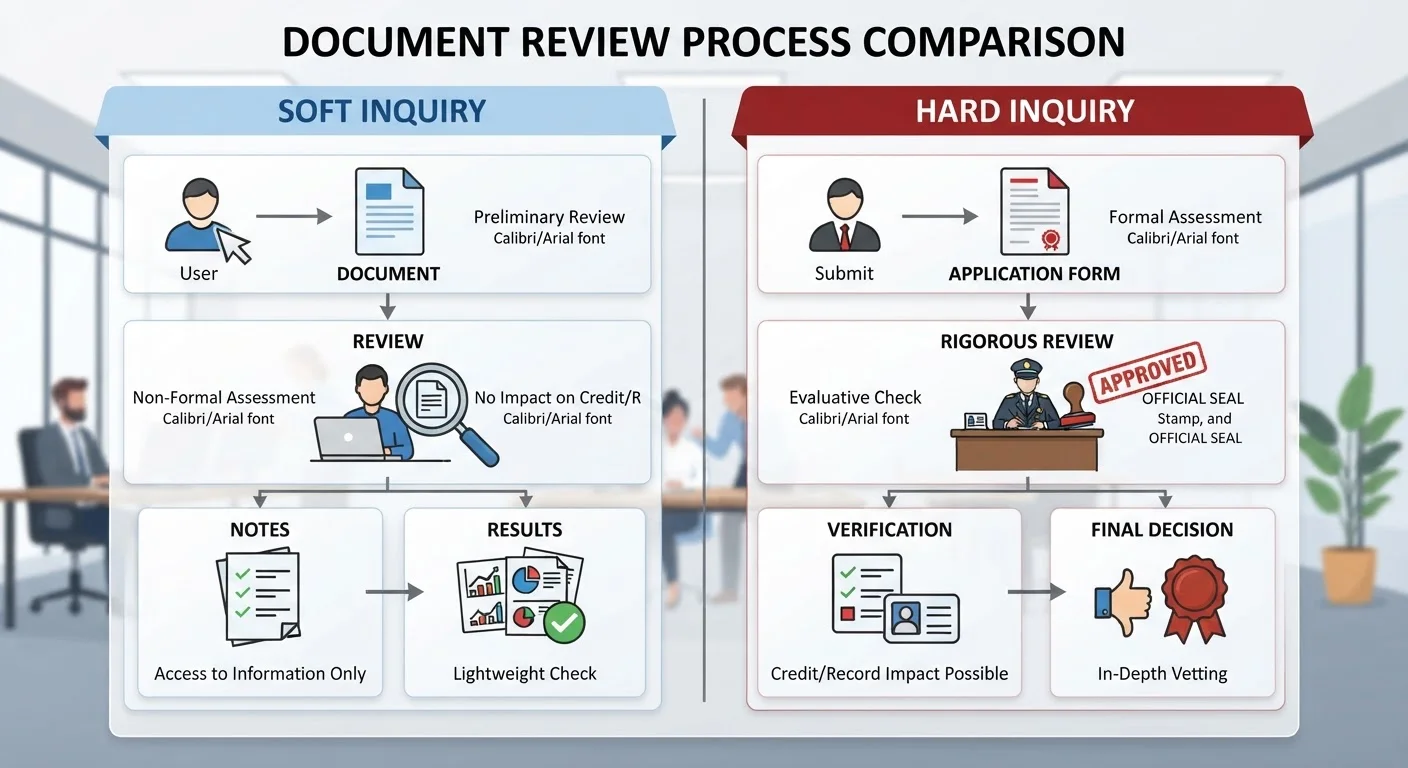
Photo: searchopenrecords editorial
—— In This Article
Key Takeaways
- Soft and hard inquiry terminology originates in credit reporting, not background checks specifically.
- Employment background checks do not affect your credit score, regardless of how thorough they are.
- A consumer reporting agency must have a permissible purpose before accessing certain personal records.
- Running a background check on yourself is treated differently than an employer-initiated check.
- The Fair Credit Reporting Act governs which checks require written consent and when inquiries can appear on file.
Why Credit Terminology Bleeds Into Background Check Conversations
The phrases soft inquiry and hard inquiry are standard vocabulary in consumer credit. A hard inquiry occurs when a lender formally evaluates your credit risk — typically for a mortgage, auto loan, or credit card application — and it temporarily lowers your credit score. A soft inquiry covers all other accesses: your own credit pulls, pre-qualification checks, and employer-ordered credit reviews.
The confusion arises because modern background checks — especially those used in hiring — frequently include a credit file component alongside criminal record searches, identity verification, and employment history. When applicants hear that their credit is being reviewed, they assume a hard inquiry is occurring. In practice, every employer-initiated or self-initiated background check involving credit data is treated as a soft inquiry by the major credit bureaus. No background screening process — however extensive — triggers the score-lowering mechanism that a loan application does.
For a fuller picture of how different check types are assembled, see our guide on criminal, credit, and employment background check structures.
The FCRA Framework: Consent, Purpose, and Consumer Rights
The Fair Credit Reporting Act (FCRA) is the primary federal law governing how consumer reporting agencies collect, share, and use personal data. It draws a clear line: accessing a consumer's report requires a permissible purpose, and for most employment situations, written authorization from the subject is mandatory before any check begins.
Myth
Any background check that pulls my credit file is a hard inquiry and will hurt my credit score.
Fact
Employment-related credit checks are soft inquiries and have no effect on your credit score whatsoever.
Hard inquiries occur when a lender or creditor evaluates your creditworthiness for a loan or credit card application. When an employer — with your written consent — accesses a credit report as part of a background check, the credit bureaus classify this as a soft inquiry. Soft inquiries are visible to you on your own credit report but are invisible to other lenders and carry zero scoring weight. See our breakdown of background check types for more on how credit-component checks are structured.
Myth
Running a background check on yourself creates a hard inquiry that signals something suspicious to lenders.
Fact
Self-initiated background checks and personal credit pulls are always soft inquiries with no negative consequence.
Under the Fair Credit Reporting Act (FCRA), a consumer requesting their own records — whether a credit report or a full background file — is explicitly categorized as a soft inquiry. There is no mechanism by which a self-check reduces a credit score or raises a flag with lenders. This applies equally to personal background check services. Learn how self-checks differ in scope from employer-ordered ones in our article on personal vs. employer-ordered checks.
Myth
If a background check feels thorough or invasive, it must be a hard inquiry.
Fact
The depth or breadth of a background check has no bearing on whether it qualifies as a hard inquiry — that classification is specific to credit applications.
The hard/soft distinction is purely a credit-bureau framework governing how inquiries affect credit scores. A background check that searches criminal court records, employment history, identity verification, and even a credit file component is still — from a credit reporting standpoint — a soft inquiry. The thoroughness of a check relates to its permissible purpose and scope, not to any credit-scoring mechanism. For context on what records such a check might surface, see what records appear in a background check.
Myth
Background screening companies can access any record about you without restriction, similar to how lenders pull credit.
Fact
Consumer reporting agencies must have a legally defined permissible purpose under the FCRA before accessing or compiling certain records about an individual.
The FCRA establishes specific permissible purposes — employment, tenancy, credit, insurance, and a few others — that authorize a consumer reporting agency (CRA) to compile a report on a subject. Outside these purposes, access is restricted. Additionally, for employment background checks, the employer generally must obtain written consent from the applicant beforehand. This consent and purpose structure is what fundamentally separates background screening from informal data gathering. Fraud-related record flags fall under similar access rules, which you can explore through our fraud scan overview.
Myth
Soft inquiries from background checks disappear immediately and leave no trace.
Fact
Soft inquiries remain visible on your personal credit report for up to two years but are never shown to third-party lenders.
When you review your own credit report, you will typically see a section listing soft inquiries — including those from employers or background check services — with timestamps going back up to 24 months. This transparency is a consumer protection feature, not a risk. It lets you verify who has accessed your records and when. If an inquiry appears that you did not authorize, that is worth investigating further. Understanding the distinction between public records and private data in a background check can help you interpret what each access point reveals.
These protections exist regardless of whether the check feels routine or extensive. Whether an employer requests only a criminal record search or a comprehensive report including credit history, education verification, and reference checks, the FCRA's consent and purpose requirements still apply. Applicants also have the right to receive a copy of any report used against them in a hiring decision — a process known as adverse action disclosure.
For guidance on where employer rights end and applicant privacy begins, see our article on employer access vs. your privacy.
Credit Score Impact: The Key Fact
A standard employment background check — even one that includes a credit history component — does not affect your credit score. Only hard inquiries initiated through a formal credit application lower a score. Confusing the two can cause unnecessary anxiety during a job search or rental application process.
Practical Implications for Job Seekers and Renters
Understanding how inquiries are classified removes one source of anxiety from the screening process. When an employer or landlord requests a background check, you can consent without worrying that doing so will lower your credit score or create a visible hard inquiry that future lenders might scrutinize.
What you should pay attention to instead: whether the requesting party has a legitimate permissible purpose, whether you have received a clear disclosure that a background check will be conducted, and whether you have been given the opportunity to review and dispute any inaccurate information before a decision is made against you.
If you want to understand what a check on yourself would reveal before an employer runs one, a self-initiated personal background check is an option. The scope and data sources differ from an employer-ordered check — a distinction worth understanding before you apply. See our comparison of personal and employer-ordered checks for a clear breakdown. Also relevant is how instant versus manual background checks differ in what they actually surface.
This article provides general informational content about background check processes and consumer credit terminology. It is not legal or financial advice. For questions specific to your situation, consult a qualified attorney or licensed financial professional.

Background Checks Editorial Team
Background Checks Editorial Team is the collective byline for our editorial team and contributor network. Articles published under this byline or an editorial pen name are researched, written, and reviewed according to our editorial standards for clarity, consistency, and independence before publication.
View author profile