
Criminal, Credit, Employment: How Different Background Check Types Are Structured
Not all background checks search the same records. This breakdown explains what each check type covers and how each is assembled.
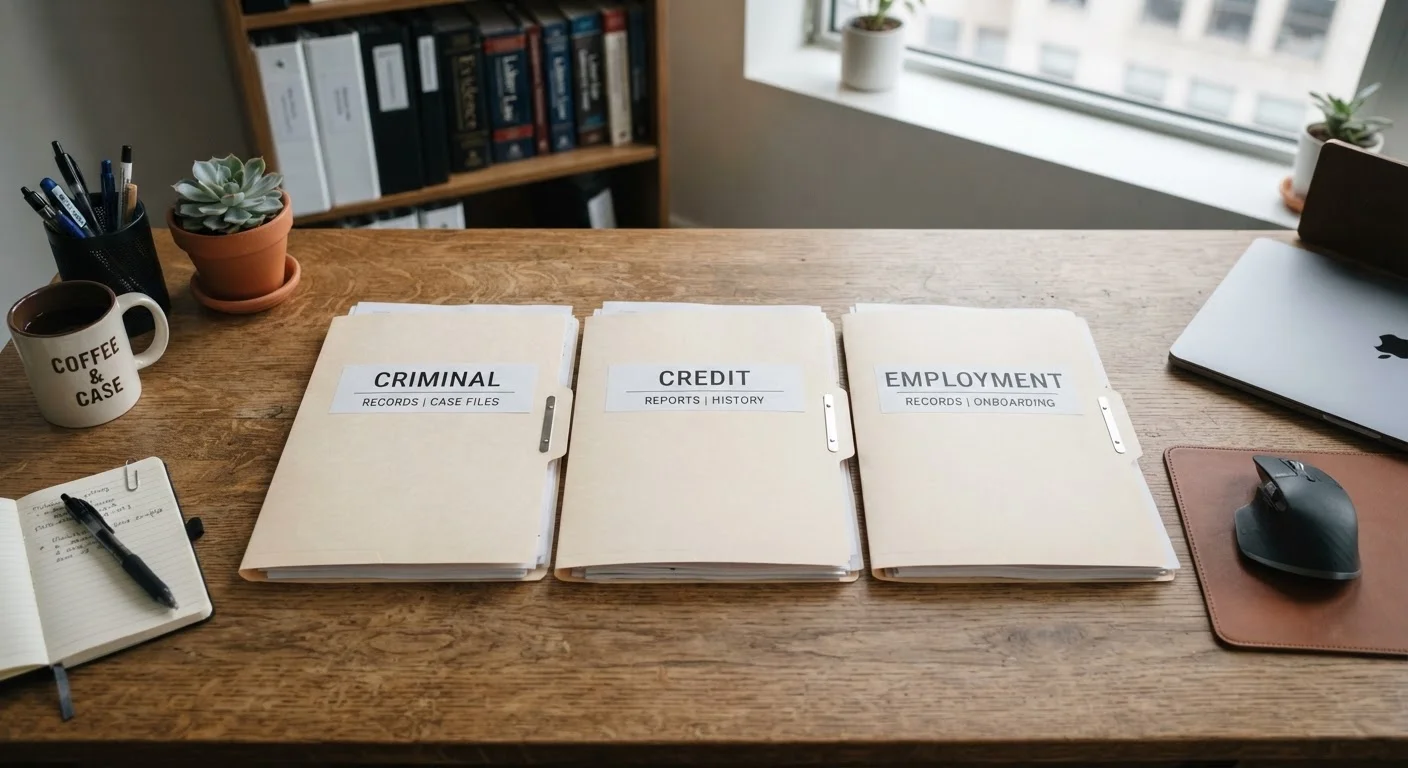
Photo: searchopenrecords editorial
—— In This Article
Why Background Check Types Aren't Interchangeable
The phrase "background check" gets used as if it describes one standard product. It doesn't. A criminal history check, a credit check, and an employment verification are each built from different data sources, governed by different rules, and designed to answer different questions. Conflating them leads to confusion — especially when a result surprises someone who assumed everything was being searched.
Understanding how each check type is structured helps consumers and applicants know what to expect, what their rights are, and why certain records do or don't appear. For a broader view of what records can surface in any given report, the What Records Appear hub is a useful starting point.
| Governing law for credit checks | Fair Credit Reporting Act (FCRA) (U.S. Federal Trade Commission) |
| Criminal record jurisdictions in the U.S. | Thousands of county, state, and federal courts |
| Employment credit report includes credit score | No — numeric score is typically omitted (FCRA guidelines) |
| Consent required for employer credit pull | Yes — written consent mandated under FCRA (15 U.S.C. § 1681b) |
| Employment verification primary method | Direct contact with former employers or third-party services |
| Single national criminal database (complete) | Does not exist — no unified national repository |
Criminal Background Checks: Scope and Sources
A criminal background check attempts to surface an individual's contact with the criminal justice system — arrests, charges, convictions, and sometimes incarceration history. Despite sounding straightforward, the scope of any given criminal check depends heavily on which databases and court systems are queried.
Most consumer-facing and employer-ordered criminal checks pull from one or more of the following: national criminal database aggregators (which compile records from multiple states), county-level court searches, statewide repository searches, and federal district court records. No single national database captures every criminal record in the United States — records exist across thousands of jurisdictions, and not all are electronically accessible. This is why coverage varies significantly by jurisdiction.
It's also worth noting that some records are sealed, expunged, or simply not digitized, meaning they may not appear even in thorough searches. For a detailed breakdown of what does and doesn't surface, see which criminal records are typically included.
Credit Background Checks: A Different Legal Framework
A credit background check — sometimes called a consumer credit report — is pulled from one of the three major credit bureaus (Equifax, Experian, or TransUnion) and is governed specifically by the Fair Credit Reporting Act (FCRA). It surfaces payment history, outstanding debt, credit utilization, public financial records such as bankruptcies, and inquiry history.
Unlike criminal checks, credit checks are tightly regulated in employment and housing contexts. Under the FCRA, an employer must obtain written consent before pulling a credit report, and the applicant has the right to receive a copy and dispute inaccuracies. The FCRA sets the ground rules for how these reports are ordered, used, and disclosed. Importantly, the report used in screening is not identical to the credit score a lender sees — employment credit reports typically omit the numeric score itself.
One common confusion point: credit inquiries in a screening context are generally "soft" pulls and do not affect the applicant's credit score. For more on this distinction, see soft vs. hard inquiries in background screening.
Employment Verification: Confirming What a Candidate Claims
Employment verification is less about searching public databases and more about confirming self-reported information. A screening company contacts previous employers — usually through HR departments or third-party verification services like The Work Number — to confirm job titles, dates of employment, and sometimes eligibility for rehire.
Education verification works similarly, confirming degrees and dates of attendance directly with institutions. Professional license verification checks with licensing boards to confirm that credentials are current and in good standing.
These checks are factual confirmations rather than record searches, which is why their accuracy depends on how responsive former employers are and how well records are maintained. Understanding what comes from public records versus private sources clarifies why employment data sits in a different category than, say, court records.
For a complete look at what a finished background check report contains across all these check types, see every section of a background check report explained. And if you're wondering how a check ordered on you differs from one you run yourself, the differences are more significant than most people realize.
This article is for general informational purposes only and does not constitute legal or financial advice. Readers with questions about their specific rights under the FCRA or other applicable laws should consult a qualified attorney.

Background Checks Editorial Team
Background Checks Editorial Team is the collective byline for our editorial team and contributor network. Articles published under this byline or an editorial pen name are researched, written, and reviewed according to our editorial standards for clarity, consistency, and independence before publication.
View author profile