
Common Myths About Ancestry Research That Can Send You Down the Wrong Branch
Surname changes, family legends, and name spelling assumptions often mislead researchers. Separate genealogy fact from fiction before you dig deeper.
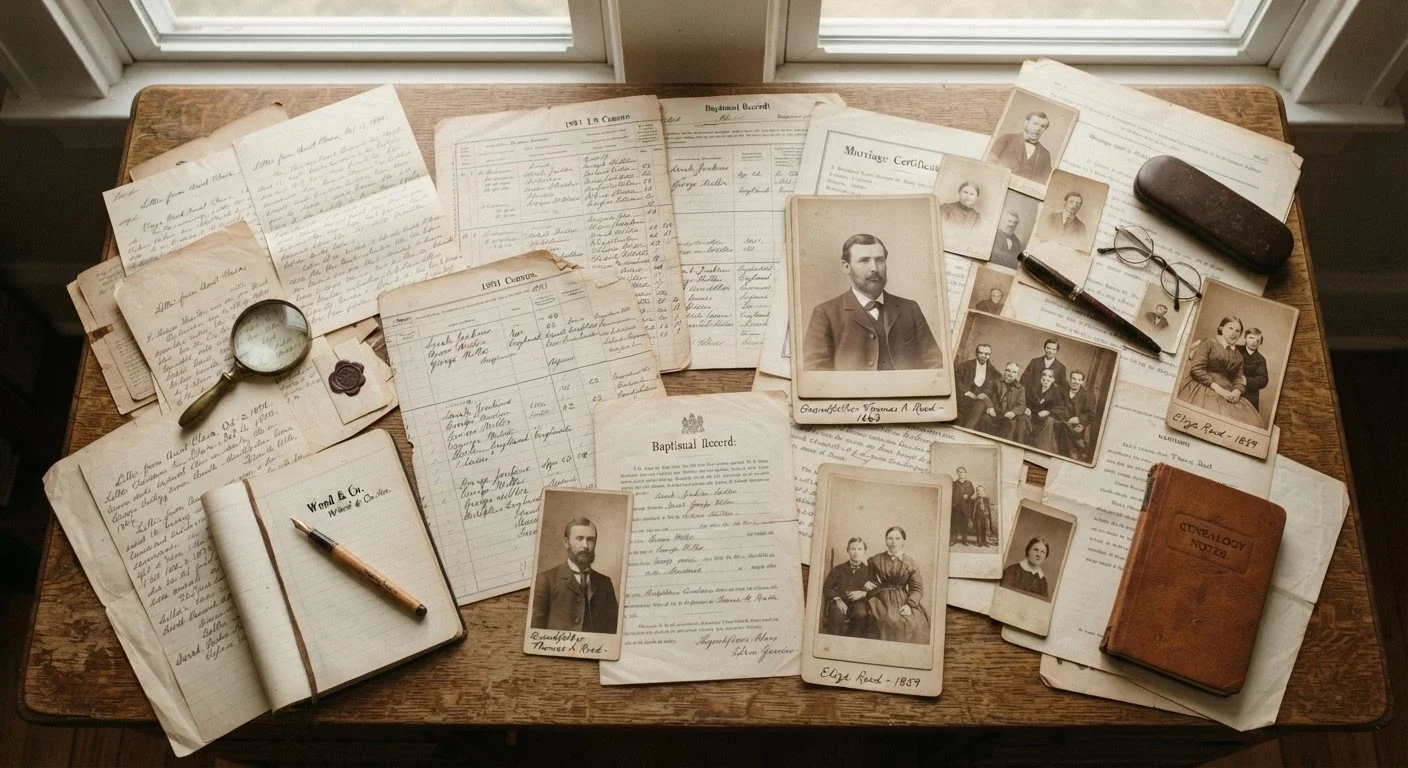
Photo: searchopenrecords editorial
—— In This Article
Key Takeaways
- Surname spellings varied widely in historical records — rigid exact-match searches miss real ancestors.
- Family oral histories often contain meaningful clues, but should never substitute for documentary evidence.
- Immigration officers rarely changed immigrant surnames; name shifts usually happened before or after arrival.
- DNA results are powerful but cannot replace paper records when establishing legal or precise genealogical proof.
- Many vital records before the 20th century were never systematically collected, making gaps entirely normal.
- Online family trees are starting points, not conclusions — unverified data spreads quickly across platforms.
Why Genealogy Myths Persist — and Why They Matter
Family history research rewards patience and skepticism in equal measure. Yet even experienced researchers carry assumptions into their work that quietly steer them toward the wrong branch. Some of these myths feel intuitively true; others are passed down through genealogical communities as casual wisdom. All of them can cost you significant time and lead you to attach the wrong people to your tree.
Understanding where these misconceptions originate — and what the documentary record actually shows — is one of the most practical skills a researcher can develop. The myth-and-fact pairs below address the most persistent errors we see researchers make, from surname spelling assumptions to over-reliance on DNA results.
For a broader look at how trusted records contradict popular beliefs, see what public records routinely disprove about genealogy.
Myth
Surnames were spelled consistently throughout history, so if the spelling doesn't match, it's a different family.
Fact
Spelling standardization is a modern convention. Historical clerks, census enumerators, and church record keepers wrote names as they heard them, producing dozens of variants for the same family.
Before widespread literacy and standardized orthography, a surname like Schneider might appear as Snider, Snyder, Sneider, or Schnieder in different records — sometimes for the same individual within the same decade. Enumerators recorded what they heard, often filtered through their own accent and literacy level. Requiring an exact spelling match in your searches will cause you to miss legitimate ancestors. Always search for phonetic variants and check strategies for tracing family roots that account for this variability.
Myth
Immigration officers changed immigrant surnames at Ellis Island and other ports of entry.
Fact
Ports of entry used ship manifests prepared abroad, and officers read from those documents rather than renaming arrivals. Name changes typically happened before emigration or after settlement.
This is one of the most durable myths in American genealogy, but it is not supported by how immigration processing actually worked. Ships' manifests were compiled at the port of departure, often by shipping company clerks who may have Anglicized or misspelled names at that stage. Once in the United States, immigrants frequently adopted shorter or more phonetically familiar versions of their names to ease daily life or to signal integration. Naturalization papers, city directories, and voter registration records often show the transition clearly — look for those documents rather than assuming a port official was responsible.
Myth
If a family story has been passed down for generations, it's reliable enough to treat as fact.
Fact
Oral tradition is a valuable research lead but not a primary source. Studies of family narratives consistently show distortions in names, dates, relationships, and places across generations.
Family stories serve important cultural functions, and they often contain directional truth — a family that claims descent from Irish nobility likely had Irish origins even if the nobility claim doesn't hold up. But names compress, dates drift, and relationships simplify over retellings. A story about a "twin brother who stayed behind" may reflect a real sibling but inaccurate details. Always treat family narratives as hypotheses to test against documentary evidence. When the records and the story conflict, follow the records — and document the discrepancy rather than resolving it arbitrarily. This approach is central to avoiding the dead ends described in why your family tree keeps hitting dead ends.
Myth
A DNA match proves a genealogical relationship definitively.
Fact
DNA confirms biological relationship within a range of probability, but it cannot on its own identify exactly how two people are related or reconstruct a paper trail.
Autosomal DNA (the type used by most consumer testing services) is shared in patterns that overlap across relationship types. A match showing 850 centimorgans of shared DNA is consistent with a half-sibling, a grandparent-grandchild pair, an aunt or uncle, or a double first cousin — among other possibilities. DNA evidence narrows the field but must be combined with traditional documentary research to reach a specific genealogical conclusion. The DNA and ancestry tools hub explains how genetic evidence and paper records work together, and why neither alone is sufficient for rigorous proof.
Myth
If a record doesn't appear in an online database, it doesn't exist.
Fact
Digitization of historical records is far from complete. Millions of documents remain in physical archives, county courthouses, church repositories, and private collections.
Large platforms have digitized enormous quantities of records, but coverage is uneven by region, time period, and record type. Many county deed books, probate files, and local church registers have never been photographed or indexed. Some records exist only as microfilm reels held at regional archives. Researchers who search only online databases will systematically miss entire record categories. For ancestors whose lives were lived largely in rural areas or in immigrant communities with non-English record-keeping, physical archive visits or correspondence with local historical societies is often essential. If your research crosses national boundaries, the differences become even more pronounced — see ancestry research across borders for a breakdown of international record systems.
How to Apply These Corrections in Practice
Knowing a myth is wrong is only the first step — you also need strategies to work around the reality it obscures. When surname spellings vary, build flexible search habits: use wildcard characters, phonetic search options (such as Soundex, available on many census indexes), and alternate spellings when searching digitized records. Document every variant you encounter so you can trace which form appears in which record set.
When a family story conflicts with documentary evidence, don't discard it entirely. Oral traditions often preserve a kernel of truth that has been distorted over generations — a great-grandfather described as "from Germany" may have emigrated from a German-speaking region that is now part of Poland or Russia. Use the story as a hypothesis to test, not a conclusion to accept.
Gaps in the record are also far more common than most beginners expect. Many states didn't require birth or death registration until well into the 20th century, and earlier records were kept by churches or counties with inconsistent survival rates. If an ancestor seems to vanish before 1900, that disappearance is often a records problem, not a true dead end. Our guide on why ancestors seem to disappear before 1900 walks through the most common causes and practical workarounds.
Finally, treat every online family tree as a lead rather than a source. When you find a tree that matches your research, look for the primary sources that tree owner used — census images, vital records scans, or military files — and verify each record yourself. This single habit prevents you from inheriting someone else's errors wholesale. For deeper guidance on interpreting what you find, see why genealogists misread historical records and consider exploring DNA and ancestry tools to complement your document-based research.

Genealogy Search Editorial Team
Genealogy Search Editorial Team is the collective byline for our editorial team and contributor network. Articles published under this byline or an editorial pen name are researched, written, and reviewed according to our editorial standards for clarity, consistency, and independence before publication.
View author profile