
DNA and Digital Records Together: An End-to-End Guide to Modern Family History Research
A comprehensive look at how DNA testing, digitised archives, and online tools work together to verify and extend your family history discoveries.
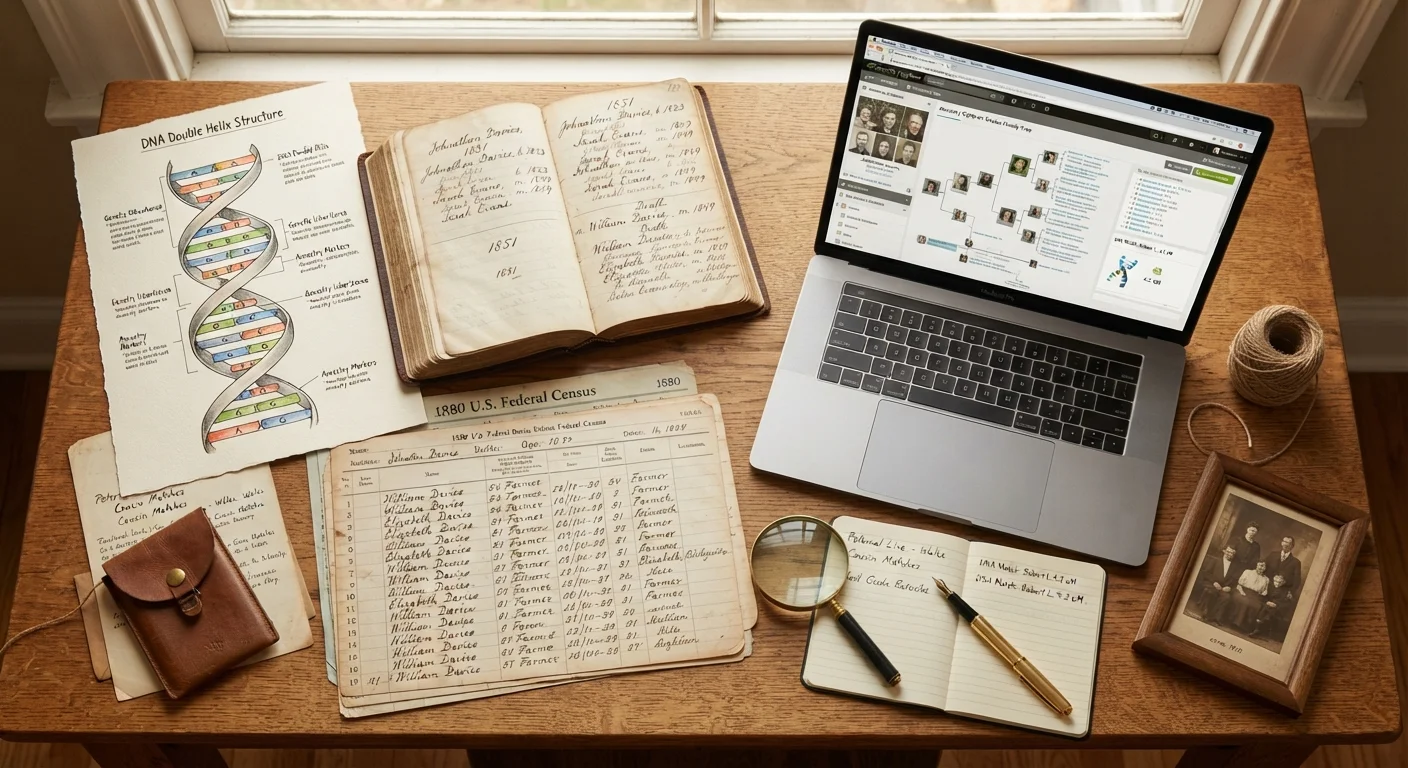
Photo: searchopenrecords editorial
—— In This Article
Key Takeaways
- DNA evidence and documentary records are most powerful when used together, not as substitutes for each other.
- Three main DNA test types—autosomal, Y-DNA, and mtDNA—each answer different genealogical questions.
- Digitised archives cover only a fraction of existing records; always check for undigitised originals at local repositories.
- Shared DNA alone cannot prove a specific relationship without supporting documentary evidence.
- A structured research log prevents duplication, tracks sources, and strengthens the credibility of your conclusions.
Why Modern Family History Research Uses Both DNA and Documents
Genealogical research has always rested on two foundations: the stories families pass down and the paper trail those stories leave behind. What has changed in recent decades is the addition of a third layer — biological evidence captured through consumer DNA testing. Used independently, each layer has blind spots. Used together, they create a cross-referenced, more defensible account of family history.
Documentary records tell you when and where events happened and, crucially, the legal identity of the people involved. DNA tells you who is biologically related to whom, often cutting through name changes, adoption, illegitimacy, or simple record gaps. Neither source overrides the other; each is a hypothesis generator that the other helps test.
For a grounding in the core records that underpin every family tree, see our guide to birth, marriage, and death records. And if you are starting from scratch, our complete family tree walkthrough covers the full methodology from concept to documented lineage.
How DNA Testing Works in a Genealogical Context
Consumer genealogical DNA tests analyse specific regions of your genome and compare them against a database of other testers. There are three main test types, each suited to different research goals:
- Autosomal DNA (atDNA): Tests chromosomes inherited from both parents. Effective for identifying relatives within roughly five to six generations. This is the most widely used test type for general family history work.
- Y-DNA: Traces the direct paternal line (father's father's father, and so on). Useful for surname studies and confirming paternal lineage, but only available to biological males.
- Mitochondrial DNA (mtDNA): Traces the direct maternal line. Changes very slowly across generations, making it better for deep ancestry than recent family connections.
Understanding the vocabulary that appears in test reports is essential before drawing conclusions. Our genetic genealogy glossary explains terms like centimorgans, haplogroups, and endogamy in plain language.
When you receive your DNA results, immediately export a raw data file and store it securely. This lets you upload your results to additional databases without retesting, expanding your match pool significantly.
Different testing companies maintain separate databases. Uploading to compatible third-party databases, such as GEDmatch, increases the number of potential matches available to you at no additional cost.
Before concluding that a record gap means no records exist, contact the county courthouse, local historical society, and state archives directly. Many collections have not been described online, let alone digitised.
Digitisation rates vary widely by state and record type. Researchers who rely solely on online databases routinely miss substantial local collections that are fully accessible by mail or in-person visit.
When a DNA match has no public tree, send a brief, specific message explaining your research interest and naming the surnames and locations you are investigating. Response rates are higher when you demonstrate you have done your own work.
Vague outreach messages are frequently ignored. A focused inquiry that shows prior research effort signals that corresponding with you will be productive, not burdensome.
DNA databases grow continuously, so a search that returns few matches today may return significantly more in twelve months as more people test. Revisiting your match list periodically is standard practice among working genetic genealogists.
Navigating Digitised Archives and Online Record Databases
Digitisation has made millions of records searchable from a home computer, but the scope of what is available online is often overestimated. Large repositories — including census images, passenger lists, military records, and many vital records — are accessible through platforms connected to national and state archives. However, local church registers, county probate files, and many pre-twentieth-century records remain undigitised and must be accessed in person or by written request.
Key starting points for US researchers include:
- FamilySearch.org — a free, publicly maintained database operated by The Church of Jesus Christ of Latter-day Saints, with billions of records indexed.
- The National Archives (NARA) — the federal repository for census records, military service and pension files, naturalization records, and more.
- State archives and vital records offices — hold birth, marriage, divorce, and death certificates under varying access rules depending on the state and record age.
- Local and county historical societies — frequently hold newspapers, land deeds, and church records not found in larger databases.
For a structured approach to locating official records using digital tools, see the Finding Records Online hub.
Integrating DNA Matches with Documentary Evidence
The most productive genealogical workflow treats a DNA match as the start of a research question, not the end of one. When you identify a match, your goal is to build a documentary paper trail that explains the shared DNA through a specific common ancestor or ancestral couple.
~100M
Consumer DNA tests sold globally
Industry analysts estimated that consumer genetic testing databases collectively held around 100 million profiles by the early 2020s, making match pools large enough for most researchers to find useful connections.
3,500+ cM
Shared DNA typical for a full sibling
According to published reference data from the International Society of Genetic Genealogy, full siblings typically share between roughly 2,300 and 3,900 centimorgans, illustrating how relationship ranges can still be wide.
billions
Records indexed on FamilySearch
FamilySearch.org, a free public resource, reports indexing billions of historical records from archives worldwide, though coverage depth varies considerably by country and time period.
The process typically follows these steps:
- Estimate the relationship range using the amount of shared DNA, measured in centimorgans (cM). Published reference tables, such as those maintained by the DNA Painter project, show the statistical range of relationships associated with any given cM value.
- Review the match's family tree if they have made one public. Look for surnames, locations, or time periods that overlap with your own research.
- Build out both trees toward the hypothesised common ancestor using documentary sources — census records, vital records, land records, and probate files.
- Confirm with additional matches. If your hypothesis is correct, other matches who descend from the same ancestor should cluster together. This triangulation approach significantly increases confidence.
Remember that shared DNA alone is not proof of a specific relationship. A quantity of shared DNA consistent with a second cousin is also consistent with a half first cousin once removed, among other configurations. Documents must resolve the ambiguity.
Common Pitfalls and How to Avoid Them
Even experienced researchers encounter traps that produce convincing but incorrect conclusions. Being aware of the most common ones reduces their impact.
- Accepting copied trees uncritically. Online family trees are user-generated and frequently contain errors copied from earlier errors. Treat them as leads, not sources. Always trace a claim back to a primary document.
- Conflating people with the same name. Before the twentieth century, the same name appearing in the same county at the same time often belonged to two or more different people. Age, household composition, and witness names help distinguish them.
- Misreading handwritten records. Historical handwriting conventions differ from modern ones. Letters such as s and f, or u and n, are frequently confused. Consulting transcription guides specific to the record's era and origin is worth the time.
- Ignoring endogamy. In communities with historically limited marriage pools — certain ethnic, religious, or geographic groups — DNA matches may share more DNA than expected due to multiple overlapping ancestral connections, not a single close relationship.
Unexpected DNA Results Can Have Personal Impact
DNA testing occasionally reveals information that is emotionally significant — such as unexpected parentage, previously unknown siblings, or misattributed family relationships. Before testing, consider whether you and your close relatives are prepared for results that may challenge existing family narratives. Genetic counselors and genealogical professionals can provide guidance when results raise difficult questions.
Building a Research Workflow That Scales
As a family history project grows, the volume of sources, hypotheses, and correspondence can quickly become unmanageable without a system. A disciplined workflow is what separates a hobby that stalls at three generations from one that extends a lineage across centuries.
Core habits worth building from the start:
- Maintain a research log. Record every source consulted — including those that yielded nothing — with the date searched, repository, search terms, and result. This prevents duplicated effort and helps others evaluate your work.
- Cite every source immediately. Document where each fact came from at the moment you record it. Reconstructing citations later is time-consuming and error-prone.
- Separate proven facts from working hypotheses. Use a consistent notation, such as a question mark or a separate hypothesis field in your genealogy software, to distinguish what is documented from what is inferred.
- Back up regularly. Store copies of your research database, scanned documents, and DNA data exports in at least two separate locations.
More guidance on structuring a complete research process is available through the Tracing Family Roots hub, which covers methodology alongside practical record-finding strategies.
This article is for general informational and educational purposes only. It does not constitute legal, medical, or professional genealogical advice. For complex research questions, consider consulting a credentialed genealogist certified through a recognised professional body.

Genealogy Search Editorial Team
Genealogy Search Editorial Team is the collective byline for our editorial team and contributor network. Articles published under this byline or an editorial pen name are researched, written, and reviewed according to our editorial standards for clarity, consistency, and independence before publication.
View author profile