
Birth, Marriage, and Death Records: The Backbone of Genealogy Research
Understand how vital records work, where they're held, and how to use them reliably when verifying family relationships.
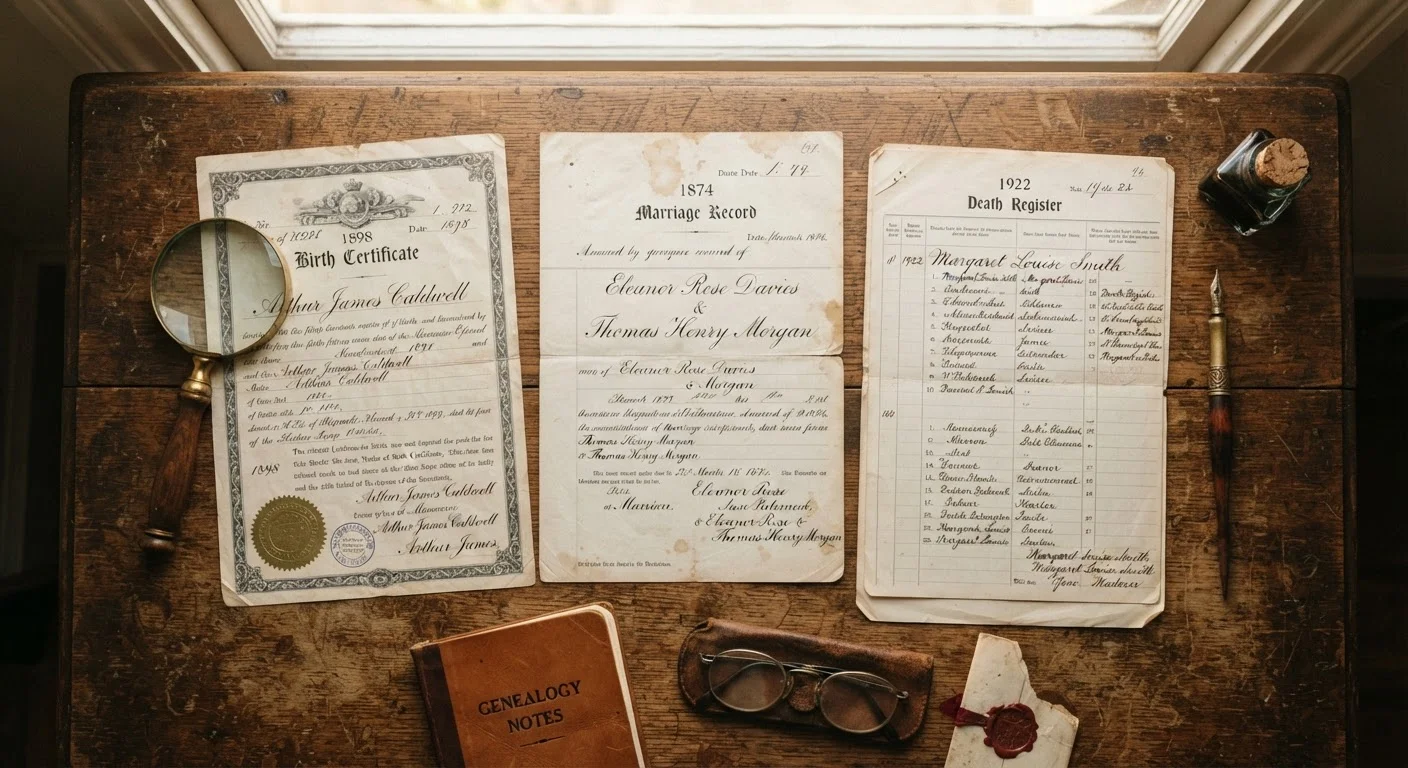
Photo: searchopenrecords editorial
—— In This Article
Key Takeaways
- Birth, marriage, and death records are the most legally authoritative documents for proving family relationships.
- U.S. states began mandating civil registration at different times, so coverage gaps vary significantly by region.
- Each record type captures distinct data — knowing what each contains helps you ask the right research questions.
- Original records and indexes can contain errors; always cross-reference with at least one additional source.
- Access rules differ between recent records (restricted) and historical records (often publicly available).
Why Vital Records Are the Starting Point for Every Family Tree
When constructing an accurate family tree, genealogists follow a foundational principle: build from known facts to unknown ones, and anchor every claim to a primary source. Birth, marriage, and death records — collectively called vital records — are the closest thing to primary sources that most family researchers will ever encounter. They were created at the time of the event, by an official authority, to serve a legal purpose.
That legal weight is what makes them valuable. A birth certificate links a child to parents by name. A marriage record connects two individuals — and often their parents — at a specific place and time. A death certificate closes the biographical loop, frequently naming a surviving spouse, informing about cause of death, and sometimes recording the decedent's birthplace or parents' names.
Together, these three record types allow researchers to trace direct lineage with a level of confidence that most other document types cannot match. See the core public record types used in genealogy for a broader overview of what's available beyond vital records.
1933
Year U.S. birth registration achieved national completeness
According to the National Center for Health Statistics, the United States did not reach a nationally accepted standard of complete birth registration until approximately 1933.
~75–100 yrs
Typical public access threshold for vital records
Most U.S. states restrict access to recent vital records, with public availability generally beginning 75 to 100 years after the record was created, though exact cutoffs vary by state law.
50 systems
Separate vital records jurisdictions in the U.S.
Each U.S. state and territory administers its own vital records system independently, meaning registration dates, access rules, and record formats vary across all 50 states plus territories.
What Each Record Type Actually Contains
Understanding what information appears on each type of record helps researchers know exactly what questions they can — and cannot — answer with a given document.
Birth Records
A U.S. birth certificate typically records: the child's full name and date of birth; the place of birth (hospital, city, county, state); the mother's full name (including maiden name); the father's full name; and sometimes the parents' ages, birthplaces, and occupations. Older birth registers may include the number of previous children born to the mother, which can help estimate the size of a sibling group.
Marriage Records
Marriage licenses and certificates usually capture: both parties' full names; the date and location of the marriage; the names of witnesses; and often the names of each party's parents. Some historical marriage records also include age, prior marital status, and residence — all useful data points for distinguishing two individuals with the same name.
Death Records
Death certificates are among the most information-rich records in genealogy. In addition to the decedent's name and date of death, they often list: place of birth; usual residence; occupation; cause of death; name of surviving spouse; and the name and address of the informant (typically a family member). The informant's knowledge of the decedent's birthplace and parentage can vary, so treat these fields as leads rather than guaranteed facts.
For a comparative look at how vital records stack up against census data in different research scenarios, see Census Records vs. Vital Records.
Registration Gaps and What They Mean for Your Research
One of the most important things to understand about U.S. vital records is that statewide civil registration was not uniform. Different states mandated registration at different times — and even after laws were passed, compliance was often inconsistent, particularly in rural areas.
As a general guide: New England states had relatively early registration systems by the 1840s–1850s. Many mid-Atlantic and Midwestern states followed in the 1860s–1880s. Several Southern and Western states did not achieve reliable statewide registration until the early 1900s. The U.S. standard for birth registration completeness was not met nationally until around 1933.
What this means practically: if you are researching an ancestor born in rural Georgia in 1895 or rural Texas in 1880, a civil birth certificate may simply not exist. In those cases, the research trail leads to church baptismal records, family Bible entries, census age listings, and other substitute sources. See lesser-known record sources that genealogists often overlook for guidance on filling these gaps.
Researchers working across national borders face additional complexity, as record-keeping systems differ widely by country and era. The country-by-country record guide is a useful reference for international research.
How to Access Vital Records for Genealogy
Access to vital records in the United States depends heavily on the age of the record and the state in which it was created. As a general rule:
- Recent records (within roughly the last 75–100 years) are restricted. Access is limited to the individual named, immediate family, or legal representatives. Contact the relevant state vital statistics office directly.
- Historical records are often publicly available, either through state archives, county courthouses, or digitized collections held by genealogy repositories and public libraries.
When requesting records, it helps to know the approximate date, the county or municipality, and the full names of the individuals involved. Many state archives maintain online indexes that allow researchers to verify a record exists before submitting a formal request.
Obituaries are often an overlooked companion to vital records — they can name siblings, adult children, and extended family in a single document. The practical field guide to reading obituaries for genealogy explains how to extract and verify the genealogical details they contain.
Cross-Referencing Records to Catch Errors
Even official vital records contain mistakes. Names were misspelled. Ages were misreported. Birthplaces were recorded from memory, sometimes decades after the fact. A death certificate completed by a grieving adult child may contain an incorrect birth year or a garbled version of a parent's maiden name.
The professional genealogy standard — documented in guidelines established by organizations such as the Board for Certification of Genealogists — is to evaluate every source critically, note where records conflict, and form conclusions only after weighing all available evidence. No single record, however authoritative it appears, should be treated as infallible.
Practically, this means pairing vital records with census records, church registers, immigration files, and other corroborating sources whenever possible. The article eight record types that fill in what birth certificates miss identifies specific alternatives worth pursuing when official vital records are incomplete or contradictory.
Good documentation habits are just as important as the sources themselves. Recording where you found each piece of information — and what you could not confirm — protects the integrity of your research over time. For proven organizational strategies, see keeping your ancestry research organised and verifiable.
Frequently Asked Questions

Genealogy Search Editorial Team
Genealogy Search Editorial Team is the collective byline for our editorial team and contributor network. Articles published under this byline or an editorial pen name are researched, written, and reviewed according to our editorial standards for clarity, consistency, and independence before publication.
View author profile