
Digitised vs. Physical Obituary Archives: Navigating Both for Family Research
Online obituary databases and physical newspaper archives each have different coverage and reliability. Here's how to choose the right approach for your search.
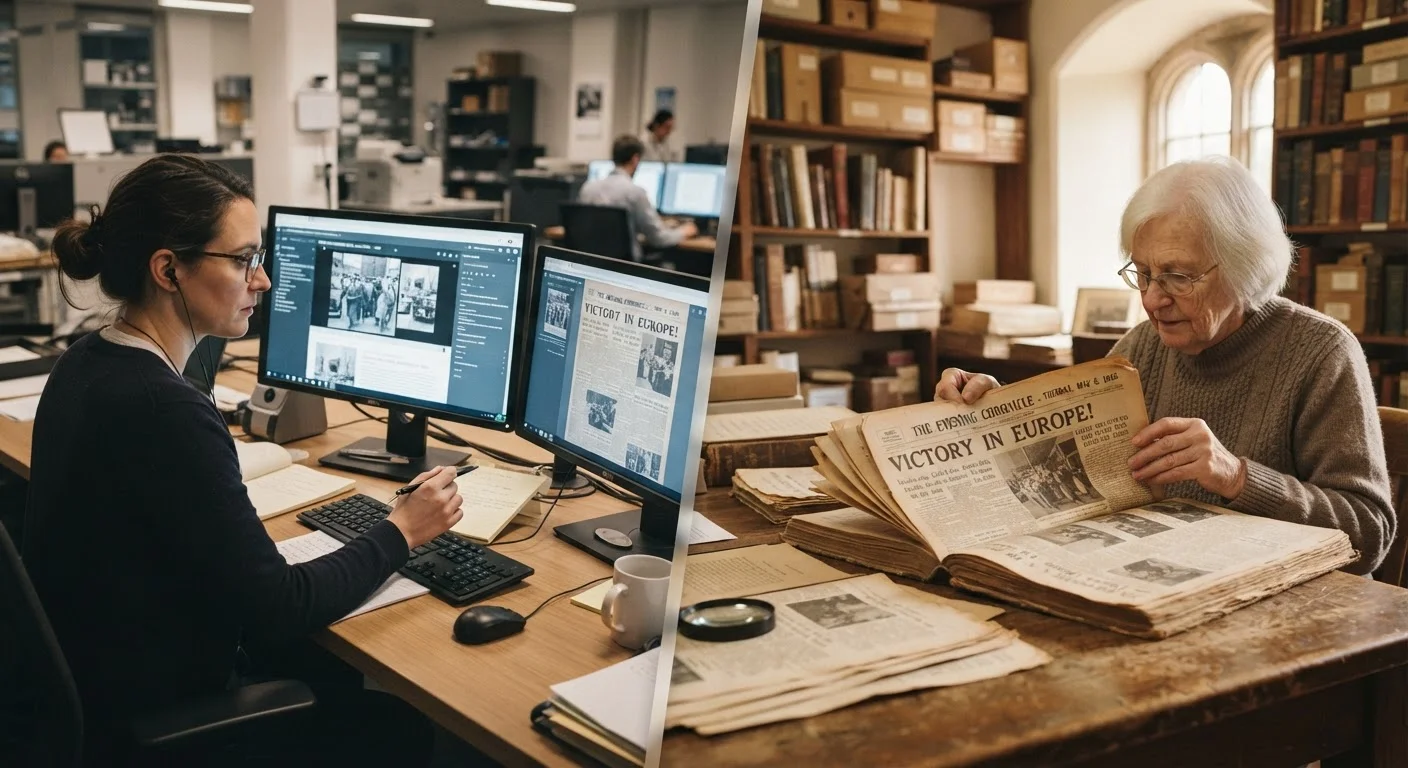
Photo: searchopenrecords editorial
—— In This Article
Key Takeaways
- Digitised obituary archives offer speed and remote access, but coverage gaps are significant for records before the 1990s.
- Physical newspaper archives at libraries and historical societies often hold obituaries never scanned or indexed online.
- The most thorough family research typically requires combining both approaches rather than relying on one alone.
- Geographic scope matters: rural and small-town papers are far less likely to have been digitised than major city dailies.
- Understanding what each format preserves — and what it omits — saves time and prevents false conclusions.
Why the Format of an Archive Shapes What You Find
When you're searching for a relative's obituary — whether to confirm a date of death, locate surviving family members, or piece together a generational story — the format of the archive you consult is not a minor technical detail. It directly determines which records are visible to you, how accurately they can be searched, and what biographical context survives.
Digitised archives have made obituary research vastly more accessible. Millions of historical newspaper pages have been scanned, indexed, and made searchable by name or keyword. But that process is uneven, incomplete, and often skewed toward larger publications. Physical archives — microfilm reels, bound newspaper volumes, card-index systems held at public libraries, county historical societies, and newspaper offices — preserve enormous quantities of records that no algorithm has yet touched.
Understanding what each format can and cannot deliver is the foundation of any effective search strategy. For a side-by-side breakdown of how this plays out specifically for newspaper archives and genealogy databases, see our guide on newspaper archives vs. genealogy databases for obituary research.
What Digitised Archives Do Well — and Where They Fall Short
The principal advantage of digitised obituary archives is accessibility. A researcher in any location can search decades of records without traveling, often within seconds. Full-text search across scanned pages means you can locate an obituary even when you're uncertain which publication carried it or on which date it appeared.
However, digitisation coverage is not uniform. Large urban newspapers — particularly those from the latter half of the 20th century onward — are far better represented than rural weeklies. Optical character recognition (OCR), the technology used to make scanned text searchable, introduces errors: unusual fonts, damaged pages, and older typefaces all produce misread names. A search for "Kowalczyk" may return nothing if the scan read the surname as "Kowalcryk."
Chronological gaps are equally significant. Many digitisation projects prioritize papers from before 1923 (the public domain threshold for most US publications) or from recent decades where digital files already exist. The mid-20th century — roughly 1923 to 1980 — is often the least well-covered window, precisely the era most relevant to researchers tracing parents and grandparents.
| Digitised Archives | Physical Archives | |
|---|---|---|
| Access | Remote, available 24/7 online | Requires in-person visit or mail request |
| Search method | Keyword and name search (OCR-based) | Manual browsing or local index |
| Coverage era | Strong pre-1923 and post-1980; gaps mid-century | Often continuous from founding date |
| Small-town/rural papers | Frequently absent or incomplete | Often well-preserved on microfilm |
| Error risk | OCR misreads can hide records | Human transcription errors in indexes |
| Cost | Free to subscription-based | Free to modest fee; travel costs may apply |
| Speed | Near-instant results | Days to weeks depending on access method |
The Case for Physical Archives
Physical archives held at local libraries, historical societies, state archives, and sometimes the newspaper offices themselves contain records that exist nowhere else. A county historical society may hold every edition of a small-town paper going back to the 1880s on microfilm — none of it indexed, all of it searchable only by browsing page by page. That effort can be considerable, but the reward is access to a record that simply cannot be found any other way.
Librarians and archivists at these institutions are often underutilised resources. They know their collections in detail, understand the indexing quirks of local papers, and can direct you to supplementary materials — church records, county death registers, funeral home ledgers — that corroborate or expand on what an obituary says. Our article on newspaper obituaries vs. funeral home records explores how these parallel sources preserve different biographical details.
Physical visits also surface format variations rarely replicated digitally: handwritten annotations in margin indexes, clipping files assembled by local historians, or oversize broadsheet pages whose full layout reveals photographs and adjacent death notices that provide context a digitised snippet omits.
Building a Research Strategy That Uses Both
The most productive approach treats digitised and physical archives as complementary rather than competing. A practical workflow typically looks like this:
- Begin with digitised sources to establish what is already findable — dates, publication names, and any indexed records that confirm a death and the paper that covered it.
- Note the geographic location where your ancestor lived. This tells you which specific newspapers are most likely to have published the obituary and whether those papers have been digitised.
- Contact the relevant local library or historical society to ask about physical holdings. Many offer remote lookup services for a modest fee, and some state libraries can request microfilm loans through interlibrary loan programs.
- Cross-reference with death certificates, which are public records accessible through most state vital records offices and can confirm the date and county of death before you spend time in a physical archive.
For a deeper comparison of how these research pathways play out in practice, see our overview of digitised archives vs. physical repository visits. Once you've located an obituary, our hub on reading obituaries can help you extract the maximum genealogical value from what you find.
Contact the Library Before You Visit
Before traveling to a physical archive, call or email the holding institution to confirm they have the specific publication and date range you need. Ask whether the collection is on microfilm, bound volumes, or original newsprint — each requires different handling equipment. Many public libraries and historical societies will also perform limited lookups by mail or email, saving you a trip when your search is focused on a narrow date range.

Obituary Search Editorial Team
Obituary Search Editorial Team is the collective byline for our editorial team and contributor network. Articles published under this byline or an editorial pen name are researched, written, and reviewed according to our editorial standards for clarity, consistency, and independence before publication.
View author profile