
Newspaper Obituaries vs. Funeral Home Records: What Each Source Offers Genealogists
Newspaper obituaries and funeral home records preserve different details. Understand the strengths and gaps of each before deciding where to search first.
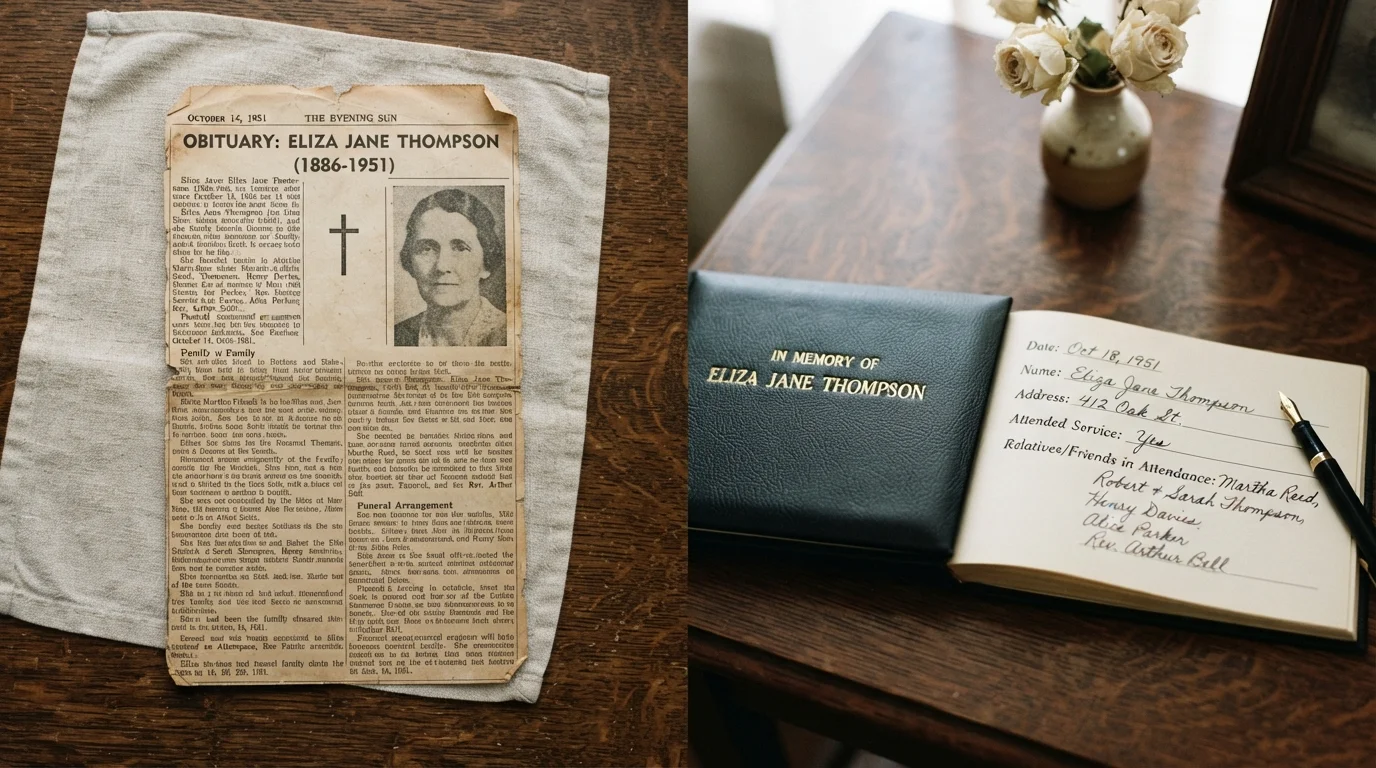
Photo: searchopenrecords editorial
—— In This Article
Key Takeaways
- Newspaper obituaries offer narrative detail and family relationships but are family-written and editorially selective.
- Funeral home records capture administrative facts — dates, places, and informant names — with greater precision.
- Neither source is universally complete; using both together produces the most reliable genealogical picture.
- Funeral home records are not always publicly accessible, while newspaper archives vary widely in digitization.
- The obituary's informant, often listed in funeral home intake forms, can reveal who supplied the family details.
What Each Source Was Designed to Do
Before comparing these two sources, it helps to understand the purpose each was created to serve. A newspaper obituary is, at its core, a public announcement — a community document written to inform neighbors, distant relatives, and readers about a death and to honor the person's life. Because families or funeral homes typically compose and submit the text, a published obituary reflects what the family chose to share, which means it can be generous with biography and relationships but also prone to omission or idealization.
Funeral home records, by contrast, are administrative documents generated to manage the business of death: arranging services, filing death certificates, and coordinating with cemeteries and crematoria. These records are not written for public consumption. They are created to be accurate and complete for legal and logistical purposes, which makes them a different — and often more reliable — category of genealogical evidence. For a broader overview of what obituary records contain across source types, see Obituary Records Explained.
What Newspaper Obituaries Offer
The genealogical value of a published obituary lies in its narrative richness. A well-written obituary may include the deceased's birthplace, parents' names, immigration history, occupation, religious affiliation, fraternal memberships, military service, and a list of surviving and predeceased relatives. These details are difficult to reconstruct from vital records alone and can open multiple new research branches in a single paragraph.
Published obituaries also carry historical context. Reading an obituary from the 1920s or 1940s in its original newspaper page reveals the community environment — nearby news, social columns, advertisements — that shaped the person's world. That context can help a researcher understand migration patterns, economic conditions, or ethnic community structures relevant to a family line.
The limitations are real, however. Families control what appears, so relatives with complicated relationships may be omitted, names may be misspelled, and dates occasionally contain errors introduced during transcription. Smaller newspapers may have charged by the line, incentivizing brevity that stripped away genealogically valuable detail. And coverage was never universal — not every death received a published notice, particularly for lower-income families or those in areas without consistent local papers. You can explore how format and source affect these gaps in Newspaper Obituaries vs. Funeral Home Obituaries.
| Criterion | Newspaper Obituaries | Funeral Home Records |
|---|---|---|
| Primary purpose | Public announcement and tribute | Administrative and legal documentation |
| Biographical narrative | Often detailed — life story, community ties | Minimal — factual fields only |
| Vital statistics accuracy | Variable — family-supplied, sometimes errors | Generally higher — legally required precision |
| Survivor/family listings | Usually extensive, relationship-labeled | Limited to immediate next of kin |
| Informant identity recorded | Rarely noted | Typically recorded by name and relationship |
| Public accessibility | Often accessible via archives and databases | Varies — business records, not always public |
| Coverage gaps | Families who couldn't afford publication | Records lost, destroyed, or withheld |
| Historical context | Rich — reflects community and era | Limited — transactional document |
What Funeral Home Records Offer
Where newspaper obituaries tell stories, funeral home records document transactions — and that distinction makes them unexpectedly powerful for genealogical research. A funeral home's intake paperwork typically records the deceased's full legal name, date and place of birth, date and place of death, parents' names (including mother's maiden name), spouse's name, place of residence, and the name and relationship of the person who provided the information — known as the informant.
That informant field is particularly valuable. Knowing whether a daughter, a neighbor, or a business associate supplied the biographical details helps a researcher assess how reliable those details are. A sibling informant who grew up with the deceased is more likely to know accurate birthplace information than a distant acquaintance.
Funeral homes also hold records — arrangement contracts, itemized service invoices, burial transit permits — that connect to cemetery records and death certificates in ways that can corroborate or correct information from other sources. Some funeral homes have operated continuously for a century or more, and their archives may contain records for entire generations of a family.
Access is the primary challenge. Unlike newspaper archives, funeral home records are business files, not public records. Policies on researcher access vary widely: some funeral homes freely share historical information with genealogists or family members; others treat their records as private or have destroyed older files. For practical guidance on approaching these institutions, Using Funeral Home Websites to Find Obituary Records outlines what to look for and how to make contact effectively.
Using Both Sources Together
The most productive genealogical approach treats these two sources as complementary rather than competing. Begin with the newspaper obituary to build a narrative framework — who the person was, who their family members were, and where they lived. Then turn to funeral home records to verify specific facts: Was the birth year consistent? Does the birthplace match what census records suggest? Who was the informant, and what do we know about their reliability?
Discrepancies between the two sources are not failures — they are research clues. A funeral home record listing a birthplace different from the obituary's version may reflect the family's regional vernacular (naming a county rather than a town, for example) or may signal that two different informants provided the information at different times. Resolving those discrepancies by consulting death certificates, census records, or immigration documents deepens the research rather than ending it.
For researchers navigating the practical question of where to search first — especially when deciding between digitized online databases and physical archives — Digitised vs. Physical Obituary Archives offers a framework for choosing the right access path. And if you are weighing which online sources to prioritize, Newspaper Archives vs. Genealogy Databases walks through the trade-offs between those platforms.

Obituary Search Editorial Team
Obituary Search Editorial Team is the collective byline for our editorial team and contributor network. Articles published under this byline or an editorial pen name are researched, written, and reviewed according to our editorial standards for clarity, consistency, and independence before publication.
View author profile