
Digitised Archives vs. Physical Repository Visits: Weighing Your Options
Online databases offer convenience; in-person visits reveal records never scanned. Compare both approaches to find what works for your research needs.
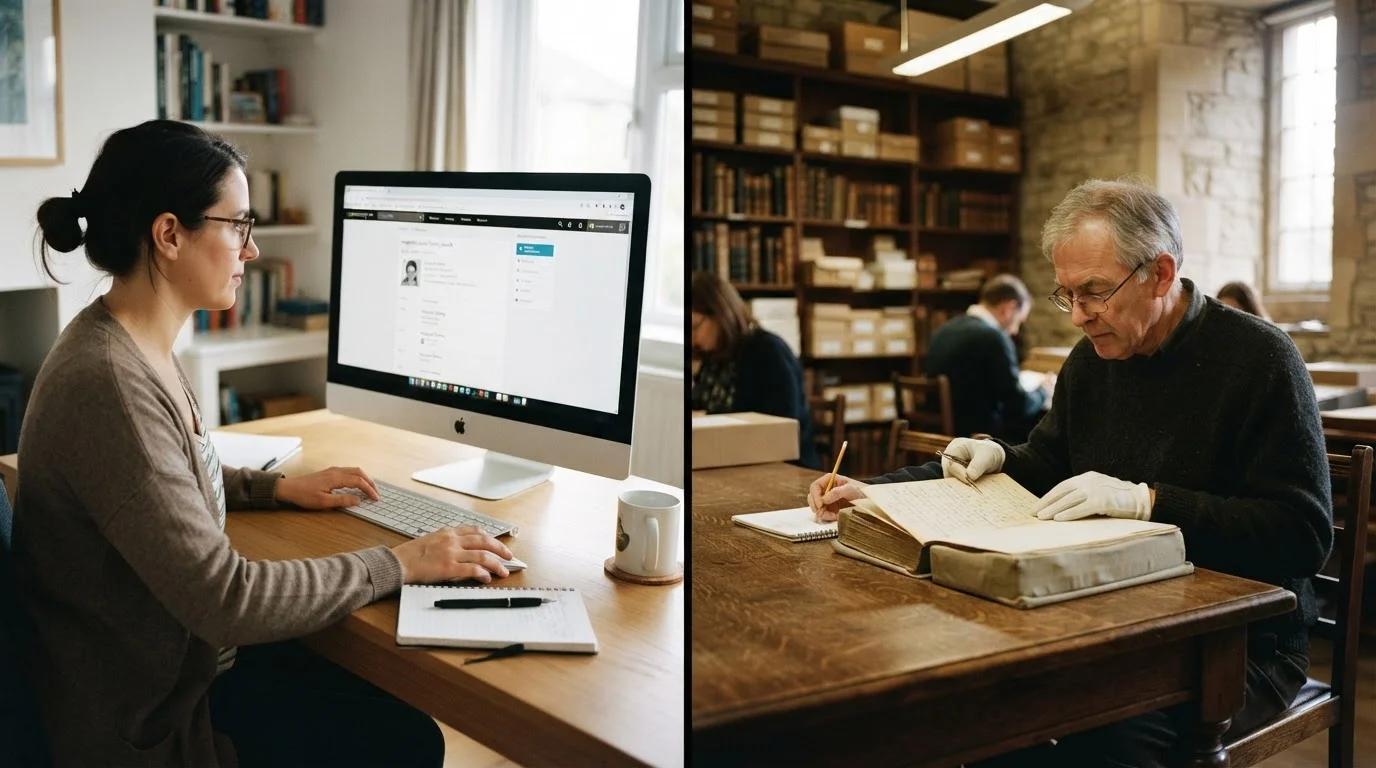
Photo: searchopenrecords editorial
—— In This Article
Key Takeaways
- Digitised archives offer 24/7 access and keyword search but cover only a fraction of existing historical records.
- Physical repositories hold originals, indexes, and record types that may never be scanned or made publicly available online.
- A combined strategy — starting online, then visiting in person for gaps — is typically the most effective research approach.
- Not all digitised records are fully indexed; browsing microfilm or original volumes may still be necessary even for 'online' collections.
- Access policies, fees, and appointment requirements vary widely between repositories, so planning ahead is essential.
What Each Approach Actually Gives You
Digitised archives — online databases of scanned census pages, vital records, ship manifests, and more — have transformed how family history research begins. From a home computer, a researcher can search millions of indexed records in minutes. But convenience has limits. Estimates within the genealogical community consistently suggest that only a small percentage of all historical records created in the United States have been digitised, let alone fully indexed for search.
Physical repositories — county courthouses, state archives, regional historical societies, church record offices, and the National Archives — hold the raw documentary record of American life. Many of these collections include record types with no online equivalent, such as loose probate papers, guardian bonds, original land surveys, and coroner's inquisitions. For researchers tracing pre-20th-century lines, these repositories are often the only path forward.
Understanding the structural differences between the two helps you allocate time and travel budget more effectively before your search stalls.
The Case for Digitised Archives
Online access has genuine advantages that extend beyond convenience. Keyword and name searching across large indexed collections can surface records you would never have thought to request in person. Cross-referencing census years, vital records, and immigration data simultaneously is practical online in a way it simply isn't at a reading room desk.
Digitised platforms also preserve researcher notes and linked family trees — useful starting points, though they require verification against primary sources. The guides to locating official public records digitally note that federal records such as census schedules (through 1950, the most recent publicly released) and military service records are well-represented online, making them strong candidates for initial digital research.
Cost is another factor: many digitised collections are available through public library cards, free of charge. State archives and the Family History Library (operated by The Church of Jesus Christ of Latter-day Saints) have made substantial free collections available, reducing financial barriers considerably.
| Digitised Archives | Physical Repository Visits | |
|---|---|---|
| Accessibility | Available 24/7 from any location | Limited to repository hours and location |
| Record coverage | Partial — fraction of all records scanned | Comprehensive — includes unscanned originals |
| Search capability | Keyword and name search for indexed records | Finding aids and archivist guidance required |
| Document detail | May miss marginal notes or physical condition clues | Full original document with all contextual detail |
| Cost | Often free via library card or low subscription | Travel, duplication fees, and time investment |
| Specialist guidance | Self-directed; online help forums available | On-site archivists can direct to unlisted holdings |
| Best record types | Census, immigration, military, vital records | Probate, land, church, local court records |
When Physical Visits Become Necessary
Digital coverage is uneven in ways that aren't always obvious. A collection may be listed as 'available online' but only partially indexed — meaning relevant records exist in scanned images that search engines cannot find. Browsing microfilm or original ledgers page by page is sometimes the only method, even for nominally digitised collections. This reality is explored further in a closer look at the trade-offs of relying solely on digitised historical records.
Original documents also carry information that scans obscure or omit: paper texture, marginal notations, stamps, and physical condition all provide contextual clues. Archivists can direct you to finding aids — internal indexes and catalogs — that describe holdings never described in any online database. Deed books, orphan's court dockets, and local church registers frequently fall into this category.
If your research involves court or legal records, the trade-offs between courthouse visits and online portals for court record searches are similarly layered: some jurisdictions have digitised case indexes but retain the full case files only on-site.
Planning a Combined Research Strategy
The most productive approach uses digitised archives to build a research framework and identify gaps, then targets physical visits to address those gaps efficiently. Before traveling to any repository, confirm current access policies — many require appointments, restrict photography, or charge duplication fees. A brief email or phone call to the archivist in advance can save significant time on-site.
Document every source consulted, whether digital or physical, using a standard citation format. The genealogical community widely uses the guidelines set out in Evidence Explained by Elizabeth Shown Mills as a citation standard, which distinguishes clearly between original records, derivative records, and authored works. This discipline matters because the same record may appear in digitised form (a derivative) and in the original (which may carry additional detail).
DNA evidence, covered in depth through DNA and ancestry research tools, can complement both approaches — helping confirm relationships suggested by documentary evidence or pointing to geographic origins that guide archive selection.
For obituary research specifically, the gap between digitised and physical holdings is particularly pronounced. Navigating both digitised and physical obituary archives requires checking newspaper morgues and library vertical files that rarely surface through standard online searches.

Genealogy Search Editorial Team
Genealogy Search Editorial Team is the collective byline for our editorial team and contributor network. Articles published under this byline or an editorial pen name are researched, written, and reviewed according to our editorial standards for clarity, consistency, and independence before publication.
View author profile