
The Hidden Genealogical Data Embedded in a Single Obituary
A single obituary can point to birth records, migration patterns, maiden names, and more. This guide decodes the layers of family history hiding in plain sight.
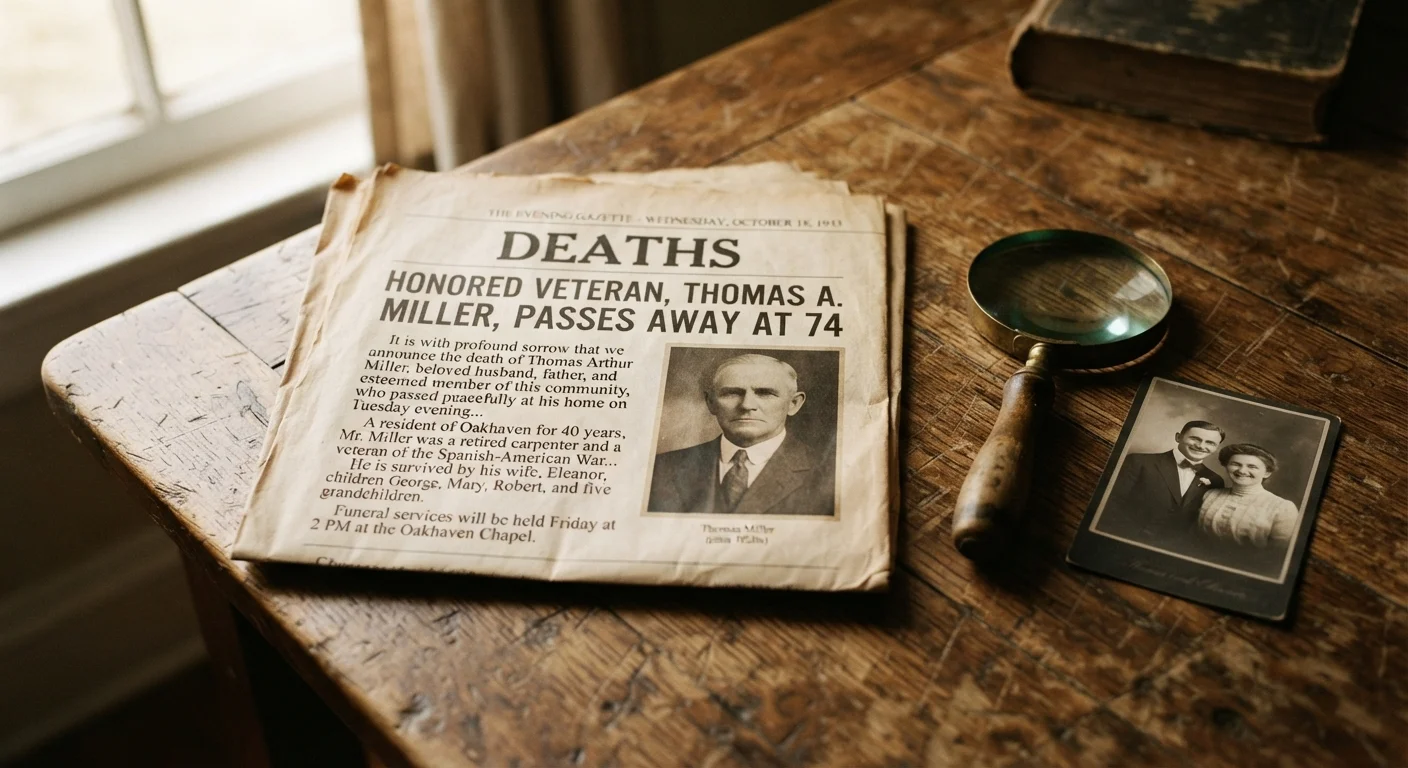
Photo: searchopenrecords editorial
—— In This Article
Key Takeaways
- A single obituary routinely contains birth dates, birthplaces, maiden names, and survivor relationships.
- Church affiliations, fraternal memberships, and military service branches open distinct archival research paths.
- Migration clues — hometowns, place of death, named cities — can chart a family's geographic movement across decades.
- Survivor lists name living relatives who may hold photos, letters, and oral histories unavailable in public records.
- Every detail in an obituary should be treated as a lead to cross-reference, not a finished fact.
What an Obituary Is Actually Recording
Most people read an obituary to learn that someone has died and when services will be held. Genealogists read the same text and see something else entirely: a compressed family document assembled by people with firsthand knowledge, capturing information that may not exist anywhere else in a single place.
At its core, an obituary records identity. The full name — including middle name and any nicknames — is the first anchor. Maiden names, which appear in parentheses or as "formerly of" phrasing, are especially significant because they unlock an entirely separate family line that might not otherwise surface in records filed under a married name. A woman listed as "Eleanor Mae Kowalczyk (née Brennan)" hands you two surnames to research simultaneously.
Beyond names, obituaries routinely state the deceased's age or birth date and birthplace. Even an approximate birth year, combined with a named city or county, is enough to locate a birth certificate, a census household entry, or an early city directory listing. These details become the coordinates of a life.
For a deeper look at how to extract and record these details systematically, see the practical field guide to reading an obituary for genealogy.
The Migration Map Hidden in Plain Sight
Families rarely stayed in one place, and obituaries often trace that movement without explicitly announcing it. Look for the gap between where someone was born and where they died. A man born in rural Mississippi who died in Detroit almost certainly followed the Great Migration northward — a documented historical pattern that produced its own rich paper trail in Northern city records, factory employment files, and church registers.
Named former residences are equally telling. Phrases like "formerly of County Cork, Ireland" or "a longtime resident of Galveston before moving to Houston" pinpoint the archival collections where earlier records will likely be found. Immigration and naturalization records, port arrival manifests, and foreign civil registration records all become accessible once you have a named place of origin.
Note the Geography Between Birth and Death
When an obituary lists a birthplace in one state or country and a death location in another, treat the gap as a research prompt. Search for the family in census records from the intermediate decades to trace the specific route and timing of that move. Each stop along the way likely produced its own paper trail.
Even the funeral home's location and the named cemetery can be informative. They often indicate where the family's community ties were strongest — sometimes a different city than the place of death — pointing to a church, a neighborhood, or an ethnic enclave whose records may hold additional family documents.
Survivor Lists and Institutional Affiliations as Research Leads
The survivor list is among the most structurally generous parts of any obituary. It names living relatives with their relationships spelled out — "daughter," "son-in-law," "grandchildren" — and sometimes includes their current cities of residence. This is an active map of a family network at a specific moment in time. Those individuals may hold photographs, family bibles, letters, and oral histories that no public archive contains.
Institutional affiliations are less obvious but equally valuable. A mention of membership in a fraternal organization like the Elks or Knights of Columbus means there may be membership records, death benefit files, or lodge minutes held by that organization. A named church congregation points to baptismal records, marriage registers, and burial logs — often predating civil vital records. Military service branches open access to the National Archives' personnel files, pension records, and unit histories.
For a thorough breakdown of these less-noticed details, the article on hidden genealogical data points most readers miss in obituaries covers church affiliations, club memberships, and military units in depth.
Obituaries Are Starting Points, Not Final Answers
Because obituaries are written under emotional pressure and often from memory, they can contain errors in dates, name spellings, and relationships. Treat every detail as a hypothesis to test against primary records — birth certificates, marriage licenses, census entries — rather than an established fact. The goal is verification, not just collection.
Once you have extracted all available leads from an obituary, the logical next step is to connect those details to the broader public record system. The guide on tracing a family tree using obituaries as your starting point shows how to build outward from a single document into a fuller, verified family history.
Frequently Asked Questions

Obituary Search Editorial Team
Obituary Search Editorial Team is the collective byline for our editorial team and contributor network. Articles published under this byline or an editorial pen name are researched, written, and reviewed according to our editorial standards for clarity, consistency, and independence before publication.
View author profile