
Reading an Obituary for Genealogy: A Practical Field Guide
Obituaries can unlock entire family branches. Learn which details to record, cross-reference, and verify when researching ancestry.
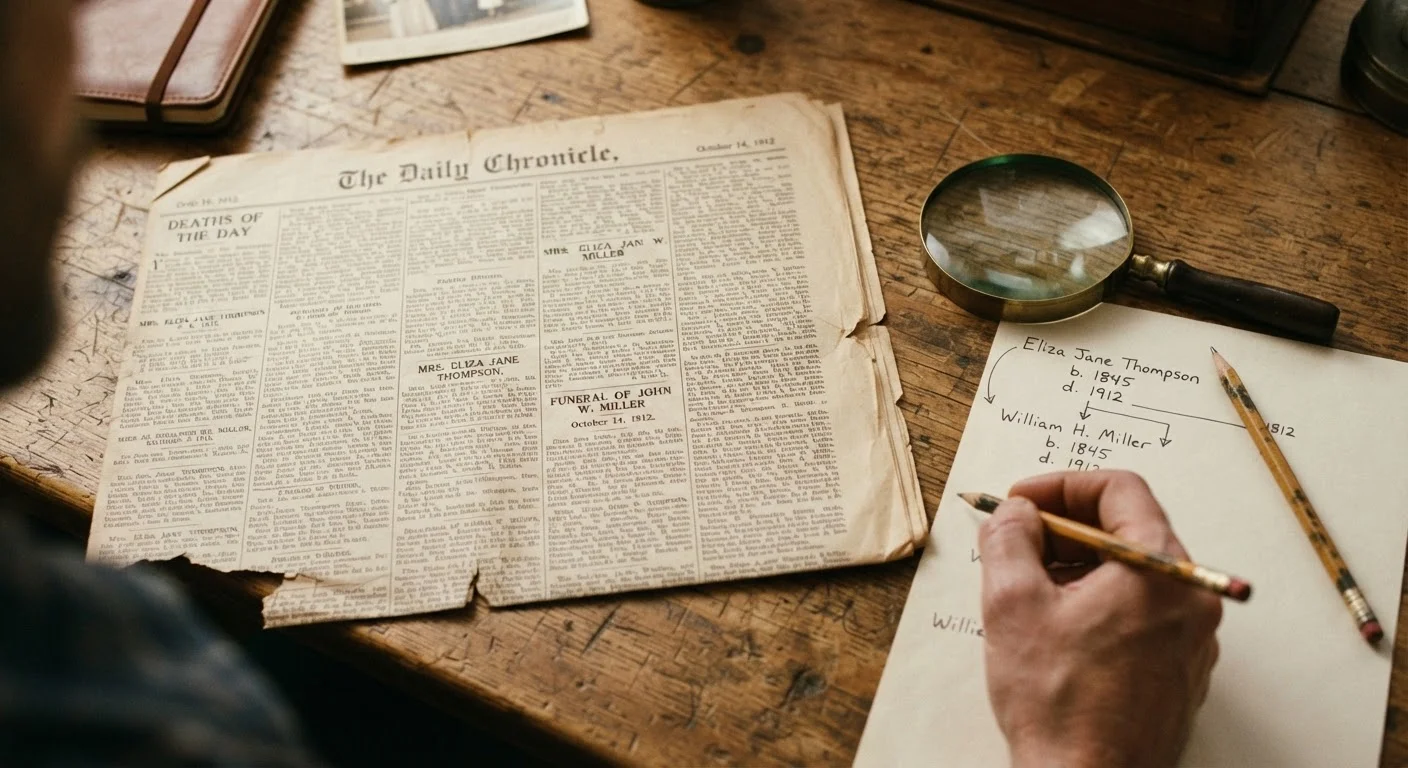
Photo: searchopenrecords editorial
—— In This Article
Key Takeaways
- Obituaries contain structured relationship language that maps directly onto a family tree.
- Names, dates, and locations in an obituary each require cross-referencing with official vital records.
- Maiden names, nicknames, and omitted relatives are as informative as the details that are included.
- Church, civic, and military references within obituary text can open entirely new research branches.
- Errors in obituaries are common — always treat them as leads, not confirmed facts.
Why Obituaries Deserve Careful, Structured Reading
Most people scan an obituary for the service details and move on. For a genealogist, that same document is a compressed biography containing names, relationships, dates, places, and institutional connections that can expand a family tree by generations. The challenge is that obituaries were not designed as genealogical instruments — they were written quickly, under emotional pressure, by people who may not have had complete information. Reading one well means extracting what is there while recognizing what might be wrong or missing.
Understanding obituaries within the broader ecosystem of death documentation helps set appropriate expectations. Unlike a death certificate — an official document completed by a physician and registrar — an obituary is a family-authored narrative. It reflects what the family chose to include, what they remembered accurately, and sometimes what they preferred to omit. That context shapes how you use it. For a broader orientation to the relationship between obituaries and official records, The Genealogist's Complete Guide to Obituaries and Death Records is a thorough starting point.
What you will need
What You'll Need Before You Begin
Before working through an obituary analytically, gather the right tools. You'll need a way to record findings with source citations attached — a genealogy software program, a structured spreadsheet, or a dedicated research notebook all work. You'll also want access to at least one corroborating record source: a vital records index, a census database, or a newspaper archive where you can retrieve related documents.
Genealogy research notebook or spreadsheet
Records names, dates, relationships, and source citations extracted from each obituary.
Newspaper archive or library database
Locates related obituaries, death notices, and historical issues for cross-referencing.
Vital records index (state or county level)
Verifies birth, marriage, and death dates mentioned in the obituary against official records.
Census database
Confirms household members and ages listed in or implied by the obituary text.
Probate court records portal
Supplements obituary details with legally verified next-of-kin and estate information.
If you're new to organizing findings across multiple documents, Organizing Your Research So Each Branch of Your Family Tree Stays Clear offers practical methods for keeping notes navigable as your research grows.
Step-by-Step: Reading an Obituary for Genealogy
The steps below move from surface-level extraction to deep verification. Follow them in order for a new obituary; return to earlier steps when a cross-reference surfaces a discrepancy.
Identify and record all personal names
Read the obituary slowly and list every name that appears — the deceased, survivors, those who preceded them in death, pallbearers, and officiants. Note the exact spelling printed, then flag any obvious variants (nicknames in quotation marks, initials only, or names preceded by "Mrs." without a given name). Each variant is a research question in its own right.
Pay particular attention to married women identified only by their husband's name (e.g., "Mrs. Harold Dawson") — a convention common in older obituaries. Pairing that name with census records or marriage indexes can recover the given name needed to extend her line. See guidance on era-specific naming conventions for context on historical practices.
Map every stated relationship
Obituaries use consistent kinship language — "survived by," "preceded in death by," "loving mother of," "devoted sister to." Diagram these relationships before moving on. Draw a simple sketch of the immediate family as described, noting each person's stated connection to the deceased.
Phrases like "preceded in death by" are especially valuable: they confirm that a relative died before the subject, which can narrow search windows for death records. The article Reading Between the Lines: How Obituary Language Reflects Family Structure explains the structural meaning behind these conventions in detail.
Extract and flag all dates and places
Record every date and location mentioned: birth, death, burial, migration references, and any institutions named. Create a column for "stated" and a separate column for "verified" — leave the verification column empty until you consult primary sources.
Locations deserve special scrutiny. A burial site in a different county or state than the death location often signals migration or family ties elsewhere. Town names that no longer exist or that changed spelling over time require additional context; historical gazetteers (geographic dictionaries) can help.
Note institutional and organizational affiliations
Church membership, lodge affiliations, military units, veterans' organizations, and civic clubs are often mentioned in passing but carry significant genealogical weight. A named church may hold baptism and marriage records. A lodge membership may mean there are membership rolls or death benefit records. Military unit references connect to service records held by the National Archives.
For a fuller treatment of how these embedded clues can open new research paths, see Hidden Genealogical Data Points Most Readers Miss in Obituaries.
Cross-reference findings with primary records
An obituary is a secondary source — written by people with incomplete information, sometimes years after key events. Every significant fact it contains should be checked against a primary record: a death certificate for the date and cause of death, a census record for household members, or a marriage record for a spouse's maiden name.
Cross-Referencing Obituary Details with Other Public Records walks through exactly how to pair obituary findings with vital records and court filings. Also consider using the Obituary Research Checklist for Genealogy Projects to ensure nothing is missed before moving on.
Search for additional obituaries in the same family
A single obituary names multiple relatives. Each named person is a candidate for their own obituary, which in turn may name additional relatives you haven't encountered yet. Work outward systematically: locate obituaries for the spouse, parents, and siblings identified in your original document.
For strategies on finding these additional records efficiently, the Getting the Most Out of an Obituary Search guide covers proven research habits across newspaper archives, library databases, and public collections. If records are missing entirely, When No Obituary Exists outlines alternative public record paths.
What Omissions Can Tell You
An obituary's silences are part of its content. A child not listed among survivors may have predeceased the subject, been estranged, or simply been overlooked — each possibility points toward a different research path. A missing birthplace might indicate immigration or a sensitive family history. When a second marriage is referenced but the first spouse is absent, there may be a divorce record or an earlier death notice worth finding.
Approach omissions as hypotheses rather than conclusions. Record the gap, note the possible explanations, and look for evidence in supporting records. For a deeper treatment of what a single obituary can silently contain, The Hidden Genealogical Data Embedded in a Single Obituary decodes these layers systematically. Paired with Public Records That Pair Naturally With Obituary Research, you'll have a complete picture of where to look next.

Obituary Search Editorial Team
Obituary Search Editorial Team is the collective byline for our editorial team and contributor network. Articles published under this byline or an editorial pen name are researched, written, and reviewed according to our editorial standards for clarity, consistency, and independence before publication.
View author profile