
Hidden Genealogical Data Points Most Readers Miss in Obituaries
Church affiliations, military units, and club memberships buried in obituary text can open entirely new research paths for family historians.
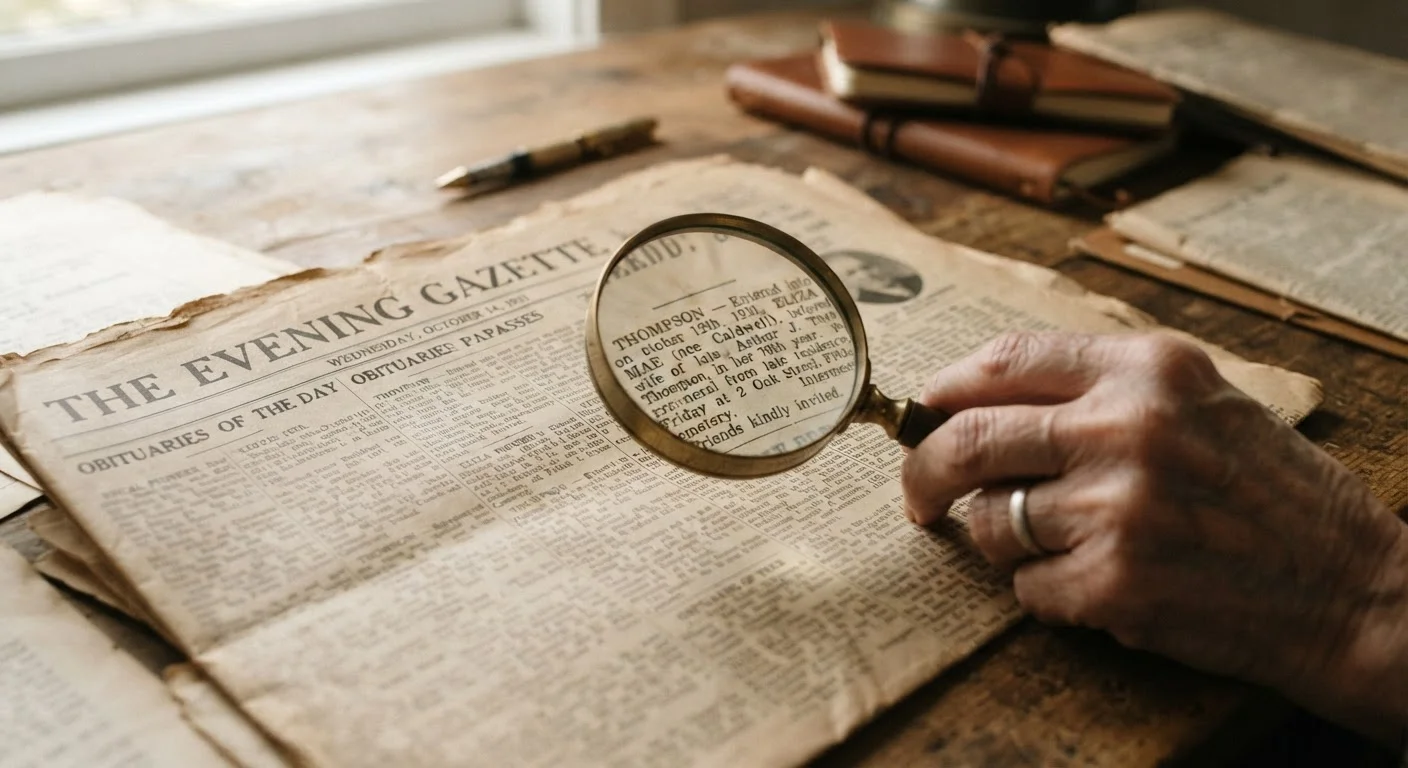
Photo: searchopenrecords editorial
—— In This Article
Key Takeaways
- Church affiliations named in obituaries can lead directly to baptism, marriage, and burial registers.
- Military unit details unlock service records, pension files, and unit histories at the National Archives.
- Club and fraternal memberships often preserved their own archives, which may include biographical member records.
- Maiden names of surviving spouses and daughters are frequently embedded in parenthetical phrases.
- Funeral home names point to unpublished records that may include cause of death and next-of-kin details.
- Geographic clues like 'formerly of' phrases reveal migration patterns and potential earlier record sets.
Why Obituaries Reward a Second Look
Most people scan an obituary for confirmation of a death date and a short list of surviving relatives. Genealogists who stop there are leaving a significant amount of research potential on the table. Obituary writers — whether professional journalists, funeral home staff, or family members — routinely embed details that point outward to entirely separate record collections. These are not hidden in any coded sense; they simply sit in plain view while readers focus on the headline facts.
This article walks through the data points that experienced researchers have learned to flag immediately. Each one represents a research thread that can break through a brick wall, validate a hypothesis, or open a branch of the family tree that would otherwise remain invisible. For a broader foundation on working with this record type, see our practical field guide to reading obituaries for genealogy.
Church or Congregation Affiliations
When an obituary states that a service will be held at a named church, or that the deceased was a longtime member of a specific congregation, that is an archival address. Many Protestant denominations, Catholic parishes, and Jewish synagogues maintained their own registers of baptisms, confirmations, marriages, and burials — records that predate or supplement civil registration. Contacting the congregation directly, or locating its records through a denominational archive, can yield documents going back several generations.
Note the full, exact name of the congregation as it appears in the text. Names changed over time, congregations merged, and buildings relocated. That specificity is what allows you to trace the correct archive.
A church name in an obituary is effectively an archival address for generations of family records.
Military Branch and Unit Identifiers
Phrases such as "served with the 82nd Airborne" or "a veteran of the Pacific Theater" are more than biographical color. They are index keys into federal record systems. The National Archives holds Official Military Personnel Files, and unit-level records — morning reports, muster rolls, and unit histories — can place an ancestor at a specific location on a specific date. Pension application files, available for conflicts from the Revolutionary War through the early twentieth century, often contain sworn statements naming wives, children, and witnesses, making them extraordinarily rich for family reconstruction.
Even a partial unit designation is worth pursuing. If the obituary names only a branch or theater, cross-reference with a draft registration card or discharge document, which may supply the missing details.
Unit identifiers unlock pension files and muster rolls that can name an ancestor's entire immediate family.
Fraternal and Civic Organization Memberships
References to membership in organizations such as the Masons, Elks, Knights of Columbus, Odd Fellows, or a veterans' post like the American Legion or VFW appear frequently in mid-twentieth-century obituaries. These organizations often kept their own membership records, which could include application forms listing birthdate, birthplace, occupation, and the names of sponsors — neighbors or colleagues who knew the applicant personally.
State and national archives for many fraternal orders still exist. Local lodge records have sometimes been deposited with county historical societies or public libraries, making them accessible without membership. The hidden genealogical data embedded in a single obituary explores how these memberships connect to a broader web of verifiable facts.
Fraternal membership applications frequently list birthplace, sponsors, and occupation — details rarely found elsewhere.
Parenthetical Maiden Names and Married Names
Family members are routinely identified in obituary text with their current married name followed by a maiden name in parentheses — for example, "his daughter, Carol (née Hartmann) Webber." This parenthetical is easy to skim past but contains a surname that may not appear anywhere else in your existing research. It gives you a new line to trace and a new set of vital records to request.
Apply the same attention to sisters, daughters-in-law, and aunts mentioned in the survivors list. Each parenthetical maiden name is a potential branch point. Record every one of them, even for relatives who are not your direct line — collateral relatives often appear in documents that name your direct ancestor.
Every parenthetical maiden name in a survivors list is a new surname and a new research branch to pursue.
"Formerly of" Geographic Phrases
Migration history is one of the hardest things to reconstruct in genealogical research, and obituaries frequently hand it to you directly. Phrases like "formerly of Scranton, Pennsylvania" or "a native of County Cork" tell you where to look for earlier records — census entries, voter registrations, church memberships, property deeds, and naturalization papers that predate a family's arrival in the community where they died.
These clues are especially valuable for urban obituaries, where families often relocated from rural areas or from other states. Each location named, even casually, represents a separate record jurisdiction with its own archives. Our guide on tracing a family tree using obituaries as your starting point explains how to build outward from these geographic anchors.
A single 'formerly of' phrase can redirect your entire search to an earlier record jurisdiction.
Funeral Home Names
The funeral home named in an obituary is not merely a logistical detail. Many funeral homes retain internal records — arrangement files, preparation records, and signed authorizations — that include information provided by the next of kin at the time of death. These records are private and access varies by state law and business policy, but it is worth contacting the funeral home directly, particularly if a family member can make the request.
Even when direct access is unavailable, the funeral home name can help you locate a death certificate, since funeral directors typically sign and file the official document. The certificate itself, as our companion article on what a death certificate can tell you about your ancestors explains, contains informant details, cause of death, and burial location — all useful for verification and further research.
Funeral home records, where accessible, can include next-of-kin details that predate a death certificate's filing.
Putting These Clues to Work
None of these data points exists in isolation. The real power comes from cross-referencing what you find in an obituary against other public record collections. A church affiliation confirms a denomination; the denomination's archives may hold a baptism record that gives a precise birth date and parents' names. A military unit leads to a service record that lists a physical description and an emergency contact — often a parent or sibling — from decades earlier. Cross-referencing obituary details with other public records is the logical next step once you have extracted every data point from the text itself.
If you are researching a relative who immigrated to the United States, pay particular attention to ethnic organization memberships and any references to a country or region of origin. Our guide on using obituaries to research immigrant ancestors explores what those references can and cannot tell you about overseas origins. And if you want to expand beyond obituaries altogether, eight record types genealogists frequently overlook can point you toward complementary sources that fill the gaps no single document can cover on its own.
Create a Structured Extraction Template
Before reading any obituary for research purposes, prepare a simple checklist covering each data category in this article: congregation, military unit, organizations, maiden names, geographic phrases, and funeral home. Working through the same checklist each time builds muscle memory and reduces the likelihood of overlooking a line buried in the middle of a long text. This habit is especially useful when processing multiple obituaries from the same family. For more research habits that experienced genealogists rely on, see our guide on getting the most out of an obituary search.

Obituary Search Editorial Team
Obituary Search Editorial Team is the collective byline for our editorial team and contributor network. Articles published under this byline or an editorial pen name are researched, written, and reviewed according to our editorial standards for clarity, consistency, and independence before publication.
View author profile