
When Obituaries Omit Information: What Absence Can Signal
Missing spouses, unnamed children, or vague cause of death aren't always oversights. Learn what deliberate omissions in obituaries may indicate.
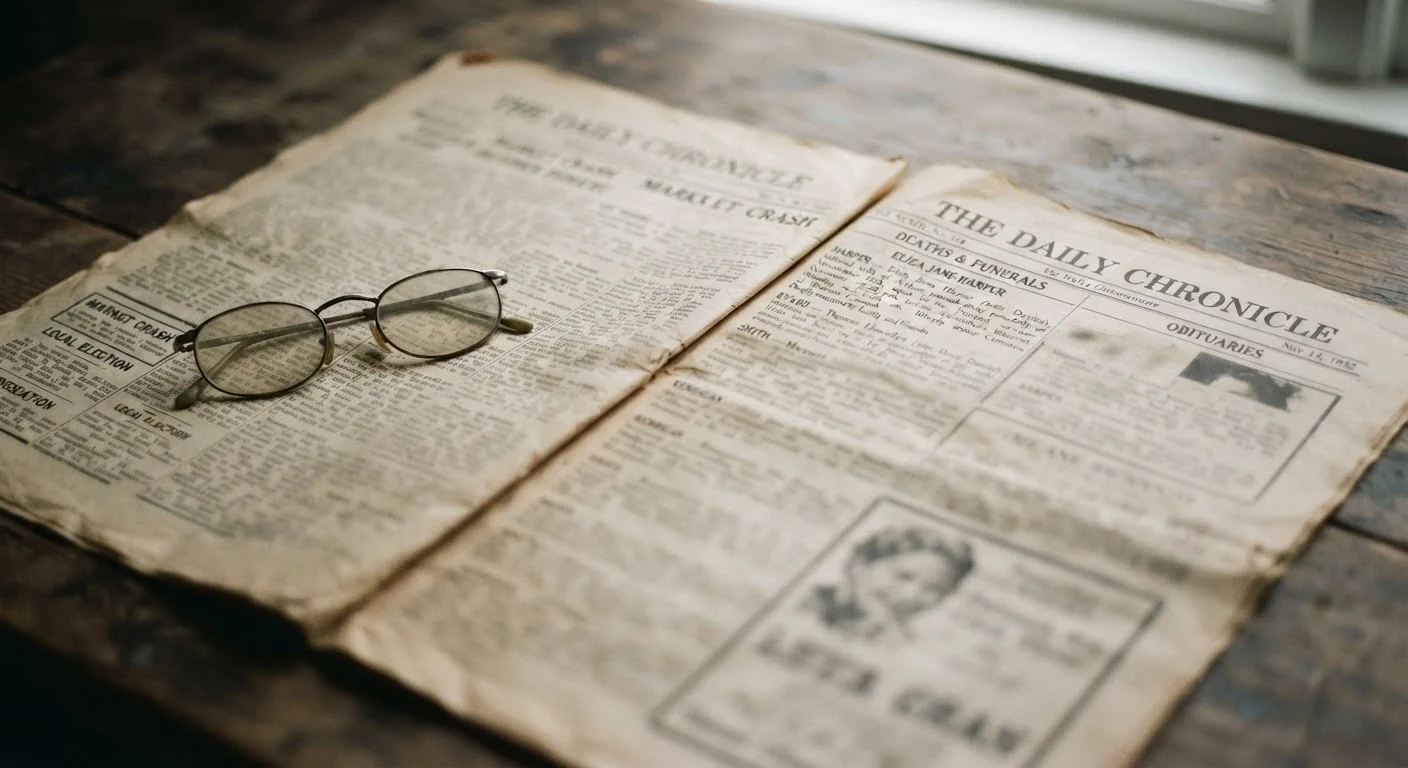
Photo: searchopenrecords editorial
—— In This Article
Key Takeaways
- Omissions in obituaries can be deliberate choices, not simply errors or oversights.
- Missing spouses or unnamed children often signal estrangement, legal disputes, or blended-family complexity.
- Vague cause of death language may reflect stigma, privacy preferences, or unresolved circumstances.
- Gaps in an obituary are starting points for deeper research using corroborating public records.
- Understanding why information is absent helps researchers ask better questions of archival sources.
The Difference Between an Omission and an Error
Most obituaries are written under grief, time pressure, and the constraints of a newspaper's word-count policies. Some missing details are simply accidents — a middle name forgotten, a sibling overlooked in a long list of survivors. But not every gap is accidental, and experienced genealogical researchers learn to distinguish between the two.
An accidental omission tends to be random: a minor detail with no pattern across other family documents. A deliberate omission, by contrast, often shows up consistently — the same name missing from every published notice, the same relationship described vaguely across multiple sources. That pattern is meaningful data, not noise.
For a broader look at what obituaries are structurally designed to capture — and what they routinely leave out by design — see what an obituary actually records and what it leaves out.
Obituaries Are Not Legal Documents
Unlike death certificates or probate filings, obituaries carry no legal weight and no disclosure requirements. They are written by families — often in partnership with funeral homes — and reflect whatever the family chose to share at that moment. This editorial freedom is precisely why omissions can be so meaningful, but it also means researchers should always corroborate obituary content against official records before drawing firm conclusions.
Missing Survivors: Spouses, Children, and Siblings
The survivors section of an obituary is where families exercise the most editorial control — and where the most revealing omissions tend to appear.
A missing spouse almost always signals something significant: divorce, estrangement, a complicated remarriage, or an ongoing legal dispute. Widows and widowers are generally named as a matter of convention; their absence is conspicuous. Researchers who notice a spouse-shaped gap should check marriage and divorce records at the county courthouse, which may explain the relationship's legal status at the time of death.
Unnamed or generically listed children — "several children" or "children from a previous marriage" — often indicate blended-family complexity, estrangement, or adoptions. In records predating the 1970s, children born outside of marriage were frequently omitted entirely due to prevailing social stigma. Biological children placed for adoption may not appear at all, even in otherwise detailed notices.
Sibling omissions are less dramatic but still informative. A missing sibling may have predeceased the subject without a documented obituary of their own, or may have been estranged. Either scenario is worth pursuing through genealogical obituary research and census cross-referencing.
~50%
U.S. deaths without a published obituary
Research on death notice publication patterns suggests roughly half of all U.S. deaths do not result in a published obituary, meaning omissions in available notices represent only a fraction of the full information gap.
1 in 4
Obituaries containing inaccurate survivor details
Genealogical organizations have documented that survivor information — names, relationships, spelling — is among the most frequently inaccurate elements in published death notices, reflecting both haste and family complexity.
Vague Cause of Death: Reading Between the Lines
Obituaries are under no obligation to state a cause of death, and many do not. When language like "died suddenly," "after a brief illness," or "peacefully at home" appears, it is often doing quiet work — signaling a cause that the family chose not to name directly.
"Died suddenly" or "unexpectedly" has historically been associated with suicide, accidental overdose, or traumatic accident. "After a long illness" once served as common shorthand for cancer in an era when the word carried heavy stigma; today it may similarly mask conditions families consider private. "Peacefully at home" typically reflects a natural or expected death but says little about its specific cause.
None of these phrases are dishonest. Families have genuine and understandable reasons for privacy. But for researchers attempting to construct a complete medical or social history, these phrases are a signal to consult the death certificate, which in most U.S. states records the medical cause of death as certified by a physician or medical examiner.
When an Entire Life Chapter Goes Unmentioned
Some omissions span years rather than single relationships. A decade with no mentioned employer, a geographic gap in an otherwise detailed biography, a military service record absent from an era when service was nearly universal — these silences can point to incarceration, institutionalization, a second family, or simply a period the family preferred not to acknowledge publicly.
Researchers encountering these larger biographical gaps should treat them as research questions. Prison records, military discharge papers, state hospital registers, and city directory archives from the relevant years can help fill the narrative. When the obituary itself proves too sparse a foundation, alternative records that fill the gap can provide a structured path through those silences.
It is worth remembering that obituaries sometimes get the facts wrong even when families intend accuracy — grief distorts memory, and deadline pressure compounds errors. Approaching both omissions and inclusions with critical, evidence-based curiosity is the most productive stance a researcher can take.
Frequently Asked Questions

Obituary Search Editorial Team
Obituary Search Editorial Team is the collective byline for our editorial team and contributor network. Articles published under this byline or an editorial pen name are researched, written, and reviewed according to our editorial standards for clarity, consistency, and independence before publication.
View author profile