
Free vs. Database-Backed Email Lookup Methods: A Practical Comparison
Manual, free-form searches and aggregated database queries each have trade-offs. Compare their accuracy, scope, and appropriate use cases side by side.
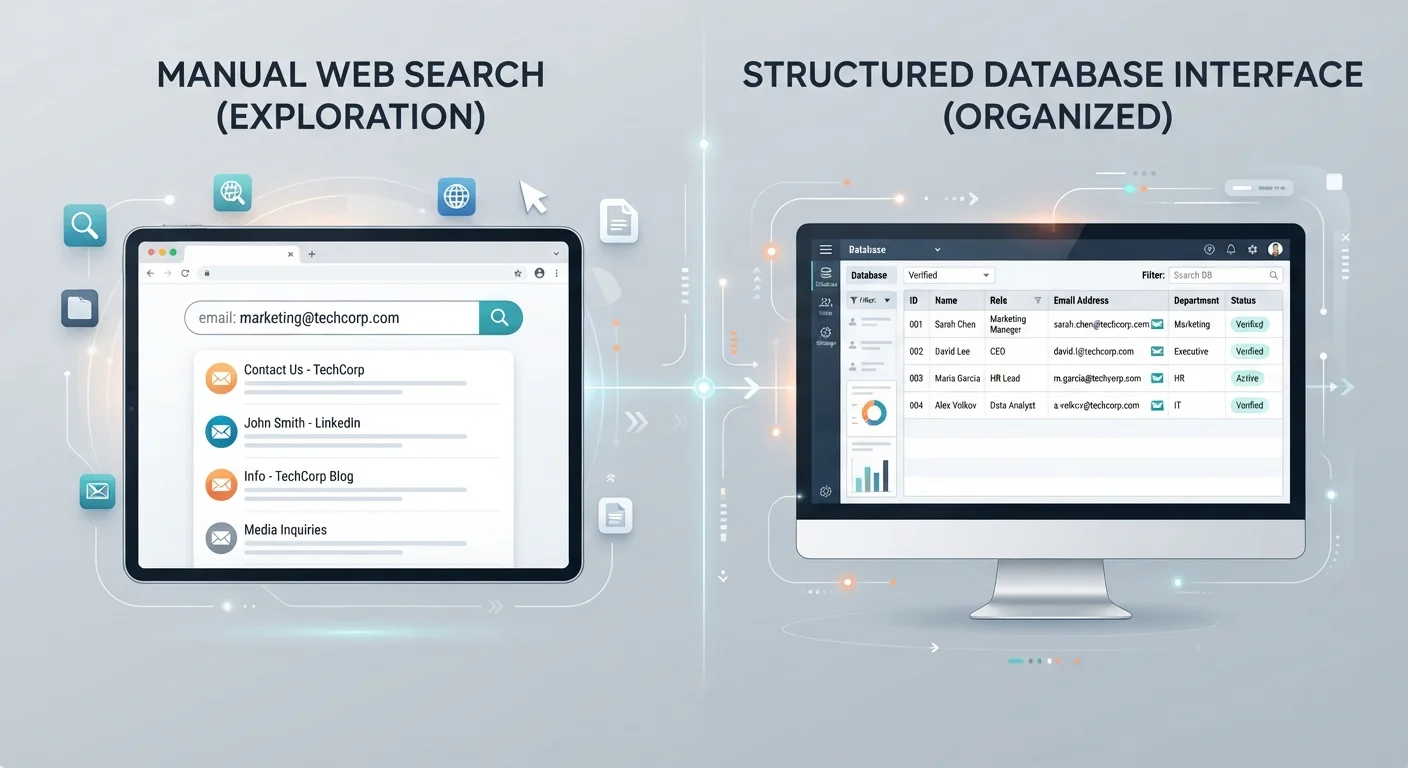
Photo: searchopenrecords editorial
—— In This Article
Key Takeaways
- Free methods rely on publicly indexed content and require manual effort, yielding inconsistent results.
- Database-backed tools aggregate data from multiple sources, offering broader scope but not guaranteed accuracy.
- Neither method is universally superior — the right choice depends on your specific research goal.
- Email lookup results, regardless of method, are often incomplete or outdated due to how data is collected.
- Legal and ethical boundaries apply to any email lookup method; results should not be used to harass or surveil.
How Each Method Works
Email lookup broadly falls into two approaches: free manual methods and aggregated database queries. Understanding their mechanics is the starting point for judging their usefulness.
Free manual methods rely on publicly indexed content — search engines, social media platforms, professional networking sites, and domain WHOIS records. A researcher enters an email address into a search engine and combs through results, forum posts, or profile pages that surface that address. This is labor-intensive and unstructured, but it costs nothing and draws on live, publicly accessible information.
Database-backed tools work differently. These services compile records from data brokers, public filings, social graph data, and historical web crawls into a searchable index. When you submit an email address, the system queries its stored records and returns linked data — sometimes including associated names, phone numbers, or addresses. The depth of results depends entirely on what the database has indexed and when those records were last updated.
For a broader look at how this pattern mirrors other lookup types, see our comparison of free vs. paid reverse phone lookup methods, which follows similar structural trade-offs.
| Free Manual Methods | Database-Backed Lookup | |
|---|---|---|
| Cost | Free | Often requires subscription or per-query fee |
| Speed | Slow; requires manual effort | Fast; results returned in seconds |
| Data freshness | Reflects current public indexing | May lag by weeks or months |
| Scope of results | Limited to publicly indexed pages | Broader; cross-references multiple data sources |
| Linked records (address, phone) | Rarely surfaced | Commonly included in results |
| Reliability | Inconsistent; depends on public presence | Inconsistent; depends on database quality |
| Privacy opt-out available | Not applicable | Often yes, varies by provider |
Accuracy and Data Freshness
Accuracy is where the two approaches diverge most visibly — though neither is reliably precise.
Free manual searches surface only what is currently indexed and publicly visible. If an email address was used in a public forum years ago but that thread has since been deleted or de-indexed, it won't appear. Conversely, current results reflect real-time public presence, which has value for confirming active digital footprints.
Database-backed tools can return richer linked data, but that data is only as fresh as the last ingestion cycle. Many aggregators update records on monthly or quarterly schedules, meaning the information may lag reality by weeks or months. An address linked to an email may reflect where someone lived two years ago. This limitation is structural — not a flaw of any particular tool — and is explored in depth in our article on why email lookup results are often incomplete or outdated.
Neither method should be treated as authoritative without corroboration from additional sources, especially for consequential decisions.
Scope, Speed, and Practical Limitations
Scope and efficiency are practical considerations beyond raw accuracy.
Manual searches scale poorly. Running a single query through a search engine, LinkedIn, and a WHOIS lookup tool might take ten to twenty minutes per email address with variable results. For bulk research or time-sensitive needs, this approach becomes impractical quickly.
Database-backed lookups return results in seconds and can surface linked records — such as associated phone numbers, addresses, and social profiles — in a single query. This makes them substantially faster for structured research tasks. However, scope is bounded by what each database has collected, which varies considerably. An email registered to a domain managed by a privacy-protective provider may return no useful data at all.
It's also worth distinguishing between reverse and forward email search approaches before choosing a method — our article on reverse email lookup vs. forward email search explains when each direction of search is most appropriate.
For context on how address-linked data fits into these queries, see our hub on address lookup methods and their public records basis.
Ethical and Legal Considerations
Regardless of method, email lookup sits within a legal and ethical framework that researchers should understand before proceeding.
In the United States, using publicly available information to identify an individual is generally lawful. However, using lookup results to stalk, harass, or discriminate against a person may violate state or federal law. The federal CAN-SPAM Act and various state privacy statutes also restrict how contact information obtained through automated means can be used commercially.
Database-backed tools that aggregate personal data are subject to regulations including the California Consumer Privacy Act (CCPA), which grants residents opt-out rights over data brokerage. Many aggregators provide opt-out mechanisms, though their completeness varies.
The ethical baseline is straightforward: use email lookup to verify identity, reconnect with known contacts, or conduct legitimate research — not to compile profiles of private individuals without their knowledge or consent. The same principles that govern responsible use of public records tools online apply here.
This article is for informational purposes only. It does not constitute legal advice. For questions about the lawful use of data lookup tools in your specific situation, consult a qualified attorney.

People Search Editorial Team
People Search Editorial Team is the collective byline for our editorial team and contributor network. Articles published under this byline or an editorial pen name are researched, written, and reviewed according to our editorial standards for clarity, consistency, and independence before publication.
View author profile