
Reverse Email Lookup vs. Forward Email Search: Understanding the Difference
Reverse and forward email searches serve different purposes. See how each approach works and when one method is more appropriate than the other.
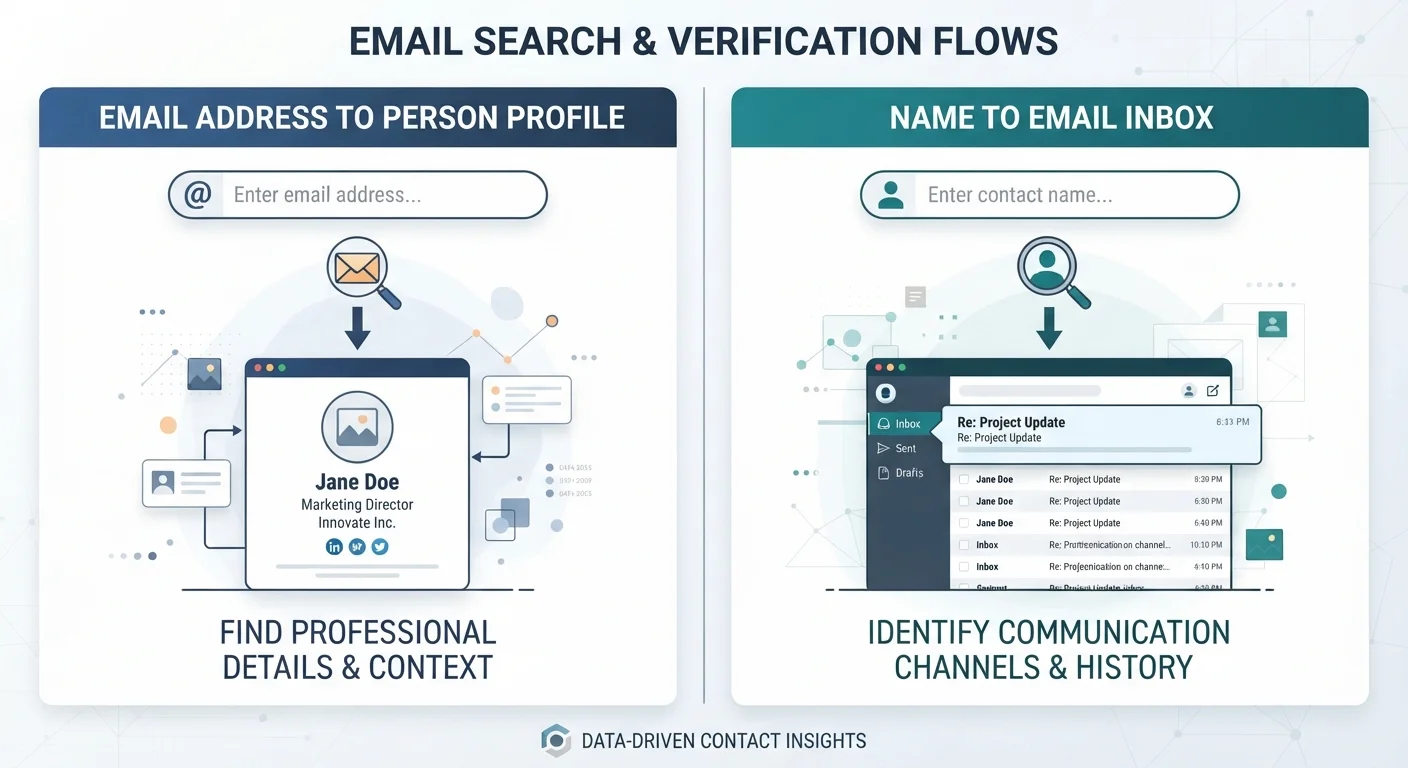
Photo: searchopenrecords editorial
—— In This Article
Key Takeaways
- Reverse email lookup starts with an address and attempts to identify the person behind it.
- Forward email search starts with a known identity and attempts to locate a contact address.
- Both methods draw on public records and aggregated data, but they answer fundamentally different questions.
- Results from either method are not guaranteed and depend heavily on available public data.
- Understanding which direction you need to search saves time and sets realistic expectations.
What Each Search Direction Actually Means
The terms "reverse" and "forward" in email searching describe the direction of the lookup — what you start with, and what you are trying to find. The distinction matters because each approach uses different data sources, produces different types of results, and is appropriate for different situations.
In a reverse email lookup, you begin with an email address and work backward to discover who owns or uses it. The goal is identity: a name, a geographic location, associated social profiles, or other publicly available details tied to that address. For a deeper grounding in how this process works, see Email Lookup Explained.
In a forward email search, you begin with a known identity — typically a person's name, employer, or profession — and work forward to locate a usable email address. This is contact discovery rather than identity verification.
Neither method guarantees a result. Both rely on what is publicly documented or indexed, and the quality of information varies significantly depending on how much a person's digital footprint intersects with accessible public data.
How Each Method Works Under the Hood
Reverse email lookup typically works by querying aggregated databases built from public records, data breaches (where legally accessible), social media profiles, forum registrations, and business directories. When an email address appears in enough of these sources, it can be linked to a name or other identifying details. The process is similar in structure to reverse address lookup, where a known data point is used to surface identity information rather than a location.
Forward email search uses a different set of signals. Common techniques include:
- Domain pattern inference — many organizations use predictable formats ([email protected]), which can be tested or verified.
- Public profile scraping — professional networks, personal websites, academic pages, and government directories sometimes list contact addresses directly.
- Search engine queries — combining a person's name with keywords like "email" or "contact" may surface publicly posted addresses.
For a side-by-side look at manual versus database-backed approaches to this kind of search, Free vs. Database-Backed Email Lookup Methods covers the trade-offs in detail.
| Criterion | Reverse Email Lookup | Forward Email Search |
|---|---|---|
| Starting point | A known email address | A known name or identity |
| Goal | Identify who owns the address | Find a contactable address |
| Primary use case | Identity verification, sender investigation | Contact discovery, outreach |
| Typical data sources | Aggregated public records, social profiles | Directories, domain patterns, public profiles |
| Result certainty | Variable; depends on public data availability | Variable; depends on public digital presence |
| Privacy implication | Your address may be traceable to you | Your name may lead to your address |
When One Approach Is More Appropriate Than the Other
Choosing the right search direction is less about preference and more about what information you actually possess at the start.
Use reverse email lookup when:
- You have received an email from an unknown or suspicious address and want to verify the sender's identity.
- You are conducting due diligence on a contact whose claimed identity you want to cross-reference.
- You are concerned about potential fraud or impersonation and want to see whether an address is publicly associated with a real identity.
Use forward email search when:
- You are trying to reach someone and do not have their contact information on hand.
- You know a person's name and employer and want to find their professional address through directory or pattern research.
- You are reconnecting with a former colleague, classmate, or professional contact.
It is also worth noting that both search types raise legitimate privacy considerations. If email addresses can be traced in either direction, your own address may be findable too — a topic covered in detail at Protecting Your Own Email Address from Reverse Lookup.
Legitimate Use Matters
Both reverse and forward email searches should be conducted for lawful purposes such as personal due diligence, journalism, or reconnecting with known contacts. Using either method to facilitate harassment, stalking, or unauthorized contact may violate state and federal laws. Always consider whether your intended use aligns with applicable privacy statutes, including the Computer Fraud and Abuse Act and applicable state privacy regulations.
The same general logic applies to phone-based searches — for context on how reverse and forward lookup differ in that domain, see Reverse Phone Lookup vs. Caller ID Apps.

People Search Editorial Team
People Search Editorial Team is the collective byline for our editorial team and contributor network. Articles published under this byline or an editorial pen name are researched, written, and reviewed according to our editorial standards for clarity, consistency, and independence before publication.
View author profile