
VoIP, Landline, and Mobile: What Each Number Type Actually Tells You
Understand how VoIP, landline, and mobile phone numbers differ — and what those differences mean for public records traceability.
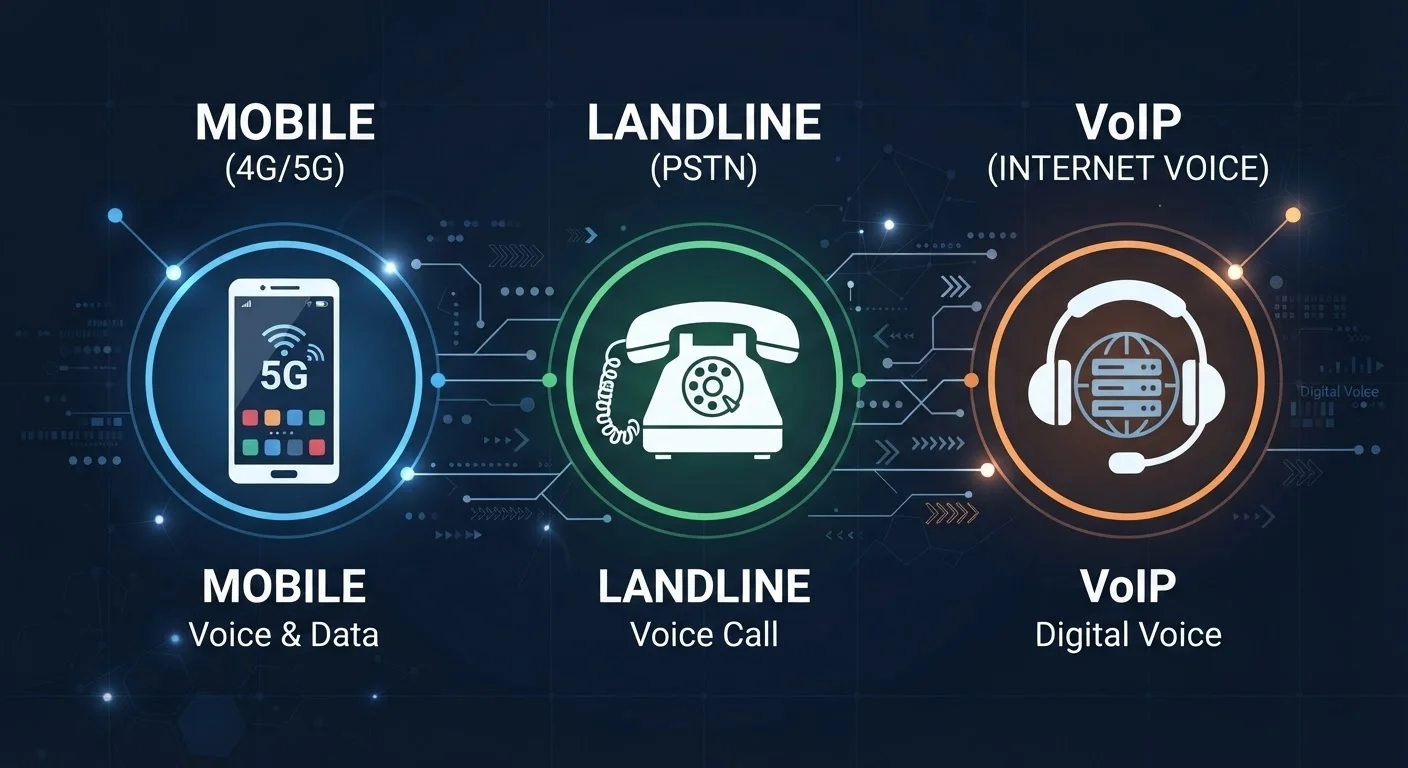
Photo: searchopenrecords editorial
—— In This Article
Key Takeaways
- Landline numbers are the most reliably traceable because they tie to a fixed, registered physical address.
- Mobile numbers carry subscriber data but are not publicly listed by default — portability adds complexity.
- VoIP numbers offer the least traceability because many providers require little or no identity verification.
- Number portability means the current carrier may differ from the carrier originally assigned to a number.
- Understanding number type helps set realistic expectations before running a reverse phone lookup.
Landline Numbers: The Most Traceable Type
Traditional landlines have the longest and most stable public records footprint of any number type. Because a landline is physically wired to a specific address — whether a home or business — it has always been tied to a location by design. Telephone companies historically submitted subscriber information to published directories, creating a lasting infrastructure for public lookup.
From a traceability standpoint, landlines offer three advantages: a fixed service address, a verified account holder, and a consistent carrier relationship. That combination means public records databases are more likely to hold accurate name-and-address pairings for landline numbers than for any other type.
The primary limitation is coverage. Landline subscriptions have declined sharply in the U.S. over the past two decades, so this highly traceable number type represents a shrinking share of active numbers. Additionally, business lines and unlisted residential numbers reduce the pool of openly searchable data. Comparing landline and mobile records side by side reveals just how much the data quality gap has widened.
Mobile Numbers: Subscriber Data Without Default Listings
Mobile numbers are issued by carriers to individual subscribers under postpaid or prepaid contracts. Unlike landlines, they are not tied to a fixed address — they move with the person — and they have never been systematically published in public directories. That distinction fundamentally shapes what a lookup can and cannot find.
Postpaid mobile accounts require name, billing address, and payment information at signup, creating a data record that third-party aggregators can license and incorporate into lookup databases. The result is that postpaid mobile numbers often return a name and general location, even if not a precise street address. Prepaid mobile numbers, by contrast, frequently carry far less verified identity data. For a closer look at how billing type influences results, prepaid vs. postpaid traceability differences are worth understanding before you run a search.
Number portability adds another layer of complexity. A mobile number may have started with one carrier and been ported to another — or even converted to a VoIP line — while retaining its original area code. Databases that rely on rate center data rather than real-time routing records may reflect outdated carrier assignments.
~35%
U.S. adults with traditional landline service
According to CDC National Health Interview Survey data, landline-only or landline-plus-wireless households have fallen sharply, with wireless-only households now the clear majority.
~3 billion
Global VoIP subscribers projected
Industry research projections cited by multiple telecom analysts estimate VoIP subscriptions continuing to grow globally, accelerating the shift away from traditional line types.
60%+
U.S. adults in wireless-only households
CDC National Health Interview Survey estimates have consistently shown more than 60% of U.S. adults living in households with only wireless phones, with the share still growing.
VoIP Numbers: Internet-Based and Harder to Pin Down
VoIP numbers are assigned by internet telephony providers rather than traditional telecom carriers. They are not tied to any physical infrastructure at a specific location, and many services issue numbers with minimal identity verification — sometimes only an email address and a payment method, or in some cases nothing at all for free-tier services.
This structural looseness is what makes VoIP numbers the least traceable of the three types. There is no physical address baked into the service, no mandatory directory listing, and no uniform registration standard across providers. A VoIP number's area code may reflect a geographic region the user has never set foot in, since providers often let customers choose any available area code regardless of location.
That said, VoIP numbers are not invisible. The provider holds account records, IP access logs, and payment data (where applicable). Law enforcement can subpoena this information. Commercial lookup tools may identify the number as VoIP and name the provider, which is itself useful context. For a detailed breakdown of what data typically exists — and where the gaps are — see VoIP numbers and public records data availability.
How Number Type Shapes Reverse Lookup Results
When you run a reverse phone lookup, the number type is one of the first signals the underlying system uses to determine which databases to query and what confidence to assign the results. Landline numbers route to directory and address databases. Mobile numbers route to carrier subscriber aggregates. VoIP numbers may return only carrier identification — or nothing beyond line type.
Understanding this before you search helps calibrate expectations. A result that shows only a carrier name and a broad region for a VoIP number is not a failure of the tool — it reflects the genuine limits of the available data. Conversely, a detailed name-and-address result for a landline number is more likely to be current and accurate than an equivalent result for a mobile number that has been ported multiple times.
How reverse lookup handles each number type differently offers a more technical look at why the same search produces different outcomes depending on line type. For a quick-reference summary across all number categories, phone number categories and their data footprints provides a useful overview.
Frequently Asked Questions

Phone Lookup Editorial Team
Phone Lookup Editorial Team is the collective byline for our editorial team and contributor network. Articles published under this byline or an editorial pen name are researched, written, and reviewed according to our editorial standards for clarity, consistency, and independence before publication.
View author profile