
Why the Same Record Can Be Public in One State and Sealed in Another
Public record access isn't uniform across the U.S. State laws create significant differences in what's available — and to whom.
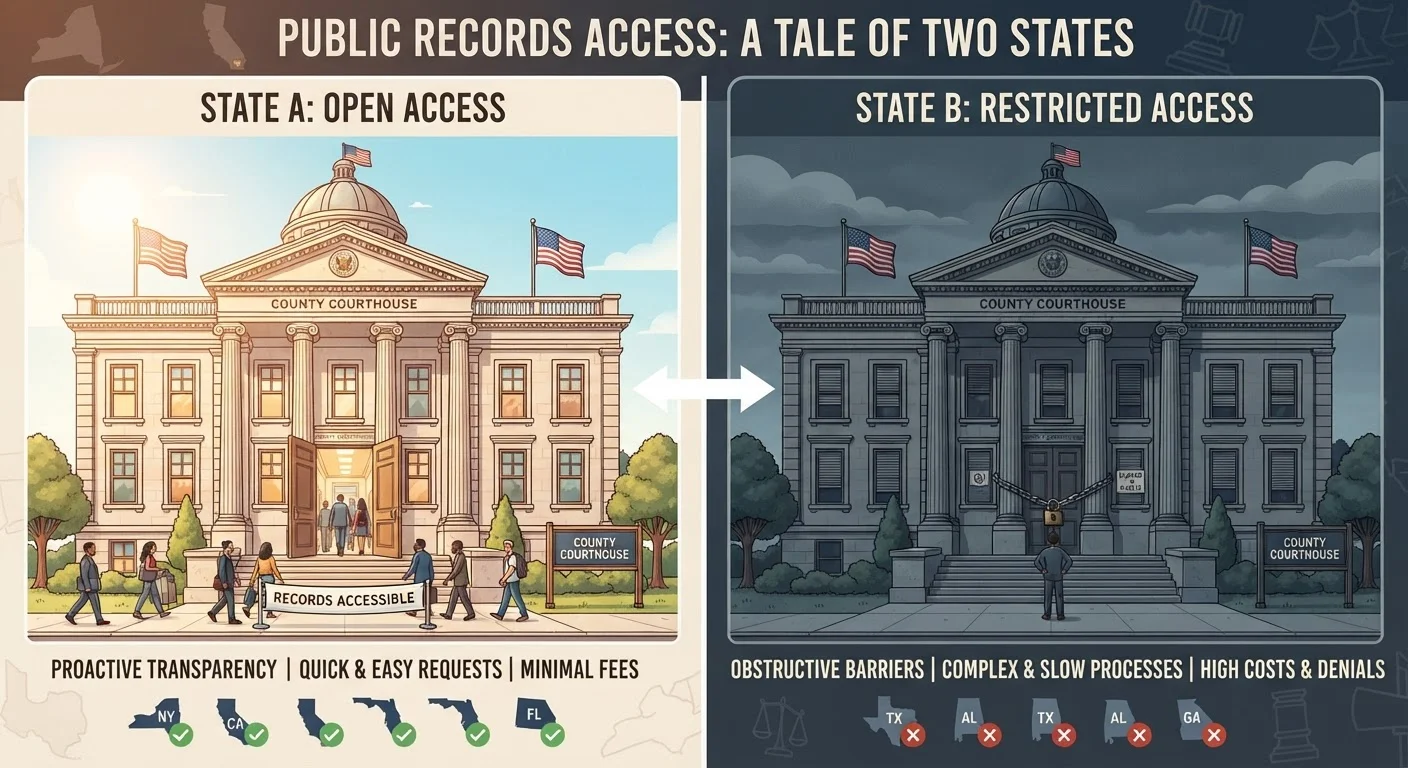
Photo: searchopenrecords editorial
—— In This Article
Key Takeaways
- Each U.S. state has its own public records law, creating significant variation in access rights.
- FOIA governs federal records only; state equivalents vary widely in scope and exemptions.
- Arrest records, divorce filings, and court records may be public in some states and sealed in others.
- Exemptions for privacy, safety, and ongoing investigations differ by jurisdiction.
- Understanding your state's specific statute is essential before relying on any public record search.
The Patchwork Problem: No Single National Standard
Most people assume that "public record" means the same thing everywhere in the United States. It doesn't. The U.S. operates under a dual system: federal records are governed by the FOIA, while state and local records fall under each state's own statute. Those statutes — often called Open Records Acts, Sunshine Laws, or Public Records Acts — were written independently by 50 different legislatures, reflecting 50 different sets of priorities.
The result is a patchwork where the same underlying document may have very different legal status depending on where it was filed. This isn't a bug in the system — it's a deliberate feature of U.S. federalism. But it creates real confusion for anyone trying to research public information across state lines.
To understand how the broader legal framework operates, see our overview of how records work across jurisdictions.
What States Actually Control
State open records laws determine several key variables that directly affect what you can find — and what you can't:
- Which records are designated public by default versus which require a specific exemption to be withheld
- Who may request access — some states restrict certain records to parties in a case, journalists, or licensed researchers
- What must be redacted before release, such as Social Security numbers, home addresses of crime victims, or minors' identities
- How long agencies have to respond and what fees they may charge
- Whether electronic records are treated differently from physical files
These variables compound quickly. A state that makes arrest records public but requires the requester to appear in person and pay a per-page fee creates a very different practical access environment than a state that offers the same records via a free online portal.
Exemptions Are the Rule, Not the Exception
Every state open records law includes exemptions — categories of records the government may withhold even when a valid request is made. Common exemptions include ongoing criminal investigations, personnel records, attorney-client communications, and records whose release would endanger public safety. The number and scope of these exemptions vary significantly, so a record category that seems straightforwardly public may still be withheld under a specific state provision.
For a structured reference across jurisdictions, our article on state-by-state differences in public records access breaks down fees, timelines, and key exemptions by state.
Common Record Types With Major State-Level Variation
Certain categories of records show the sharpest divergence between states. Understanding these helps set realistic expectations before you begin any search.
Arrest and Criminal Records
Some states treat arrest records as fully public regardless of whether a conviction occurred. Others seal or restrict arrest records when charges were dropped or the person was acquitted, on the grounds that publicizing an arrest without a conviction is inherently prejudicial. Expungement adds another layer: a record cleared under one state's law may still surface in a background check run through another state's system. Our related explainer on what court records are sealed, expunged, or restricted covers this in more depth.
Divorce and Family Court Records
Divorce filings are public court records in many states, meaning financial disclosures, property settlements, and custody arrangements can be accessed by anyone. Other states restrict these filings to protect sensitive family information — particularly involving minors — making them available only to the parties involved or their attorneys.
Vital Records
Birth and death certificates illustrate how access rules diverge even within record types. Most states restrict birth certificates to direct family members for privacy reasons, but the waiting period before a certificate becomes publicly accessible varies enormously — from 25 years to 100 years depending on the state.
Why These Differences Exist — and Why They Matter
State-level variation in public records access reflects genuine policy disagreements about how to balance two competing values: government transparency and individual privacy. A state with a strong open-government tradition may err toward disclosure; a state that has experienced high-profile privacy abuses may err toward restriction.
Safety considerations also play a role. Many states exempt home addresses of domestic violence survivors, undercover law enforcement officers, or certain public officials from disclosure — even when similar records for other individuals would be publicly available.
For people doing research — whether for genealogy, background checks, or legal due diligence — these differences have practical consequences. A record's absence from a search result does not mean that record doesn't exist. It may simply mean that the state where it was filed treats it as non-public. Our piece on what public records actually leave out explores what gaps like these mean in practice.
Similarly, finding a record doesn't guarantee it's complete. States vary in what they redact before release, so the version you access may omit details that another state's equivalent record would include. For context on how records are classified and restricted, see our guide on sealed, expunged, or restricted records.
This article is for general informational purposes only and does not constitute legal advice. For questions about your rights to access specific records, consult a qualified attorney familiar with the applicable state's open records law.
Frequently Asked Questions

Public Records 101 Editorial Team
Public Records 101 Editorial Team is the collective byline for our editorial team and contributor network. Articles published under this byline or an editorial pen name are researched, written, and reviewed according to our editorial standards for clarity, consistency, and independence before publication.
View author profile