
State-by-State Differences in Public Records Access
Each US state has its own public records statute. This reference breaks down the key variables—fees, timelines, exemptions—that differ across jurisdictions.
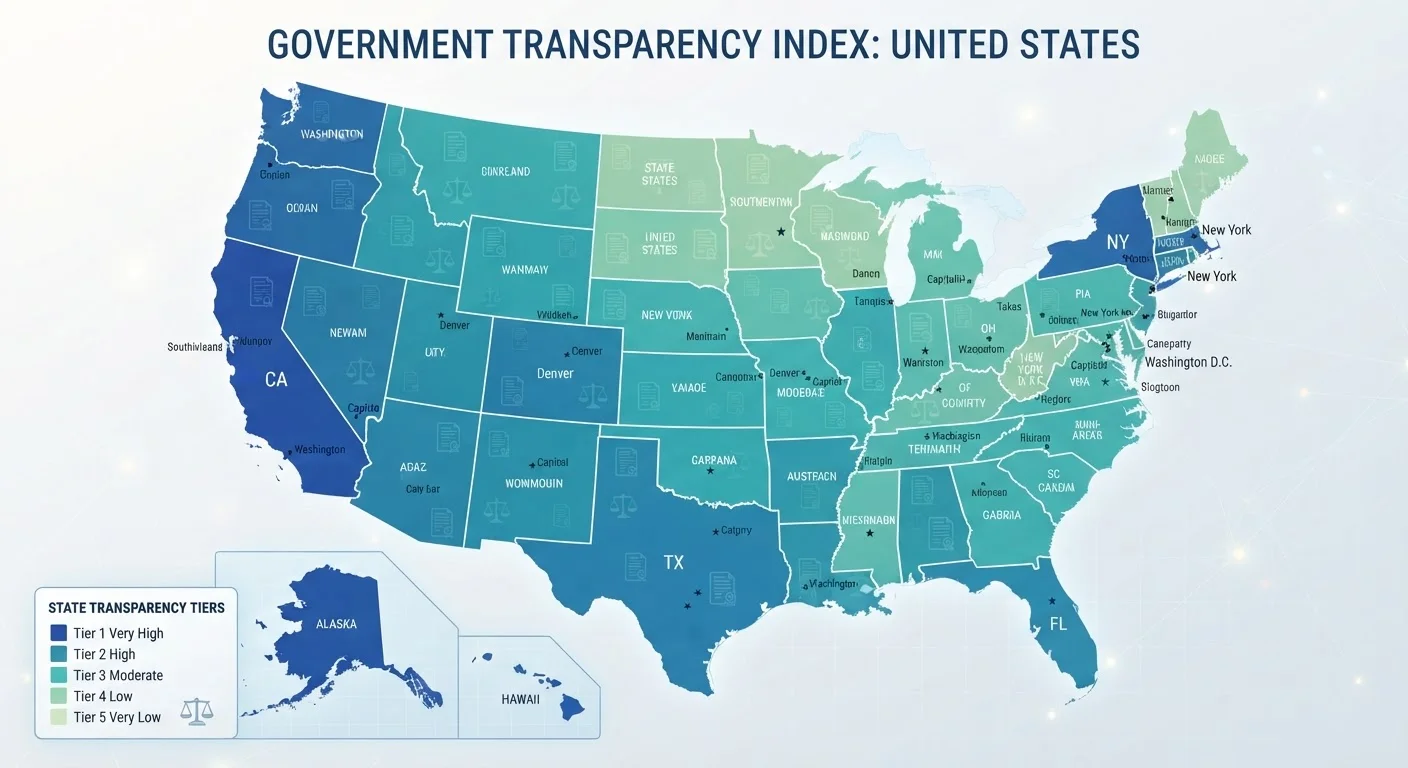
Photo: searchopenrecords editorial
—— In This Article
Why No Two States Handle Public Records the Same Way
The United States has no single national public records law governing state and local government documents. The federal Freedom of Information Act (FOIA) applies only to federal agencies. Every state has enacted its own statute — sometimes called a sunshine law, open records law, or public records act — that governs access to state and local government information.
The result is a patchwork of rules: what is freely available in one state may be sealed or fee-restricted in another. Understanding the key variables that differ across jurisdictions helps you set realistic expectations before you submit a request. See our plain-language guide to sunshine laws for a broader overview of how these frameworks work, and why the same record can be public in one state and sealed in another for deeper context on this variation.
| Governing law for federal agencies | Freedom of Information Act (FOIA) (5 U.S.C. § 552) |
| State response deadline range | 3 to 30 business or calendar days (Varies by state statute) |
| Typical copy fee cap (where set) | $0.10–$0.25 per page (State-specific; not universal) |
| States limiting requests to residents | Minority; courts have narrowed such rules (First Amendment Coalition analysis) |
| States with constitutional open-records guarantee | Approximately 10, including Florida and Louisiana (Reporters Committee for Freedom of the Press) |
| Common universal exemptions | Active investigations, juvenile records, attorney-client privilege (National Conference of State Legislatures) |
The Four Variables That Differ Most Between States
1. Response Timelines
State laws set mandatory deadlines for agencies to acknowledge and fulfill records requests. These vary widely. Some states require a response within 3 business days; others allow up to 30 calendar days for an initial determination. A handful of states permit extensions when requests are complex or voluminous, but must notify the requester in writing. Always check your state's specific statute before assuming a timeline.
2. Fee Structures
Agencies are generally permitted to charge for the cost of locating, copying, or transmitting records. However, how those fees are calculated — and whether a fee waiver is available — differs significantly by state. Some states cap per-page copy fees (often at $0.10–$0.25), while others allow agencies to charge for staff time spent searching or redacting. Several states provide reduced or waived fees when the request serves a public interest or comes from a journalist or nonprofit.
3. Exemption Categories
Every state defines categories of records that are shielded from disclosure. Common exemptions include ongoing criminal investigations, personnel files, attorney-client privileged communications, juvenile records, and certain health data. The scope of these exemptions varies: a category that is broadly exempt in one state may be only partially protected in another. For a detailed map of federal privacy frameworks that intersect with state law, see privacy laws that shape what you can and cannot find online.
4. Who May Request Records
Most states allow any person — including non-residents and businesses — to submit a public records request. A minority of states limit access to state residents or require requesters to identify themselves, though courts have increasingly narrowed such restrictions. Purpose-based restrictions, where the agency may deny a request based on the stated use, are rare but exist in some jurisdictions.
Notable State-Level Distinctions Worth Knowing
While a full 50-state breakdown is beyond the scope of a single reference, certain states are frequently cited for their distinctive approaches:
- Florida: Among the broadest open-records frameworks in the country. The state constitution independently guarantees public access, and the default presumption is that records are open unless a specific statutory exemption applies.
- California: The California Public Records Act provides strong access rights, but the state also has extensive exemptions. Requesters can seek judicial enforcement when agencies fail to comply.
- Virginia: The Freedom of Information Act here imposes a 5-business-day response requirement and allows fees only for actual costs of duplication.
- New York: FOIL (Freedom of Information Law) requires agencies to acknowledge requests within 5 business days and provides a formal appeals process through the Committee on Open Government.
- Texas: The Public Information Act requires agencies to request an Attorney General opinion before withholding records under most exemptions — a distinctive procedural safeguard for requesters.
For records held at the county or municipal level, the same state statute applies but agency practices can still differ. See which government level holds the record you need for guidance on locating the right custodian. Court records introduce additional complexity — consult federal vs. state court records if that is your focus.
If your goal is locating unclaimed property held by a state, the access rules for those databases follow a separate track — searching state databases covers the relevant portals.
This article provides general educational information about public records law in the United States. It is not legal advice. For guidance specific to your situation or jurisdiction, consult a qualified attorney familiar with your state's open records statutes.

Public Records 101 Editorial Team
Public Records 101 Editorial Team is the collective byline for our editorial team and contributor network. Articles published under this byline or an editorial pen name are researched, written, and reviewed according to our editorial standards for clarity, consistency, and independence before publication.
View author profile