
The Full Lifecycle of an Unclaimed Property Claim
From dormancy and escheatment to filing, review, approval, and payment — a comprehensive look at how unclaimed property moves through the system.
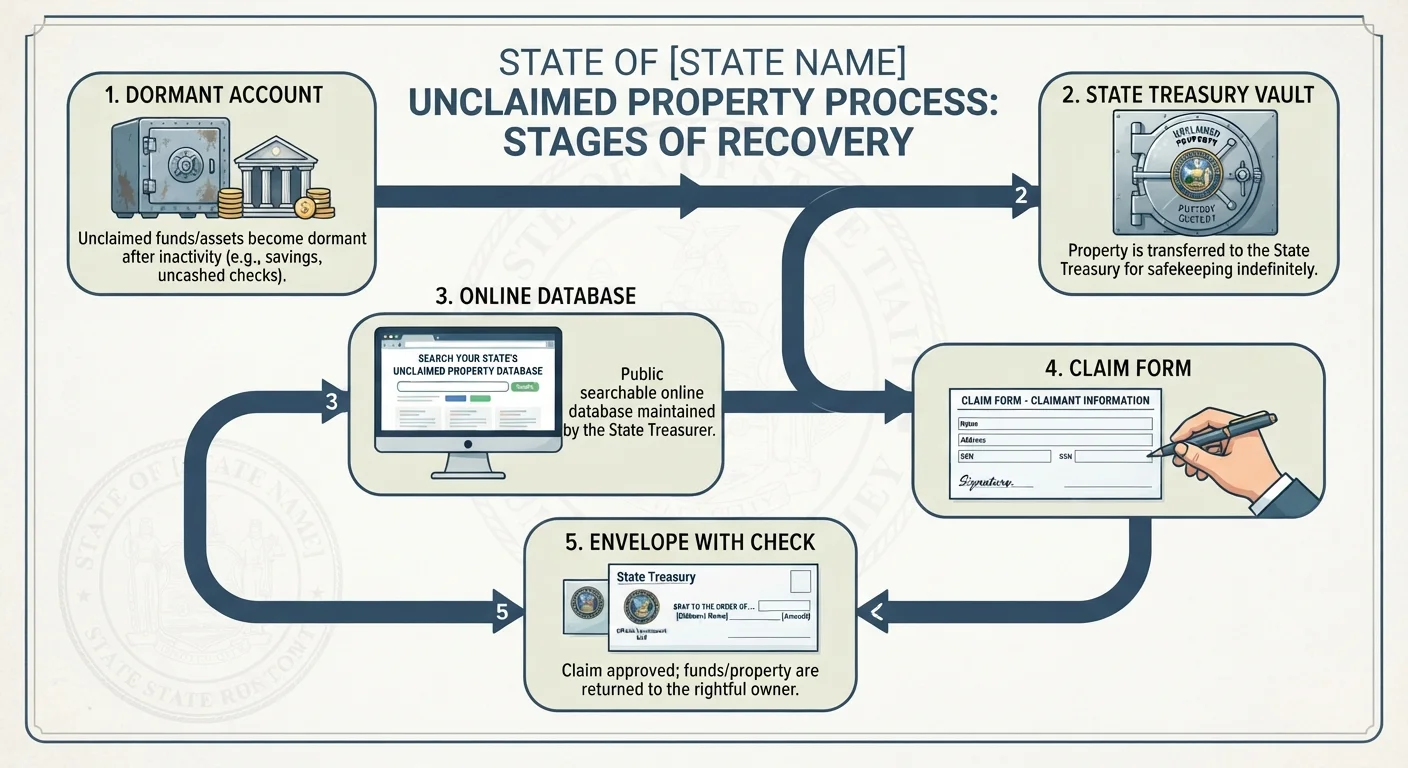
Photo: searchopenrecords editorial
—— In This Article
Key Takeaways
- Unclaimed property begins as a dormant account before a financial institution transfers it to the state.
- States hold funds indefinitely as custodians — the original owner's right to claim generally does not expire.
- Filing a claim requires identity documentation matching the original account holder's records.
- Review timelines vary by state, ranging from a few weeks to several months.
- Payment is issued directly by the state, not the original holder institution.
- Legitimate claims are free to file — no third-party intermediary is required.
Stage 1: Account Dormancy
Every unclaimed property journey starts the same way: an account, policy, or financial instrument goes dormant. This happens when the account owner stops interacting with it — no deposits, withdrawals, correspondence, or responses to contact attempts — for a period defined by state law. This window, called the dormancy period, typically ranges from one to five years depending on the property type and state.
Common property types that trigger dormancy include bank checking and savings accounts, uncashed payroll or dividend checks, forgotten security deposits, unredeemed gift certificates, and life insurance policy proceeds. The dormancy clock usually starts from the last owner-initiated activity, not the most recent bank statement or automatic fee charge.
To understand the full arc of how funds enter this system, see our overview at How Unclaimed Money Works.
Stage 2: Holder Reporting and Escheatment
Once the dormancy period ends, the institution holding the funds — called the holder — is legally required to attempt to locate the owner. This typically means sending a due-diligence letter to the owner's last known address. If no response is received, the holder must report the property to the appropriate state and transfer the funds. This transfer is called escheatment.
Holders file annual reports with state unclaimed property programs, usually through the state treasurer's or controller's office. Reporting deadlines vary by state but commonly fall between October and November for the prior fiscal year. Holders who fail to report on time can face penalties, which is why compliance is taken seriously by banks, insurers, and brokerages.
Your Right to Claim Does Not Expire
In most U.S. states, there is no statute of limitations on claiming your own unclaimed property. The state holds the funds indefinitely as custodian until the rightful owner comes forward. A handful of states have limited exceptions for certain property types — check your specific state's rules if you have concerns about older accounts.
Escheatment does not mean the government keeps your money permanently. The state acts as a custodian, holding the funds on your behalf until you come forward to claim them.
Stage 3: State Custody and Database Entry
After receiving the transferred funds, the state enters the property into its unclaimed property database. This record typically includes the owner's name, last known address, the type of property, and its approximate value (exact amounts may be withheld for security reasons on public-facing portals). States are required to make these records searchable by the public.
Most states participate in multi-state search portals such as MissingMoney.com, which is endorsed by the National Association of Unclaimed Property Administrators (NAUPA). The federal government also maintains databases for specific property types — for example, the FDIC for failed bank deposits and the U.S. Treasury for savings bonds.
For a guided tour of how to search these portals, visit our hub on Searching State Databases.
Stage 4: Searching and Filing a Claim
Once you locate a potential match, the next step is filing a formal claim directly with the state agency — always at no cost. You will need to provide documentation proving your identity and your connection to the property. Typical requirements include a government-issued photo ID, your Social Security number, and proof of your past address or relationship to the account (such as an old bank statement or utility bill).
Claims for a deceased relative's property require additional documentation: a death certificate, proof of your relationship (such as a birth certificate or marriage certificate), and often letters testamentary or letters of administration if an estate is involved.
Search your name exactly as it may have appeared on old accounts — including maiden names, middle names, or common misspellings. States search by the name the holder submitted, not necessarily your current legal name.
Name variations are one of the most common reasons rightful owners fail to find their own records on state databases, according to state unclaimed property program guidance.
Gather your documentation before you start the claim form, not after. Most portals impose submission deadlines or session timeouts that can interrupt an incomplete application.
Incomplete submissions are a leading cause of processing delays; having all documents ready in advance significantly reduces back-and-forth with state examiners.
For a thorough walkthrough of the filing process — including document checklists — see our guide on filing an unclaimed property claim.
Stage 5: Agency Review and Verification
After submission, a state examiner reviews your claim to verify ownership. This involves cross-referencing the documents you submitted against the holder's original account records. The examiner may request additional documentation if your submission is incomplete or if the records reveal a discrepancy — for example, a name variation or an address mismatch.
Review timelines differ considerably by state and claim complexity. Straightforward claims with complete documentation at high-volume agencies can take 30 to 90 days. Claims involving estates, larger dollar amounts, or missing records can extend to six months or longer. For a detailed breakdown of what drives these timelines, see Unclaimed Property Claim Timelines.
Most states provide an online portal or phone line where you can check the status of a submitted claim. Use these official channels rather than relying on third-party services that may charge fees for status updates.
Stage 6: Approval and Payment
Once approved, the state issues payment directly to the verified owner — typically by check mailed to the address on file, though some states now offer direct deposit. The amount paid reflects the original property value transferred by the holder; states generally do not add interest for the period during which funds were held, though this varies by state law and property type.
If a claim is denied, you should receive a written explanation. Most states have a formal appeals process, and you may resubmit with corrected or additional documentation. A denial is not necessarily final.
For a detailed account of what happens after you locate funds, the claims process walkthrough covers each post-filing step in plain terms. You can also explore the broader picture in The Full Lifecycle of Unclaimed Property.
This article is for general informational purposes only. It does not constitute legal, financial, or tax advice. For questions specific to your situation, consult a qualified professional.

Unclaimed Money Editorial Team
Unclaimed Money Editorial Team is the collective byline for our editorial team and contributor network. Articles published under this byline or an editorial pen name are researched, written, and reviewed according to our editorial standards for clarity, consistency, and independence before publication.
View author profile