
The Full Lifecycle of Unclaimed Property: From Dormancy to Your Pocket
Follow unclaimed funds from the moment an account goes dormant, through state custody, to the point a rightful owner successfully reclaims them.
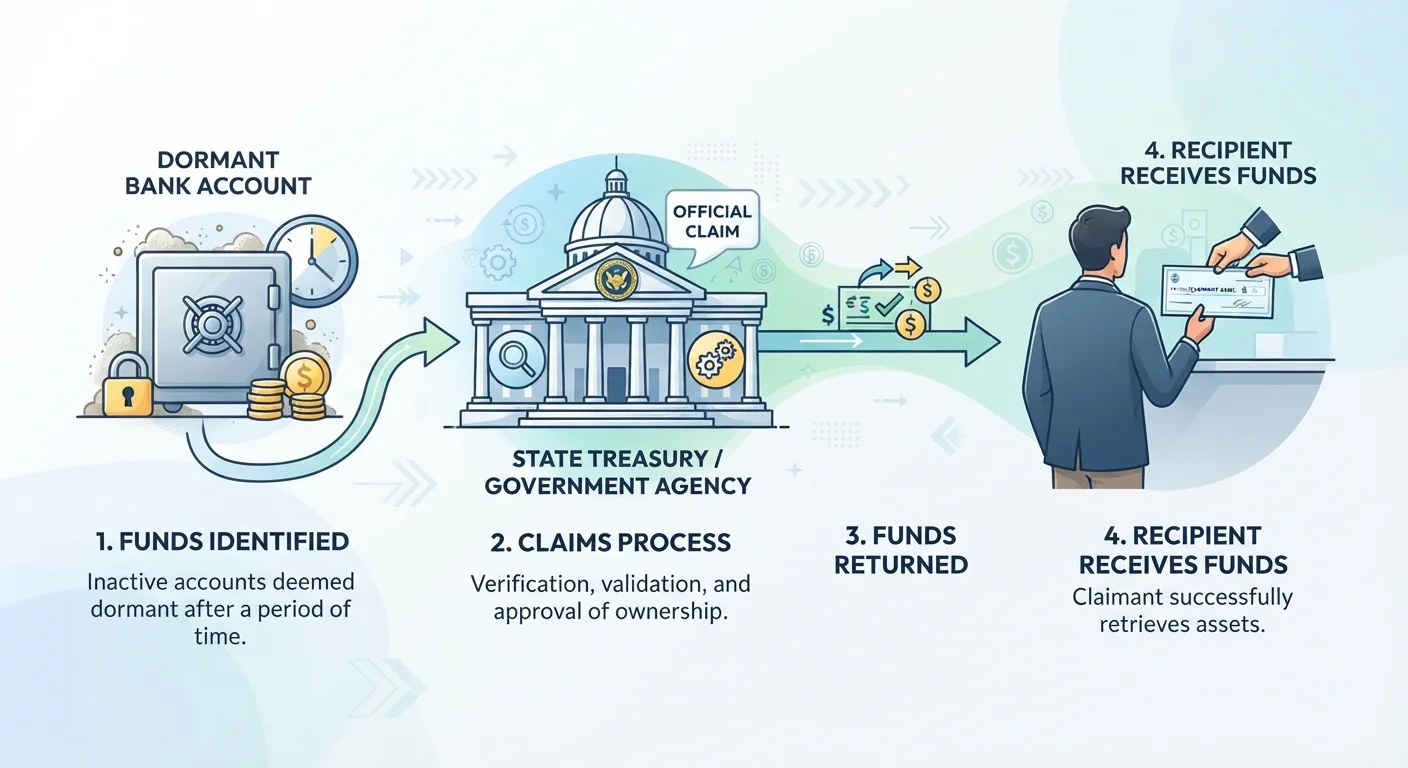
Photo: searchopenrecords editorial
—— In This Article
Key Takeaways
- Most financial accounts are classified as dormant after 3–5 years of owner inactivity.
- State governments hold unclaimed property indefinitely — the funds do not disappear or expire.
- Free, official databases at state treasurer sites and MissingMoney.com are the safest starting points.
- You will need identity and ownership documentation to successfully file a claim.
- Claims can take weeks to several months to process depending on the state and complexity.
- No legitimate government agency charges a fee to search for or claim your own property.
What Triggers the Dormancy Clock
Every piece of unclaimed property begins with a single event: the owner stops interacting with an account or asset. Banks, insurers, brokerage firms, utilities, and employers are all legally required to monitor customer accounts for activity. When an account shows no owner-initiated contact — no deposits, withdrawals, correspondence, or logins — for a set period, that account is reclassified as dormant.
The dormancy period varies by property type and state law, but common thresholds include:
- Bank accounts and certificates of deposit: typically 3–5 years of inactivity
- Uncashed payroll or dividend checks: often 1–3 years
- Life insurance benefits: generally 3–5 years after a policy matures or a death benefit becomes payable
- Stock shares and mutual funds: commonly 3–5 years without owner contact
Before reclassifying an account, holders are usually required to make a good-faith effort to locate the owner — typically by sending a written notice to the last known address. If that outreach goes unanswered, the dormancy period continues to run. For a plain-language introduction to every stage, see our beginner's overview of how the system works.
The Escheatment Process: How States Take Custody
Once the dormancy period expires, the holder — a bank, insurer, or other business — must transfer the property to the appropriate state government through a legal process called escheatment. The state with jurisdiction is generally the owner's last known address; if no address is on record, the holder's home state typically receives the funds.
Holders are required to file an annual report listing all escheatable property and then remit those assets to the state treasurer or unclaimed property division. This reporting cycle usually runs once per year, which is why newly dormant funds may not appear in a public database immediately.
Search for unclaimed property under every legal name you have ever used, including maiden names, hyphenated names, and previous business names — states index records exactly as the holder reported them.
A name mismatch is one of the most common reasons a legitimate owner fails to find their property in a database search, even when funds are present.
Run a search in every state where you have ever lived, worked, or held a financial account — not just your current state of residence.
Escheatment jurisdiction follows the owner's address on file with the original holder, which may reflect an address from years or decades ago.
It is important to understand that escheatment is not the same as forfeiture. The state holds the property on behalf of the rightful owner indefinitely. Unlike most government seizures, unclaimed property laws are designed specifically to protect owners, not to deprive them of assets. For a detailed look at the step-by-step sequence leading to escheatment, see the timeline of the unclaimed funds process.
Where the Money Lives: State Databases and National Registries
After a state takes custody of unclaimed property, it enters the information into a publicly searchable database. There are two primary ways to search:
- Your state treasurer's website: Each state maintains its own portal. Search for your state's unclaimed property division through its official .gov website.
- MissingMoney.com: A multi-state search tool endorsed by the National Association of Unclaimed Property Administrators (NAUPA) that queries participating state databases simultaneously.
For federal-level funds — such as forgotten U.S. savings bonds — the U.S. Treasury's TreasuryDirect portal and the Bureau of the Fiscal Service's tools handle searches separately from state systems. The IRS also holds unclaimed tax refunds for a statutory period before they revert to the general fund, making timely filing essential.
Property descriptions in these databases are intentionally limited for privacy reasons. You will typically see a property type, approximate value range, and the name of the original holder — enough to recognize a legitimate match without exposing full account details publicly. To understand how forgotten dollars move from private hands to public record, that linked guide traces the journey in fuller detail.
Filing a Claim: Documents, Steps, and Timelines
Finding a match is only the beginning. To release funds, states require claimants to prove both identity and rightful ownership. The specific documents vary, but you should generally expect to provide:
- A government-issued photo ID (driver's license, passport)
- Proof of your Social Security number
- Documentation linking you to the property (old account statements, a policy number, a former employer's pay stub)
- Proof of address history if the property is from a previous state of residence
For inherited property or claims on behalf of a deceased relative, additional documentation — such as a death certificate, letters testamentary, or probate court documentation — is typically required.
Most states now offer online claim submissions through their official portals, though some require paper forms for complex or high-value claims. Processing times vary widely: straightforward claims may resolve in four to eight weeks, while estates or disputed ownership can take several months. For a thorough walkthrough of what happens after you locate funds, see how the unclaimed property claims process actually works and the Claiming Your Money hub for supporting guides.
After Approval: How Funds Are Paid Out
Once a state reviews and approves a claim, it issues payment directly to the verified owner. Payment methods differ by state but typically include a check mailed to the claimant's verified address or, increasingly, an electronic funds transfer. States do not charge a fee to release approved funds — the full amount held on your behalf is returned.
For tangible property such as the contents of a safe-deposit box, the process may involve scheduling a pick-up or arranging shipping for specific items. Securities like stocks are generally liquidated before transfer unless the state has specific provisions for in-kind return.
For a comprehensive look at the full arc — from escheatment through payment — the full lifecycle of an unclaimed property claim covers each stage in depth.
This article is for general informational purposes only and does not constitute legal, tax, or financial advice. For guidance specific to your situation, consult a qualified professional.
Common Pitfalls and How to Avoid Them
The unclaimed property process is straightforward, but several common mistakes slow claims down or expose claimants to fraud:
- Using third-party finders without scrutiny
- Private "heir finder" or "asset locator" companies are legal in most states but charge fees — sometimes 10–30% of the recovered amount. Because searching official databases is free, independent searching is always worth attempting first. Some states cap the fees these companies can charge; check your state's rules before signing any agreement.
- Searching only one state
- Property escheats to the state of your last known address on file with the holder — which may not be where you currently live. Search every state where you have lived or worked.
- Ignoring maiden names or former business names
- Property may be listed under a name you no longer use. Search all legal names you have ever used.
- Falling for impersonators
- Legitimate state agencies will never call, email, or text you unsolicited demanding payment to release your funds. If an outreach requires upfront payment, it is a scam.
Staying within official channels — state treasurer portals, MissingMoney.com, and federal databases — protects you from both fraud and unnecessary fees. The How Unclaimed Money Works hub provides additional context on each stage of this process.

Unclaimed Money Editorial Team
Unclaimed Money Editorial Team is the collective byline for our editorial team and contributor network. Articles published under this byline or an editorial pen name are researched, written, and reviewed according to our editorial standards for clarity, consistency, and independence before publication.
View author profile