
Third-Party Finders vs. Claiming Directly: Understanding the Trade-offs
Some companies offer to file claims on your behalf for a fee. Here's a balanced look at what you gain and give up compared to filing yourself.
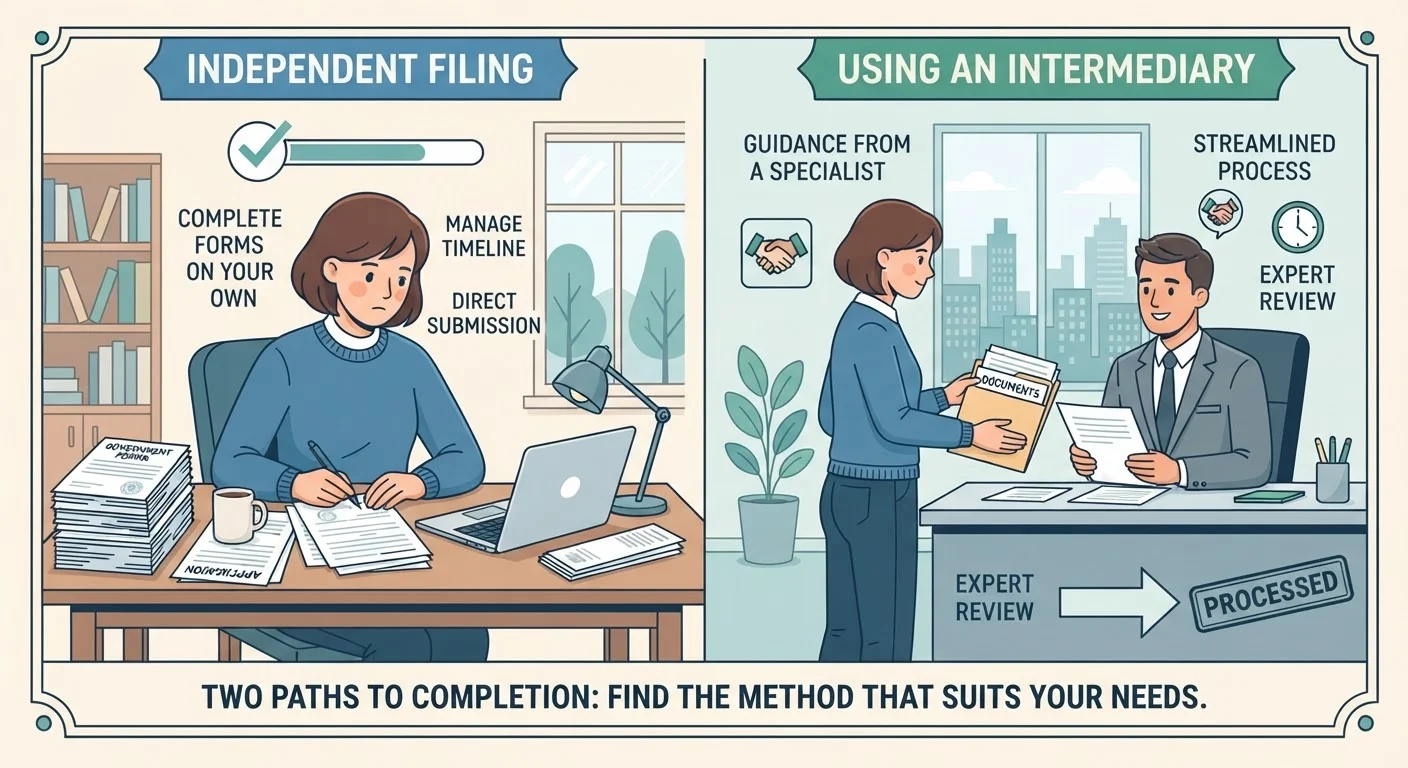
Photo: searchopenrecords editorial
—— In This Article
Key Takeaways
- State unclaimed property databases are free to search and free to claim through directly.
- Third-party finders typically charge 10–40% of recovered funds as their fee.
- For most straightforward claims, the DIY route saves money and is no more difficult.
- Finders may add value in complex estate claims or multi-state searches across many years.
- Always verify a finder's legitimacy and read contract terms before signing anything.
Handles documentation assembly on your behalf
Finders compile identity verification, ownership proof, and state-specific forms into a single submission package, which can reduce back-and-forth with state agencies.
Useful for multi-state or multi-decade searches
For estates spanning several jurisdictions and years, a finder's consolidated search may surface accounts that a self-directed search would miss.
Proactive outreach alerts you to unknown funds
If you were unaware the property existed, a finder's letter may be what prompts you to act — though you should always verify independently before signing any contract.
Can reduce administrative burden for complex claims
In estate or business claims involving probate documentation or dissolved-entity records, outsourcing the paperwork may save significant time.
Fees reduce your total recovery significantly
Finder fees commonly range from 10% to 40% of recovered funds — money you would receive in full by filing directly through an official state portal.
The official process is free and not especially complex
Most individual claims involve a standard identity verification and can be completed online in under an hour, making paid assistance unnecessary for straightforward cases.
Contract terms may limit your options
Once you sign a finder agreement, you may be contractually obligated to pay the fee even if you later realize you could have filed independently — read all terms carefully.
Some operators are predatory or misleading
Unregulated finders may obscure the state holding your funds until after you've signed, or charge fees on amounts where state law caps are not enforced.
State fee caps don't apply everywhere
Finder fee regulations vary by state — some cap fees at 10–15%, while others have no cap at all, leaving consumers exposed to very high percentage charges.
The Core Distinction: Free Process vs. Paid Convenience
Every U.S. state maintains a custodial unclaimed property program. When financial accounts, insurance proceeds, or other assets go dormant, holders — banks, insurers, employers — transfer them to the state treasurer's office. The state holds the funds indefinitely, and the rightful owner (or their heirs) can claim them at no cost through official portals.
Third-party finders — sometimes called heir finders or asset recovery specialists — are private companies that locate unclaimed property on someone's behalf and file the claim for a percentage fee. Their existence is legal in most states, but regulation varies widely. Some states cap allowable fees; others do not.
The fundamental question is straightforward: if the official process is free, what exactly are you paying for when you hire a finder?
Handles documentation assembly on your behalf
Finders compile identity verification, ownership proof, and state-specific forms into a single submission package, which can reduce back-and-forth with state agencies.
Useful for multi-state or multi-decade searches
For estates spanning several jurisdictions and years, a finder's consolidated search may surface accounts that a self-directed search would miss.
Proactive outreach alerts you to unknown funds
If you were unaware the property existed, a finder's letter may be what prompts you to act — though you should always verify independently before signing any contract.
Can reduce administrative burden for complex claims
In estate or business claims involving probate documentation or dissolved-entity records, outsourcing the paperwork may save significant time.
What Third-Party Finders Actually Do
Legitimate finder services typically combine database searches across multiple states, compile documentation packages, and handle correspondence with state agencies. For a property owner who is unaware a claim exists, a finder may reach out proactively — sometimes by letter — alerting them to funds they didn't know were waiting.
This outreach model is where caution is warranted. If a company contacts you about unclaimed money but won't disclose the state or amount until you sign a contract, that is a red flag. Reputable finders disclose the state holding the funds; from that point, you can verify the claim yourself for free via official state database portals.
You Can Always Search First — For Free
Before signing any finder agreement, visit your state treasurer's official unclaimed property portal or MissingMoney.com — both are free. If you can locate the property yourself, you retain 100% of the recovered amount. As explained in our article on why legitimate searches are always free, no official government portal charges a search or claim fee. Paying a finder is only rational if the complexity of your specific claim genuinely justifies the cost.
Fees are the defining variable. Finder agreements commonly run 10% to 40% of the recovered amount. On a $500 claim, that's up to $200 in fees for a process you could complete yourself in under an hour. On a $50,000 estate claim involving five states and contested documentation, the calculus changes considerably.
Fees reduce your total recovery significantly
Finder fees commonly range from 10% to 40% of recovered funds — money you would receive in full by filing directly through an official state portal.
The official process is free and not especially complex
Most individual claims involve a standard identity verification and can be completed online in under an hour, making paid assistance unnecessary for straightforward cases.
Contract terms may limit your options
Once you sign a finder agreement, you may be contractually obligated to pay the fee even if you later realize you could have filed independently — read all terms carefully.
Some operators are predatory or misleading
Unregulated finders may obscure the state holding your funds until after you've signed, or charge fees on amounts where state law caps are not enforced.
State fee caps don't apply everywhere
Finder fee regulations vary by state — some cap fees at 10–15%, while others have no cap at all, leaving consumers exposed to very high percentage charges.
When Hiring a Finder May Make Practical Sense
Three scenarios genuinely tilt the trade-off toward using a professional:
- Complex estate claims. When a deceased relative held assets across multiple states over several decades, assembling probate documentation, letters of administration, and chain-of-ownership proof is time-consuming. Our guide to estate and family claims outlines what's typically required — and it's substantial.
- Business entity claims. Corporate dissolved entities, partnership distributions, and business escrow funds involve authorisation documentation that goes beyond individual claims. See how business claims differ from individual ones for context.
- High-value accounts with disputed ownership. Where competing heirs or legal ambiguity exist, a finder with legal affiliates may streamline a process that would otherwise require an attorney anyway.
Outside these scenarios, the DIY path is almost always the more economical choice.
$68B+
Total unclaimed property held by U.S. states
According to the National Association of Unclaimed Property Administrators (NAUPA), U.S. states collectively hold tens of billions in unclaimed property awaiting rightful owners.
10–40%
Typical third-party finder fee range
Finder fee percentages vary widely by company and state regulation; some states cap fees by statute while others impose no limit.
$0
Cost to search and file directly with the state
All 50 states provide free official search portals; filing a claim directly with the state treasurer's office carries no processing fee.
Filing Directly: What the Process Actually Involves
Claiming unclaimed property yourself is genuinely accessible. The standard steps are: search the relevant state's official portal (or MissingMoney.com for multi-state searches), identify a matching record, submit a claim with supporting identity documentation — typically a government-issued ID, Social Security number, and proof of the original account (such as an old statement or utility bill) — and then wait for the state to process and disburse.
Processing times range from a few weeks to several months depending on the state and claim complexity. Most states now offer an online portal that tracks claim status. For a full comparison of digital versus mail-based submission, see how online and mail claims compare.
The one concrete disadvantage of the DIY route is awareness: you only find property you know to look for. Finders actively scan on your behalf. Closing that gap yourself is simple — search your name in every state where you have ever lived or worked, using free portals.
This article is for general informational purposes only and does not constitute legal or financial advice. Consult a qualified attorney or financial adviser for guidance specific to your circumstances.

Unclaimed Money Editorial Team
Unclaimed Money Editorial Team is the collective byline for our editorial team and contributor network. Articles published under this byline or an editorial pen name are researched, written, and reviewed according to our editorial standards for clarity, consistency, and independence before publication.
View author profile