
Why the Same VIN Can Produce Different Reports from Different Sources
VIN report results can vary depending on which data sources a provider accesses. Understand why discrepancies occur and how to reconcile them.
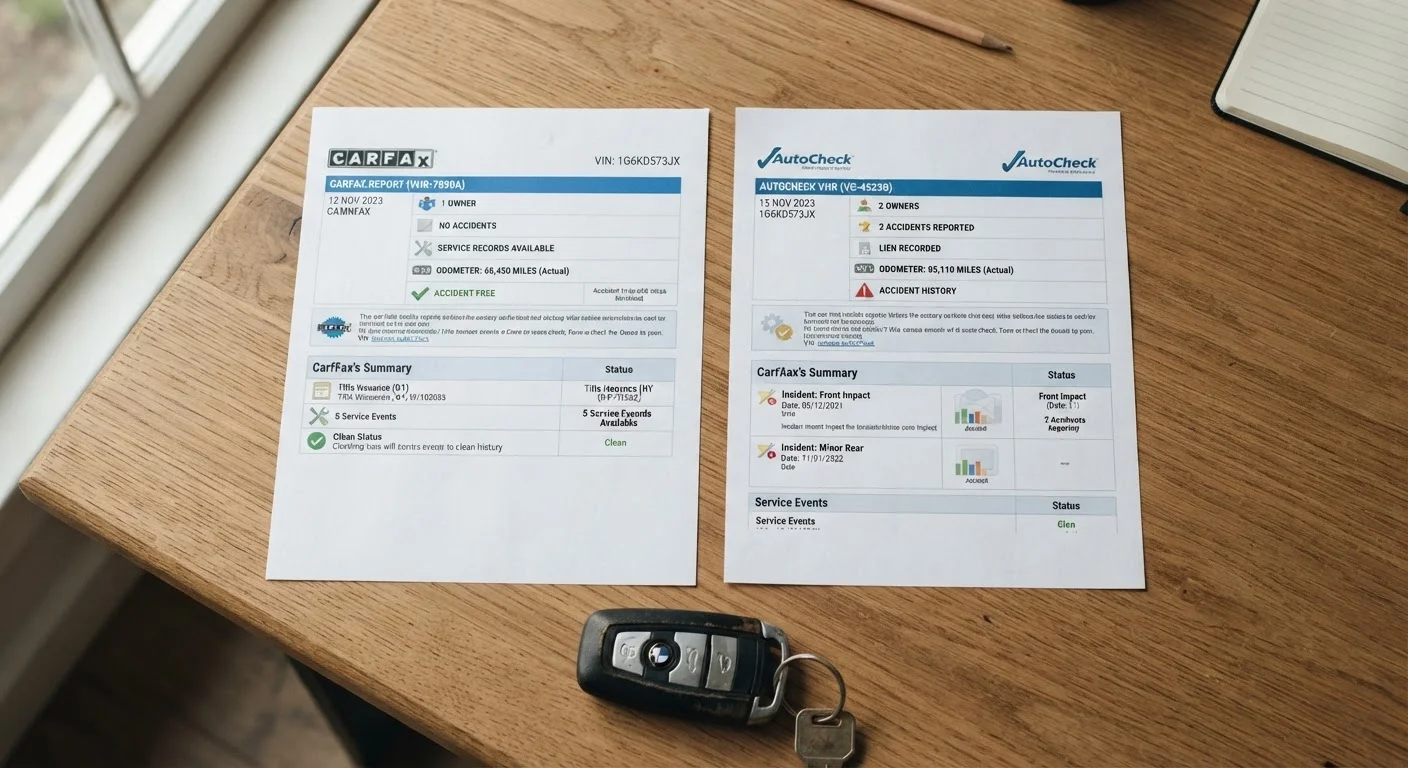
Photo: searchopenrecords editorial
—— In This Article
Key Takeaways
- No single VIN report provider accesses every data source that tracks vehicle history.
- State DMV title records, insurance claims, and salvage data each flow through separate pipelines with different update schedules.
- An incident not reported to a covered source will be absent from a report, even if it actually occurred.
- Comparing reports from multiple sources can reveal gaps that any single report might miss.
- A clean report does not guarantee a clean history — it confirms only what was reported and captured.
How VIN Data Is Collected — and Why Gaps Exist
Every vehicle history report begins with the same 17-character VIN assigned by the manufacturer at the point of production. That VIN is a permanent identifier standardized under NHTSA regulations. What varies dramatically is not the VIN itself — it's the data that gets attached to it over time, and which provider manages to collect that data.
Vehicle history is not stored in one centralized federal database. Instead, records accumulate across dozens of independent systems: state DMV title registries, insurance company claims databases, salvage and auction yard records, auto inspection stations, fleet management systems, and collision repair networks. Each of these systems operates independently, with its own reporting timelines, access rules, and geographic scope.
VIN report providers license access to subsets of these sources. No provider holds contracts with every state DMV, every insurer, and every auction network simultaneously. The result is that Provider A may have deep coverage of insurance claim data but limited auction records, while Provider B has broader salvage auction coverage but fewer insurer partnerships. For the same VIN, each will return what it can see — and nothing more.
This is not a sign of fraud or error. It is the structural reality of how vehicle data flows through the US public and private records ecosystem. Understanding it helps you read any report more critically. For a broader look at how this dynamic plays out across public records generally, see our article on why public records results sometimes contradict each other.
The Most Common Sources of Conflicting Information
Certain categories of vehicle data are more prone to discrepancies than others. Knowing where conflicts most often appear helps you focus your verification efforts.
50+
Independent state DMV title systems in the US
Each US state and territory maintains its own vehicle title registry with independent update schedules and data-sharing policies, meaning no single provider can access all of them uniformly.
~25%
Accidents estimated to go unreported to insurers
Industry research has consistently suggested that a significant share of minor collisions are settled privately, generating no insurance claim and therefore no data for VIN report databases to collect.
Weeks to months
Typical lag for title data to reach report providers
State DMV processing times and licensing update cycles mean title transfers, lien releases, and brand assignments often take weeks or longer to appear in third-party VIN reports.
Accident and Damage Records
Collision data enters the system only when a police report is filed or an insurance claim is submitted to a carrier that shares data with aggregators. A fender-bender settled privately between drivers, or repaired by a body shop that doesn't report to any aggregator network, will not appear in any report. One provider may have a partnership with a particular regional insurer whose claims another provider never sees.
Title Brand and Salvage Status
Title brands — designations such as "salvage," "flood," or "rebuilt" — are recorded at the state level. Because titling rules differ state by state, a vehicle that received a salvage brand in one state and was then re-titled in another may show the brand inconsistently across reports, depending on whether a provider captures interstate title transfer records. Learn more about how VINs connect to title records in the VIN & Title Records hub.
Ownership History
Ownership count discrepancies often stem from how providers define an "owner" and how promptly state DMV transfer records are processed and licensed. A lease returned to a dealership, then sold at auction, may count as one, two, or three owners depending on the methodology a provider applies and which state records they have ingested.
What a Clean Report Actually Means
A report with no accidents, no title brands, and a consistent ownership chain is meaningful — but it has a specific, limited meaning. It means that within the data sources that particular provider accesses, no adverse events were recorded against that VIN. It does not mean no adverse events occurred.
This distinction matters most when evaluating used vehicles with significant mileage or a history of private-party sales, where the likelihood of unreported incidents is higher. The limits of what a VIN search can find extend beyond any single provider's coverage — some incidents simply generate no reportable data at all.
Use Reports as a Starting Point, Not an Endpoint
When evaluating a used vehicle, treat any VIN report as a lead-generation tool rather than a final verdict. Flag anything that appears — or conspicuously doesn't appear — and follow up through official channels. A state DMV title check and a professional mechanical inspection address the gaps that no database can fill.
For a grounded understanding of what VIN data can and cannot guarantee, the common VIN misconceptions article addresses several widespread misreadings of what a report confirms.
How to Reconcile Conflicting VIN Reports
When two reports diverge, a methodical approach helps you move from confusion to clarity.
- Treat additional detail as additive, not contradictory. If Report A shows an accident that Report B omits, assume the event occurred and investigate further — don't assume Report B is correct simply because it shows less.
- Verify title status directly with the state DMV. For title brands and lien status, the authoritative source is always the issuing state's DMV, not any third-party report. Most state DMVs provide title history lookup tools or can confirm status on request.
- Request a pre-purchase inspection. A qualified mechanic performing a physical inspection can identify structural repair evidence, paint overspray, or misaligned panels that no database records — and no report can capture.
- Compare the VIN decoded specifications. Use the NHTSA VIN decoder at vpic.nhtsa.dot.gov to confirm manufacturer-level specifications. This data is derived directly from manufacturer submissions and is not subject to provider variation. See our guide on avoiding errors in VIN lookups for practical steps.
No single report — regardless of source — should be the sole basis for a vehicle purchase decision. Reports are one input among several, best used alongside physical inspection and direct title verification.
Frequently Asked Questions

Vin Search Editorial Team
VIN Search Editorial Team is the collective byline for our editorial team and contributor network. Articles published under this byline or an editorial pen name are researched, written, and reviewed according to our editorial standards for clarity, consistency, and independence before publication.
View author profile