
DNA Evidence and Paper Records: How the Two Complement Each Other in Genealogy
DNA results can confirm or challenge documentary findings. Understand what each source type proves and how to use them together responsibly.
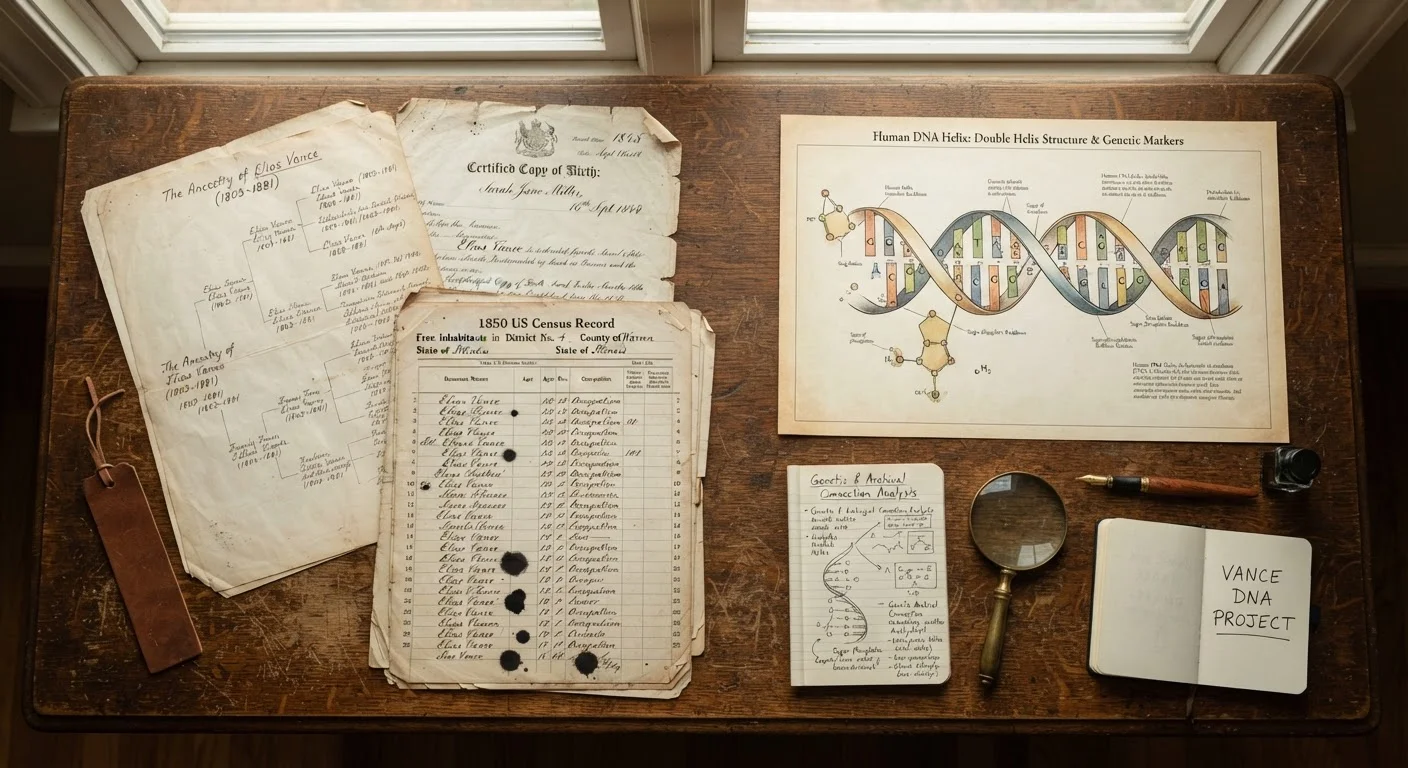
Photo: searchopenrecords editorial
—— In This Article
Key Takeaways
- Paper records establish names, dates, and legal relationships; DNA confirms biological ones.
- DNA evidence alone cannot name ancestors or place them in a time and location.
- Documentary records can be falsified or incomplete; DNA provides an independent check.
- Combining both source types is the most reliable method for resolving uncertain ancestry.
- Conflicts between DNA and paper records require careful analysis, not immediate conclusions.
What Each Source Type Actually Proves
Genealogical research has always depended on paper: birth certificates, marriage registers, census schedules, church baptismal records, and immigration manifests. These documents create a named, dated, and located record of a person's life and legal relationships. When records survive and are accurate, they provide a clear chain of identity across generations.
DNA evidence operates differently. A shared genetic segment between two people confirms that they share a common biological ancestor — but it does not say who that ancestor was, when they lived, or where. DNA is a biological measurement, not a narrative. It answers the question are these people related? rather than who are they?
This distinction matters enormously in practice. A birth certificate can name a father; DNA can confirm whether that named individual is the biological father. A ship manifest can show a surname and origin country; DNA ethnicity estimates can suggest broad regional ancestry consistent — or inconsistent — with the documentary record. Neither source makes the other redundant. See the DNA & Ancestry Tools hub for a broader overview of how genetic and digital tools work together.
Where Paper Records Have Limitations
Documentary evidence has well-known weaknesses. Records were destroyed in courthouse fires, floods, and wars. Clerks recorded names phonetically, producing spelling variations that can hide ancestors behind unfamiliar surnames. Informants on death certificates — often grieving relatives — sometimes provided incorrect birth dates or parentage. And in cases of adoption, non-paternity events, or informal family arrangements, the paper record may reflect a social reality rather than a biological one.
Digitization has not eliminated these gaps. Many collections remain unindexed or accessible only in person. Rural and minority communities are often underrepresented in surviving records. Researchers working on pre-1850 American ancestry, for instance, frequently encounter census years that listed only the head of household by name, leaving other family members invisible.
Record Gaps Are Common — Not Exceptional
Researchers often assume that missing records indicate a problem with their methodology. In reality, gaps are a structural feature of historical documentation. Courthouse fires, wartime destruction, and inconsistent recording practices across states and counties mean that incomplete paper trails are the norm rather than the exception. DNA evidence is not a last resort — it is a standard research tool for navigating these gaps.
In these situations, DNA evidence can be transformative. A cluster of DNA matches sharing a common surname or geographic origin can point a researcher toward an ancestral line that the paper trail alone cannot illuminate. This is particularly powerful when digitised records are paired with DNA data — each source sharpening the interpretation of the other.
Where DNA Evidence Has Limitations
DNA results are probabilistic, not definitive. Shared centimorgans — the unit used to measure genetic overlap — indicate a range of possible relationships, not a single confirmed one. A match sharing 1,700 centimorgans could be a half-sibling, grandparent, aunt, or double first cousin. Without documentary evidence to narrow the field, the relationship remains ambiguous.
Ethnicity estimates carry additional uncertainty. They are calculated by comparing a person's DNA against reference populations, which vary by testing company and are revised as databases grow. An estimate showing 30% Irish ancestry is a statistical approximation, not a genealogical finding.
Database size also affects usefulness. DNA matching depends on other tested individuals appearing in the same database. Some ancestral lines — particularly those from regions with lower testing rates — may produce few or no useful matches regardless of how complete a researcher's paper trail is. For a balanced view of DNA testing's strengths and trade-offs, see our article on the case for and against DNA testing.
~1 in 7
People with unexpected close DNA matches
Research published in genealogical literature suggests roughly 1 in 7 people who take autosomal DNA tests discover a close match that contradicts their known family history, highlighting how often paper records and biology diverge.
5–6 generations
Reliable range of autosomal DNA matching
Autosomal DNA tests are generally considered reliable for identifying shared ancestors within five to six generations; beyond that, shared segments may fall below detectable thresholds.
Thousands
U.S. county courthouses destroyed since 1776
Historians and archivists estimate that thousands of U.S. county courthouses have experienced record-destroying fires, floods, or conflicts since the colonial period, creating structural gaps in the documentary record that DNA evidence can help bridge.
Using Both Sources Together Responsibly
The most effective genealogical workflow treats DNA and paper records as two legs of the same argument. A hypothesis about a family relationship should be supported by both a documentary chain of evidence and a DNA match consistent with the proposed relationship. When both agree, confidence is high. When they conflict, further research is needed — not a hasty conclusion.
Practically, this means building the paper trail first where possible. Identify the individuals in question, establish their approximate birth years and locations, and map out what the documentary evidence says about their relationship. Then examine DNA matches: do the shared segments align with what the paper record predicts? Are there unexpected matches suggesting an alternative explanation?
Understanding how DNA testing fits into traditional genealogy research helps set appropriate expectations for what each source can and cannot resolve. For those ready to integrate both approaches systematically, the end-to-end guide to DNA and digital records provides a structured framework. Building a verified family tree ultimately requires both types of evidence working in concert.
Frequently Asked Questions

Genealogy Search Editorial Team
Genealogy Search Editorial Team is the collective byline for our editorial team and contributor network. Articles published under this byline or an editorial pen name are researched, written, and reviewed according to our editorial standards for clarity, consistency, and independence before publication.
View author profile