
How DNA Testing Fits Into Traditional Genealogy Research
Understand how DNA test results complement paper records, census data, and oral history to build a more complete family tree.
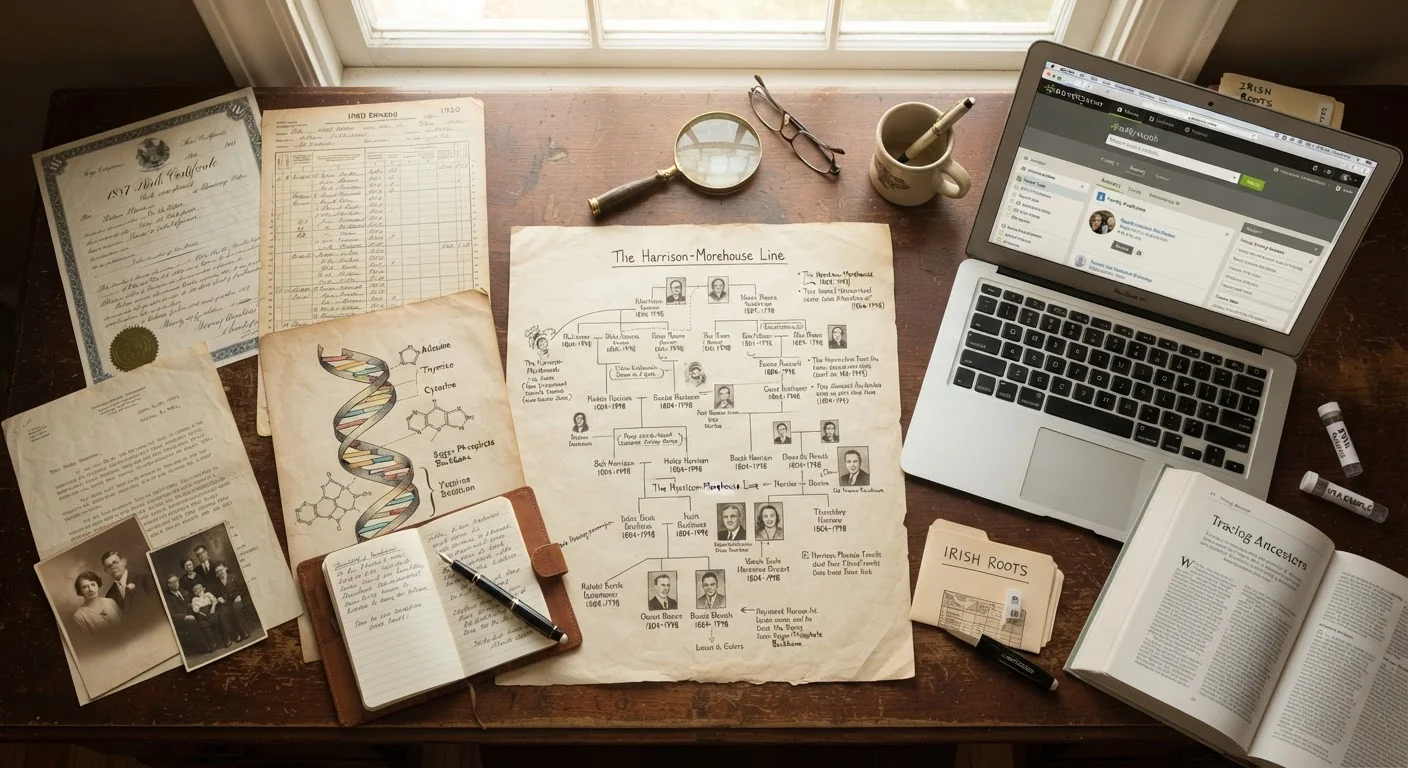
Photo: searchopenrecords editorial
—— In This Article
Key Takeaways
- DNA testing is most powerful when combined with paper records, not used as a standalone source.
- Different DNA test types trace different ancestral lines, so test selection affects what you can discover.
- DNA matches can break through "brick wall" ancestors where documents have been lost or never created.
- Ethnicity estimates are broad population approximations, not precise genealogical proof of specific ancestry.
- Conflicts between DNA results and paper records are common and require careful, methodical interpretation.
The Limits of Paper Records Alone
Traditional genealogy depends on documents: birth certificates, marriage registers, census schedules, immigration manifests, and church records. When those records survive and are accessible, they can build a remarkably detailed family history going back centuries. The problem is that records frequently do not survive. Fires, floods, wars, administrative gaps, and the simple absence of formal record-keeping in many communities leave researchers staring at what genealogists call a brick wall — an ancestor they cannot push further back through documents alone.
Even when records exist, they can mislead. Name spellings varied wildly, ages were misreported, and family relationships were sometimes obscured deliberately. A census entry listing a child as a biological offspring may conceal an informal adoption. A marriage record may reflect a second marriage without noting a prior one. Documents record what people reported, not necessarily what was biologically true.
This is the gap that DNA evidence is specifically positioned to fill. It offers a biological record that exists independently of what any clerk wrote down. For researchers working on tracing family roots, understanding where documents end and DNA evidence begins is foundational to effective research strategy.
What DNA Testing Actually Adds
A consumer genealogy DNA test produces two main outputs: a set of DNA matches (other tested individuals who share segments of DNA with you) and an ethnicity estimate (a broad population breakdown of your ancestry). These serve very different research purposes, and conflating them is one of the most common mistakes new researchers make.
DNA matches are the more genealogically actionable result. When you share a measurable segment of DNA with another person in a database, it indicates a common ancestor — and the amount of shared DNA gives a rough estimate of how distant that relationship is. By comparing your matches to your documented family tree, you can identify which matches belong to which family lines, then work backward to find shared ancestors you may not yet have documented.
~30 million
Consumer DNA tests taken globally by 2023
Industry analysts estimated that consumer genealogy DNA databases collectively held data from approximately 30 million people by 2023, creating large match pools for genealogical research.
5–6 generations
Typical autosomal DNA reach for relationship detection
Autosomal DNA testing is generally reliable for identifying shared ancestors within five to six generations; beyond that, shared segments may not be detectable due to recombination over time.
~1,700
Years of records lost in the 1922 Dublin fire
The destruction of the Irish Public Record Office in 1922 eliminated census, church, and civil records spanning centuries, illustrating why DNA evidence is critical for Irish genealogy research.
The ethnicity estimate, by contrast, is a statistical approximation. It reflects broad geographic patterns in your DNA relative to reference populations, and it can shift as databases expand. It is a useful conversation starter with your paper research, but it is not genealogical proof. For a deeper explanation of how these two outputs differ, see ethnicity estimates vs. DNA matches.
Different test types also serve different research goals. Autosomal tests reach all ancestral lines but grow less reliable beyond five or six generations. Y-DNA tests follow the direct patrilineal line, useful for surname research. Mitochondrial DNA traces the direct matrilineal line across many generations. Choosing the right test for your specific research question matters enormously — a point covered in detail in our guide to autosomal, Y-DNA, and mitochondrial tests.
Integrating DNA With Your Existing Research
The most effective approach treats DNA results and paper records as two separate evidence streams that must be reconciled, not two versions of the same answer. Begin by anchoring your DNA matches to your documented tree. If a match shares a surname cluster with a known branch of your family, that connection — confirmed by both biological and documentary evidence — is far stronger than either alone.
When you encounter a DNA match you cannot place, the process mirrors traditional genealogy: build out that match's tree using public records, look for geographic or surname overlaps with your own documented ancestors, and check for shared matches that might triangulate the connection. Tools like clustering group your matches by likely family line, making large match lists more manageable. Our walkthrough on shared matches and clustering explains this method step by step.
Census records, digitized vital records, and immigration documents take on new meaning when paired with DNA data. A ship manifest that places an ancestor in a specific port city in a specific year becomes more powerful when a DNA match's tree places a related family in the same location. For practical guidance on this cross-referencing process, see our article on using digitised records alongside DNA evidence.
It is equally important to understand what DNA cannot do. It cannot name your ancestors, confirm specific family stories, or resolve every discrepancy. Our companion article on what genealogy DNA tests cannot tell you is essential reading for keeping results in proper perspective. For a comprehensive end-to-end strategy combining both approaches, the guide on DNA and digital records together is a natural next step.
Frequently Asked Questions

Genealogy Search Editorial Team
Genealogy Search Editorial Team is the collective byline for our editorial team and contributor network. Articles published under this byline or an editorial pen name are researched, written, and reviewed according to our editorial standards for clarity, consistency, and independence before publication.
View author profile