
Autosomal, Y-DNA, and Mitochondrial Tests: What Each One Actually Reveals
A plain-language breakdown of the three main DNA test types and the specific ancestral lines each one can—and cannot—trace.
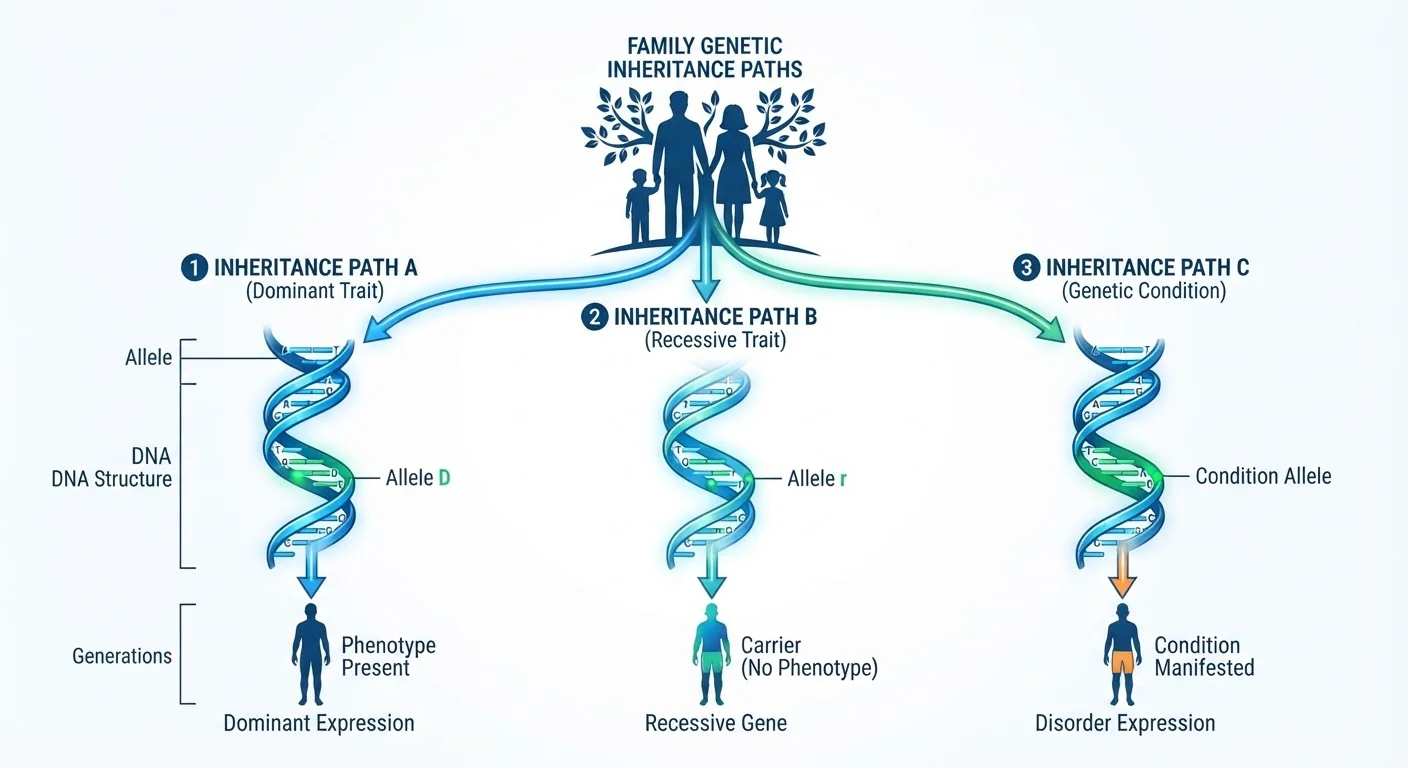
Photo: searchopenrecords editorial
—— In This Article
Three Tests, Three Ancestral Windows
Choosing a DNA test for genealogy isn't a one-size-fits-all decision. The three main test types — autosomal, Y-DNA, and mitochondrial (mtDNA) — each examine a different segment of your genome and trace a distinct line of ancestry. Understanding what each one actually measures helps you match the right tool to your research question.
| Autosomal DNA useful range | 4–6 generations (International Society of Genetic Genealogy (ISOGG) guidelines) |
| Y-DNA carriers | Biological males only |
| mtDNA passed on by | Biological mothers to all children; only daughters transmit it |
| Lines traced by Y-DNA | Strict paternal line only |
| Lines traced by mtDNA | Strict maternal line only |
| Lines traced by autosomal | All branches of the family tree |
For a broader look at how DNA evidence fits alongside paper records, see how DNA testing fits into traditional genealogy research. If you're weighing whether to test at all, the case for and against DNA testing as a genealogy tool offers a balanced overview of the trade-offs.
Autosomal DNA: Your Broad Family Network
Autosomal DNA is inherited from both parents across all of your chromosomes (numbered 1–22), meaning it carries contributions from ancestors on every branch of your family tree. This makes it the most versatile of the three test types for general genealogical purposes.
What it reveals
- Cousin matches going back roughly four to six generations on any branch
- Ethnicity estimates broken down by broad geographic regions
- Shared DNA segments useful for confirming documented relationships
Key limitations
Because DNA is reshuffled (recombined) with each generation, autosomal evidence becomes statistically unreliable beyond about six generations. You may share no detectable DNA with a legitimate seventh-generation cousin simply due to inheritance chance — not because the family connection is wrong.
Autosomal DNA
DNA inherited from both parents across chromosomes 1–22. It carries genetic material from all branches of a person's family tree and is the basis for cousin matching and ethnicity estimates.
Y-DNA
A chromosome passed exclusively from father to biological son. Because it changes very little over generations, it is used to trace direct paternal lineages and assign paternal haplogroups.
Mitochondrial DNA (mtDNA)
DNA found in cell mitochondria, inherited from the biological mother by all her children. Only daughters pass it on, making it a marker for the unbroken direct maternal line.
Haplogroup
A genetic population group sharing a common ancient ancestor, identified through specific DNA mutations. Haplogroups indicate broad prehistoric geographic origins, not recent family relationships.
Recombination
The genetic reshuffling that occurs when chromosomes are passed from parent to child. It causes autosomal DNA evidence to become less reliable with each successive generation.
Non-Paternity Event (NPE)
A situation in which a child's documented surname father is not the biological father. NPEs can cause Y-DNA results to diverge from an expected surname lineage.
For a detailed look at where autosomal results fall short, see what genealogy DNA tests cannot tell you.
Y-DNA: The Paternal Line, Deep in Time
Y-DNA is passed virtually unchanged from father to son, generation after generation, following the strict paternal line. Only biological males carry a Y chromosome, so women who want paternal-line data need to test a male relative — a brother, father, or paternal uncle.
What it reveals
- Deep paternal-line ancestry stretching back hundreds or thousands of years
- Haplogroup assignment — a broad prehistoric population marker indicating ancient geographic origins
- Surname-project matching, which can confirm or challenge a documented male lineage
Key limitations
Y-DNA traces only one line out of every ancestral generation — your father's father's father's line, and so on. It tells you nothing about any other branch. It is also highly sensitive to non-paternity events (NPEs): if a son in that direct line was not the biological child of the man whose surname he carried, Y-DNA results will reflect the biological father's line, not the documented surname lineage.
Mitochondrial DNA: The Maternal Line Across Generations
Mitochondrial DNA (mtDNA) is inherited from mother to child — both sons and daughters receive it, but only daughters pass it on. This makes it the mirror image of Y-DNA: it follows the strict maternal line (your mother's mother's mother's line) with very little change across millennia.
What it reveals
- A maternal haplogroup indicating ancient geographic and population origins
- Confirmation that two individuals share the same unbroken maternal line
- Ancestral migration patterns in prehistoric populations
Key limitations
mtDNA mutates very slowly, which is a double-edged feature. Two people can share an exact mtDNA sequence but have a common maternal ancestor who lived several hundred years ago — making it difficult to identify a specific genealogical relationship without supporting documentary evidence. It is best used to confirm a known maternal connection or to break through a brick wall on that single line.
Ready to put these test types into practice? Genetic genealogy from the ground up walks through the first steps for new researchers, and ancestry record searches can supply the documentary evidence that DNA results need to become meaningful conclusions.

Genealogy Search Editorial Team
Genealogy Search Editorial Team is the collective byline for our editorial team and contributor network. Articles published under this byline or an editorial pen name are researched, written, and reviewed according to our editorial standards for clarity, consistency, and independence before publication.
View author profile