
Genetic Genealogy From the Ground Up
New to DNA-based family research? This guide explains the core concepts, test types, and first steps for turning results into a useful family tree.
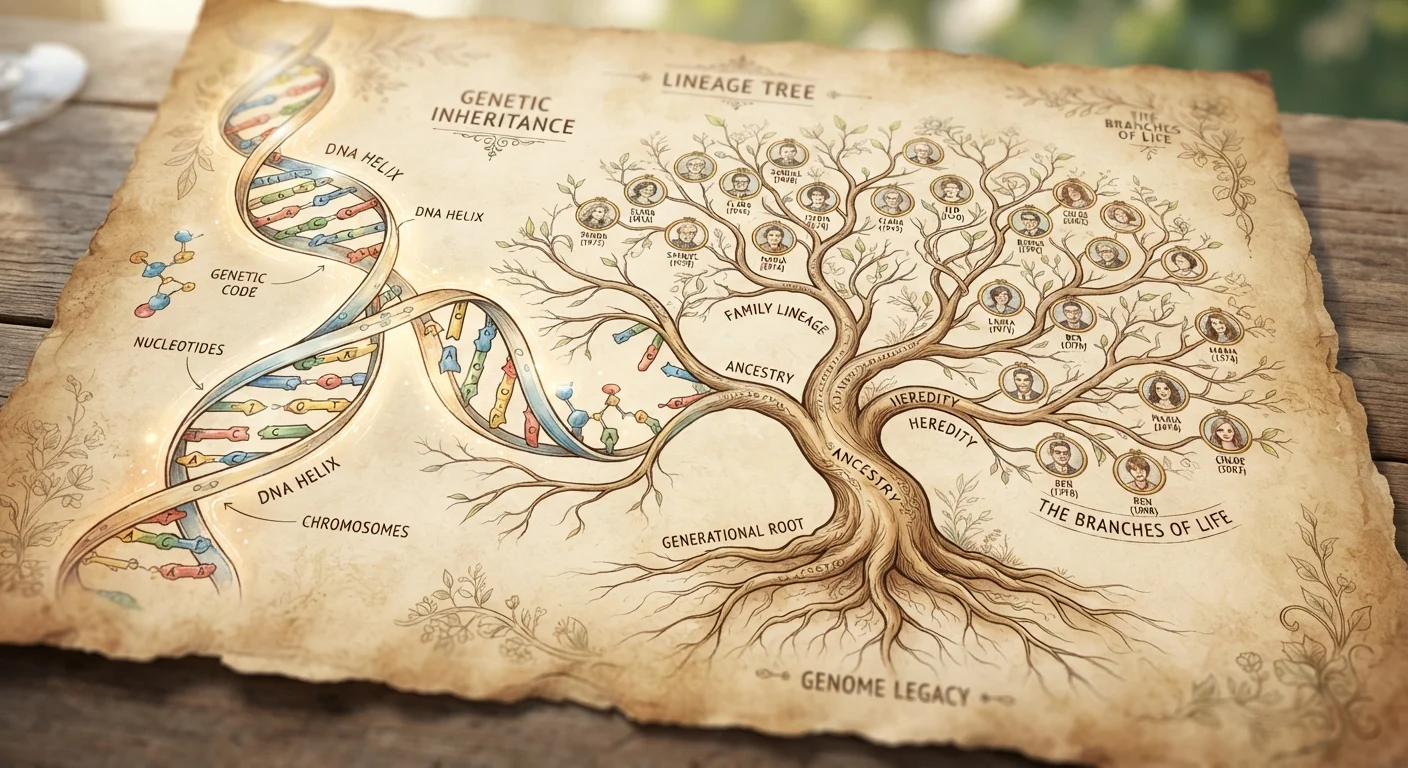
Photo: searchopenrecords editorial
—— In This Article
Key Takeaways
- Genetic genealogy uses DNA test results alongside traditional records to confirm or extend family trees.
- Three distinct test types — autosomal, Y-DNA, and mtDNA — answer different research questions.
- DNA matches indicate shared ancestry but require paper records to interpret accurately.
- Ethnicity estimates are population-level approximations, not precise geographic origins.
- Privacy trade-offs are real: testing connects you to relatives who may not have expected contact.
What Is Genetic Genealogy?
Genetic genealogy is the practice of using DNA test results — alongside traditional documentary evidence — to research family history. It doesn't replace census records, birth certificates, or immigration files; it works alongside them, filling gaps that paper trails can't always close.
The field became accessible to everyday researchers when consumer DNA testing launched in the early 2000s. Since then, millions of people have uploaded their results to shared databases, creating a global network of potential cousin matches. For beginners, the simplest way to think about it is this: your DNA carries inherited markers that you share, to varying degrees, with biological relatives. Testing detects those markers and compares them to others in the database.
If you're just starting your ancestry journey, our roadmap for first-time genealogy researchers is a useful companion to this guide.
Autosomal DNA
DNA inherited from both parents across all family lines, used to find relatives within approximately five to seven generations.
Centimorgan (cM)
A unit used to measure the length of shared DNA segments between two people. Higher cM values generally indicate a closer relationship.
Haplogroup
A genetic population group that shares a common ancestor from thousands of years ago, indicating ancient geographic migration patterns.
Endogamy
The practice of marrying within a specific community across many generations. It causes DNA relatives to appear more closely related than they actually are.
Ethnicity Estimate
A percentage breakdown of your DNA compared against reference populations. It's an approximation of broad geographic ancestry, not a precise origin map.
DNA Match
Another tested person who shares measurable DNA segments with you, suggesting you have a common ancestor somewhere in your family trees.
The Three Main DNA Test Types
Choosing the right test starts with understanding what each one measures.
- Autosomal DNA (atDNA): The most popular option. It examines the 22 pairs of non-sex chromosomes you inherited from both parents. Results surface matches across roughly five to seven generations on all family lines. Most beginners start here.
- Y-DNA: Passed from father to son with minimal change across generations. It traces the direct patrilineal line — your father's father's father, and so on. Useful for researching a specific surname or male line blocked by missing records.
- Mitochondrial DNA (mtDNA): Passed from mother to children of either sex, but only daughters pass it on further. It traces the direct matrilineal line across many generations, sometimes thousands of years. Less immediately useful for recent genealogy but valuable for deep ancestry research.
Each test type answers a different question. Most researchers eventually use more than one, but autosomal testing gives you the broadest immediate return for standard family history work. For a fuller look at how these tests integrate with document research, see how DNA testing fits into traditional genealogy research.
Reading Your Results: Matches, Ethnicity, and Haplogroups
Once results arrive, you'll typically see three categories of information.
DNA Matches
These are other tested individuals who share measurable DNA segments with you, indicating a probable common ancestor. Match strength is measured in centimorgans (cM) — the higher the number, the closer the likely relationship. A first cousin typically shares 550–1,200 cM; a second cousin roughly 40–360 cM. These are ranges, not fixed values, because DNA inheritance involves chance.
Ethnicity Estimates
Platforms compare your DNA against reference populations to generate a regional breakdown. These estimates are useful for broad orientation — discovering Scandinavian or West African ancestry you hadn't documented, for example — but they are approximations that shift as reference panels are updated. Treat them as a starting hypothesis, not a final answer.
Haplogroups
A haplogroup is a genetic population group sharing a common ancestor far back in human prehistory. Y-DNA and mtDNA tests assign you to a haplogroup that indicates ancient migration patterns. This is more relevant to deep ancestry than to finding a great-great-grandmother's maiden name.
A full glossary of genetic genealogy terms can help decode the vocabulary in your results report.
Combining DNA Evidence With Paper Records
DNA matches tell you that a relationship probably exists. Paper records tell you who the people are. Neither source is complete on its own.
A practical workflow for beginners:
- Identify your closest matches first. Start with anyone sharing over 200 cM and try to place them on a family tree using what you already know.
- Build or borrow a tree. Many matches attach trees to their profiles. Comparing surnames and locations can reveal the common ancestor you share.
- Verify with documents. Once you have a hypothesis — say, that a match descends from the same great-grandparents — confirm it using census records, vital records, or immigration documents.
- Use chromosome browsers where available. Some platforms let you compare which specific chromosome segments you share with multiple matches. This can confirm that two matches are related to you through the same ancestral line.
Start With What You Already Know
Before diving into match lists, document everything you already know about your family — names, birth places, and approximate dates. The more grounded your starting tree, the easier it is to place DNA matches correctly. Even rough information helps narrow down which branch of your family a match belongs to.
For a deeper look at the interplay between digital archives and DNA results, our end-to-end guide to modern family history research covers the full process.
Privacy, Limitations, and Ethical Considerations
Testing has real trade-offs worth thinking through before you submit a sample.
Privacy: Your DNA data is shared with a testing company and, if you opt in, with a match database. Relatives you've never met may contact you. Unexpected discoveries — unknown half-siblings, misattributed parentage — do occur. Review each platform's privacy and data-sharing policies carefully before testing.
Interpretive limits: DNA cannot prove a specific relationship without corroborating documents. Endogamy (when communities marry within a closed group across generations) inflates shared cM values and makes relationship prediction less reliable. Understanding what DNA tests cannot tell you is essential reading before drawing firm conclusions.
Informed consent: Testing a family member — particularly an elderly relative or a child — involves decisions that affect their genetic privacy, not just yours. The case for and against DNA testing offers a balanced view of these considerations.
Genetic genealogy is a powerful research tool when used thoughtfully. Paired with solid document research — explored further in our complete family tree research walkthrough — it gives you the best chance of building an accurate, well-supported family history.
Results Can Take Time to Interpret
Don't be discouraged if your match list doesn't immediately unlock new discoveries. Genetic genealogy often requires patience: matches may not have trees attached, or their trees may be incomplete. Revisiting your results over months as new people test and as you build more document evidence tends to yield better results than expecting instant answers.
Frequently Asked Questions

Genealogy Search Editorial Team
Genealogy Search Editorial Team is the collective byline for our editorial team and contributor network. Articles published under this byline or an editorial pen name are researched, written, and reviewed according to our editorial standards for clarity, consistency, and independence before publication.
View author profile