
Ethnicity Estimates vs. DNA Matches: Two Very Different Tools in One Report
Ethnicity percentages and cousin matches come from the same test but serve very different research purposes. Here's how to use each correctly.
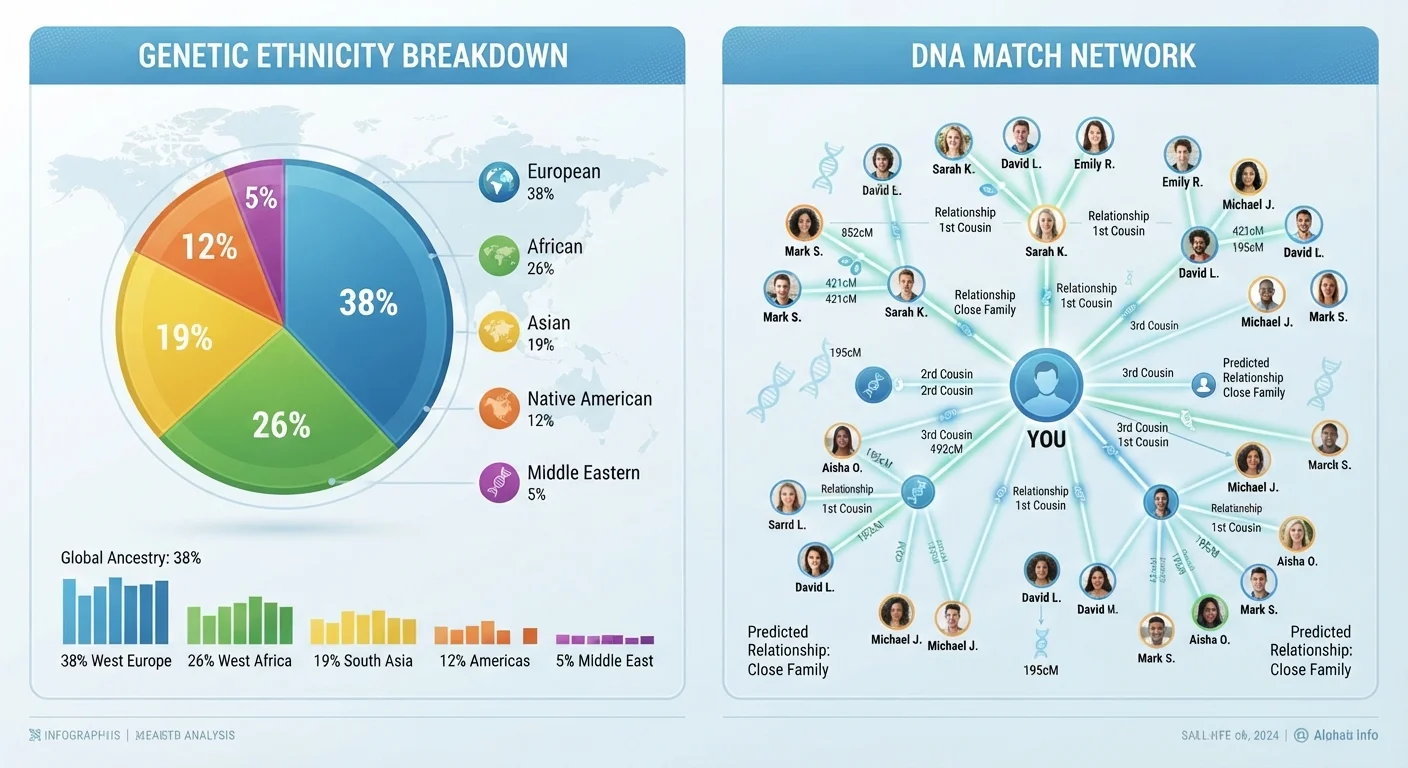
Photo: searchopenrecords editorial
—— In This Article
Key Takeaways
- Ethnicity estimates are probabilistic population snapshots, not genealogical proof of specific ancestors.
- DNA matches are based on shared chromosome segments and directly indicate a biological relationship.
- Ethnicity percentages shift when providers update their reference panels — matches do not work the same way.
- For solving genealogical problems, DNA matches almost always provide more actionable evidence than ethnicity estimates.
- Both tools work best when combined with traditional documentary research.
Same Test, Fundamentally Different Outputs
When a consumer DNA test returns results, it delivers two categories of information that look related but function very differently. Ethnicity estimates and DNA matches both appear in the same report, which leads many researchers to treat them as equally reliable or interchangeable. They are not.
Ethnicity estimates are generated by comparing your DNA to reference populations — groups of people whose ancestry is documented within specific geographic regions. The algorithm calculates the statistical probability that portions of your genome resemble those populations. The result is a percentage breakdown: "32% Scottish, 28% Nigerian, 40% Ashkenazi Jewish," for example. These figures are inherently probabilistic and are shaped by the size and composition of the provider's reference panel. As providers add more reference samples, the estimates update — sometimes substantially — without any change to your underlying DNA.
DNA matches, by contrast, identify specific individuals in the provider's database who share measurable segments of identical DNA with you. That shared DNA is inherited from a real common ancestor. The tool doesn't estimate probability — it detects a concrete, biological relationship. For this reason, DNA matches are the foundation of most serious genealogical DNA research. See our guide to integrating DNA with traditional research to understand where each fits in a complete methodology.
How Each Tool Is Calculated — and Why It Matters
Understanding the mechanics behind each feature clarifies why they serve such different purposes.
Ethnicity estimates use a process called admixture analysis. Your genome is divided into segments, and each segment is compared statistically to reference populations. Because human populations have mixed and migrated throughout history, these comparisons carry inherent uncertainty — particularly for regions with overlapping genetic signatures, such as neighboring European countries or populations with shared historical roots. A result showing "French" versus "German" ancestry, for instance, may reflect more about the reference panel's boundaries than about your actual forebears. Our article on evaluating the reliability of ethnicity estimates explores exactly how much weight these percentages can reasonably carry.
DNA matches use segment matching — the platform identifies stretches of DNA where your genome and another person's genome are identical by descent (IBD). The length of shared segments, measured in centimorgans (cM), correlates with how closely related you are. A match sharing 1,800 cM is likely a first cousin or half-sibling; one sharing 45 cM might be a second cousin twice removed. Understanding centimorgans is essential before drawing conclusions from any match list.
| Criterion | Ethnicity Estimates | DNA Matches |
|---|---|---|
| What it measures | Statistical similarity to reference populations | Shared DNA segments with specific individuals |
| Reliability for genealogy proof | Low — probabilistic, not documentary | High — indicates real biological relationship |
| Changes over time | Yes — updates with reference panel changes | Stable — segment data does not change |
| Best use case | Broad heritage exploration, hypothesis generation | Breaking brick walls, confirming relationships |
| Precision | Regional percentages, often broad | Named individuals with cM values |
| Actionable for research | Indirectly — guides document searches | Directly — links to real family trees |
When to Rely on Each — and When Not To
Ethnicity estimates work well for exploration and hypothesis generation. If you discover an unexpected regional percentage, it's a prompt to investigate further through documentary records — not a conclusion in itself. They are poor tools for proving any specific relationship or confirming that a particular ancestor was from a particular place.
DNA matches, by contrast, are among the most powerful tools available for resolving specific genealogical questions. When a brick wall in your paper trail stops you from identifying a great-great-grandparent, clustering your matches by shared segments can reveal which family line to investigate. The shared matches and clustering method is one of the most systematic ways to make sense of a large match list.
One common mistake is using ethnicity estimate shifts to "disprove" a family relationship — for example, concluding a grandparent wasn't Irish because the estimate shows only 3% Irish. Ancestry percentages are not apportioned evenly across grandparents; DNA inheritance is random, and a grandparent's heritage may be underrepresented or absent entirely in your estimate. For a balanced look at DNA testing's genuine strengths and its real interpretive limits, see the case for and against DNA testing as a genealogy tool.
When DNA matches do conflict with your documented paper trail, resist the impulse to dismiss either source immediately. Unexpected conflicts between DNA and paper records require careful, methodical investigation — not a quick judgment.
Ethnicity Estimates Are Not Fixed Facts
Several major DNA testing providers have updated their ethnicity estimate algorithms multiple times, sometimes causing a user's regional percentages to shift by 10 percentage points or more between updates. This does not mean your DNA changed — it means the reference panel improved. Treat ethnicity estimates as an evolving interpretation, not a permanent genealogical record. Documentary evidence from censuses, vital records, and immigration files remains the standard for proving ancestry.

Genealogy Search Editorial Team
Genealogy Search Editorial Team is the collective byline for our editorial team and contributor network. Articles published under this byline or an editorial pen name are researched, written, and reviewed according to our editorial standards for clarity, consistency, and independence before publication.
View author profile