
Shared Matches and Clustering: Making Sense of a Large DNA Match List
Hundreds of DNA matches can feel overwhelming. Clustering groups related matches together so you can identify family lines more systematically.
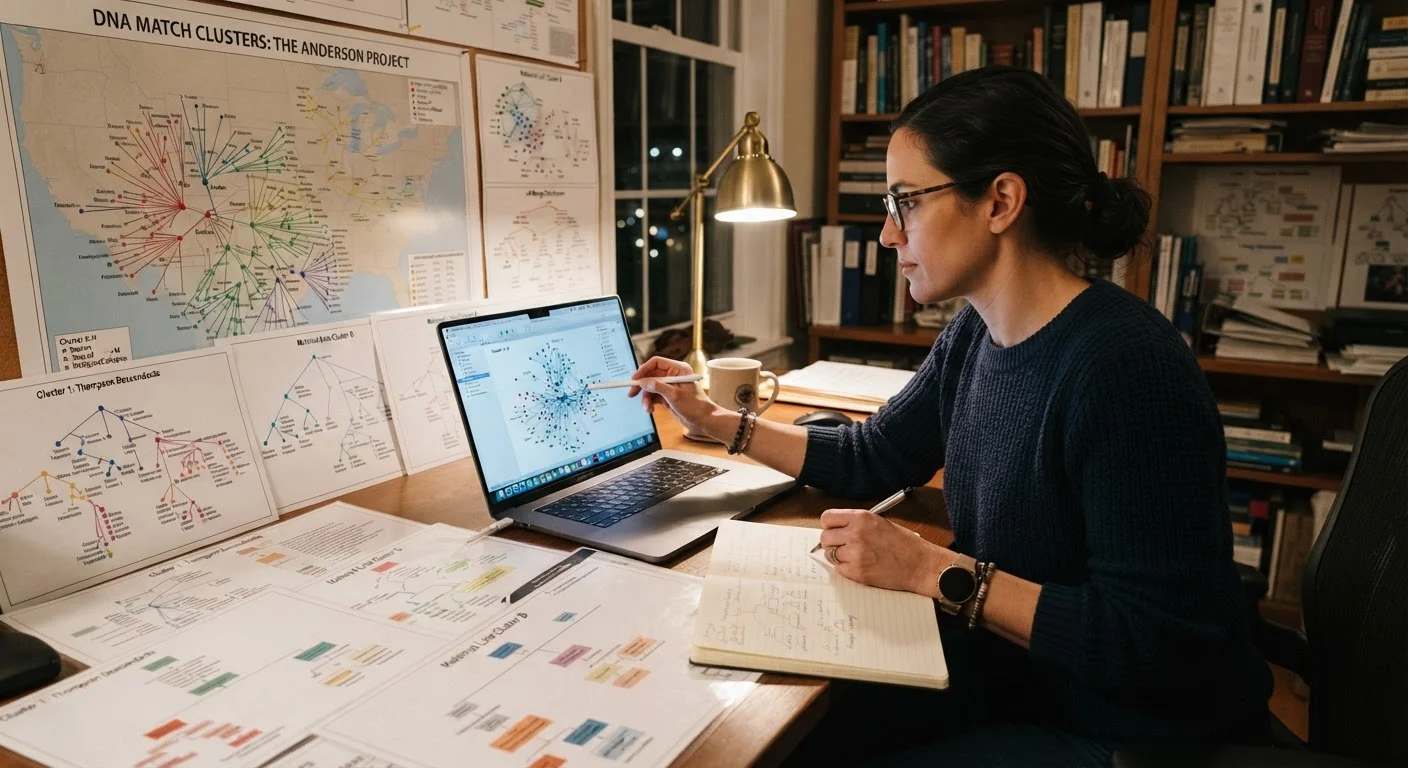
Photo: searchopenrecords editorial
—— In This Article
Key Takeaways
- Shared matches are people who appear in both your match list and another match's list — a signal of common ancestry.
- Clustering groups shared matches visually so you can identify which matches belong to the same family line.
- Each cluster typically corresponds to one ancestral couple, helping you assign matches to specific branches.
- Free and low-cost tools can automate clustering using data exported from major testing platforms.
- Clustering works best alongside paper records, not as a standalone research method.
Why a Large Match List Needs a System
If you have tested at any of the major consumer DNA platforms, you already know the sensation: hundreds or even thousands of people listed as your genetic relatives, most of them strangers with no obvious connection to your known family tree. Raw match lists, sorted by shared centimorgans (cM) — the unit used to measure shared DNA — give you data but not meaning.
The challenge is that each match is a clue to a specific ancestral line, but without grouping, those clues are scattered. A third cousin on your father's paternal grandfather's side sits in the same undifferentiated list as a second cousin once removed on your mother's maternal grandmother's side. Clustering gives that list structure.
This technique complements traditional genealogical research well. As explained in our guide to how DNA testing fits into traditional genealogy research, genetic evidence works best when it supports — and is supported by — paper records, census data, and vital documents. Clustering accelerates that process by letting you focus on one family line at a time.
The Logic Behind Shared Matches
Before clustering can make sense, the concept of a shared match needs to be clear. When you open any match's profile on a testing platform, you typically have the option to see which of your other matches that person also shares. Those overlapping matches are called shared matches or "in common with" matches.
The genetic logic is straightforward: if you and Match A both share DNA with Match B, there is likely a common ancestor connecting all three of you. That ancestor — or more precisely, that ancestral couple — is the root of a cluster.
Endogamy Complicates Cluster Interpretation
Not every shared-match relationship points to the same ancestor. Endogamous populations (communities with historically limited outside marriage, such as certain Ashkenazi Jewish or isolated island communities) produce many overlapping matches that span multiple lines. In these cases, clustering is still useful but requires more careful interpretation.
Not every shared-match relationship points to the same ancestor. Endogamous populations (communities with historically limited outside marriage, such as certain Ashkenazi Jewish or isolated island communities) produce many overlapping matches that span multiple lines. In these cases, clustering is still useful but requires more careful interpretation.
How Clustering Works in Practice
Clustering tools take your match data — typically exported as a spreadsheet from a testing platform — and calculate which matches share DNA with each other. The output is usually a color-coded grid or matrix. Matches that cluster together appear in the same colored block.
Each block ideally represents one ancestral couple in your tree. In a straightforward case, you might see four main clusters corresponding to your four grandparents' lines. In practice, you may see more clusters representing more distant ancestors, or fewer if your family has limited matching in the database.
Once you have clusters, the research task becomes assigning each cluster to a known branch. You do this by finding at least one match per cluster whose tree you can examine. If a well-documented match in Cluster 3 has a great-grandfather named Heinrich Straub from Bavaria, and your paper records also show a Straub connection, you have a hypothesis worth investigating further — as described in our overview of using digitised records alongside DNA evidence.
~1,500 cM
Average DNA shared with a first cousin
The Shared cM Project, a crowdsourced dataset maintained by genealogist Blaine Bettinger, documents expected cM ranges for various relationship types.
4–8
Typical main clusters for a tested individual
Most researchers with moderate-sized match databases see four to eight primary clusters, each corresponding to one grandparent or great-grandparent couple.
3 generations
Depth where clustering is most reliable
Clustering tends to produce the clearest, most actionable groups when matches share ancestors within the past three to five generations, according to genetic genealogy practitioners.
Interpreting and Acting on Your Clusters
Assigning a cluster to a family line requires at least one "anchor" match — a person whose relationship to you is known and whose tree is accessible and documented. Once you anchor a cluster, every other match in that cluster becomes a potential research partner for that same line.
Clusters also help you catch anomalies. If a match appears in a cluster you have confidently assigned to your maternal grandfather's line but that match's tree shows no apparent overlap, it is worth investigating whether a tree is incomplete, a name was recorded differently, or there is an unexpected relationship. Our article on when DNA results contradict your paper trail walks through how to handle exactly these situations without jumping to conclusions.
For researchers hitting dead ends in documentary records, clustering is one of several DNA-based strategies covered in our guide to the DNA toolkit for brick-wall ancestors. Clustering alone rarely breaks a brick wall, but it narrows the search considerably by isolating which family line needs the most attention.
Remember that clustering is a hypothesis-generating tool, not a proof mechanism. Every cluster assignment should eventually be confirmed through documentary evidence — birth, marriage, death, census, or immigration records — as part of a complete research process. For a broader orientation to that process, see our introduction to tracing family roots.
Frequently Asked Questions

Genealogy Search Editorial Team
Genealogy Search Editorial Team is the collective byline for our editorial team and contributor network. Articles published under this byline or an editorial pen name are researched, written, and reviewed according to our editorial standards for clarity, consistency, and independence before publication.
View author profile