
The DNA Toolkit for Brick-Wall Ancestors
When records run dry, DNA techniques like clustering and triangulation can open new research paths. Here are the methods genealogists rely on.
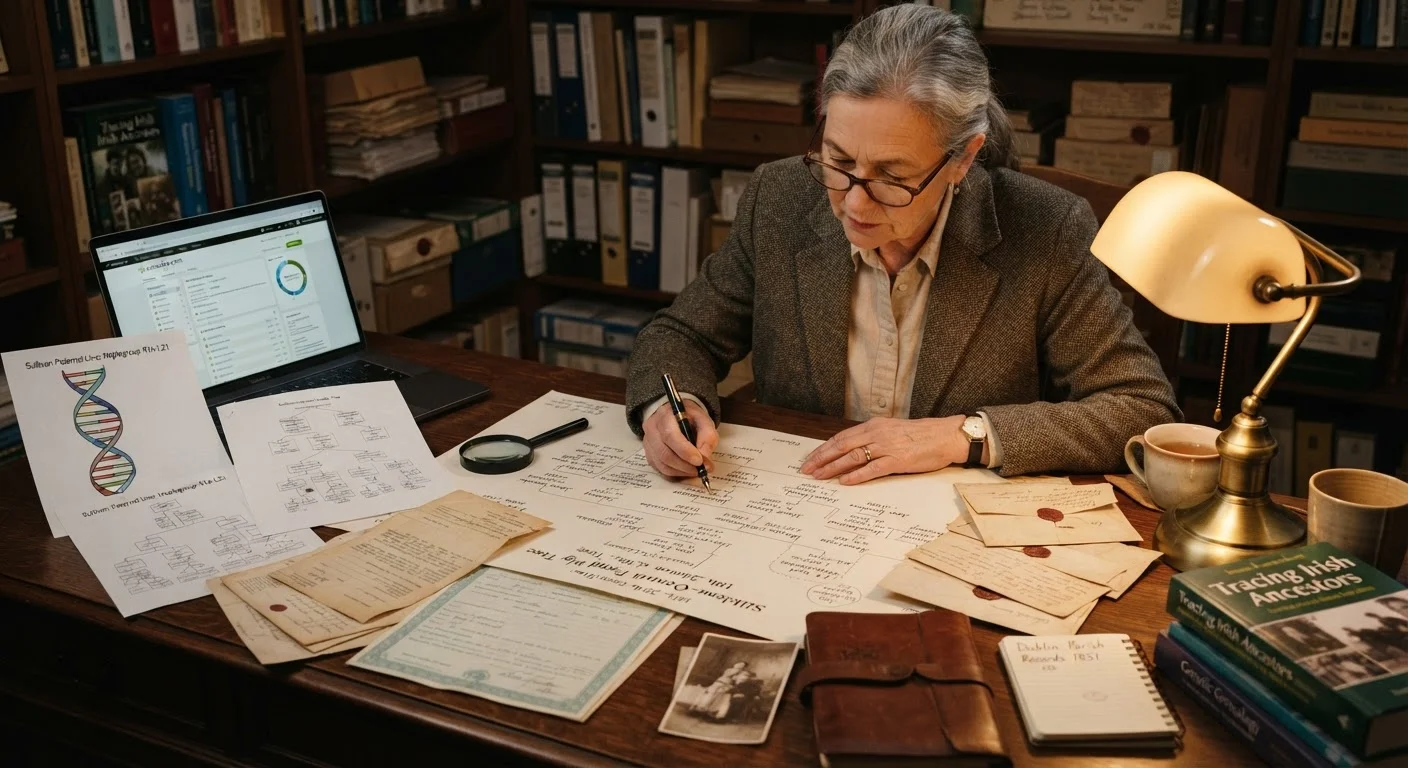
Photo: searchopenrecords editorial
—— In This Article
Key Takeaways
- Clustering shared DNA matches helps identify which ancestral family line each match belongs to.
- Triangulation confirms that multiple matches share a DNA segment inherited from a common ancestor.
- Chromosome mapping assigns specific DNA segments to known ancestors, strengthening evidence for unknown lines.
- Uploading raw DNA data to multiple databases maximizes the pool of potential matches to analyze.
- Endogamy and close-cousin marriages require specialized interpretation strategies that differ from standard analysis.
When Paper Records Run Out
Every family historian eventually hits a wall — a missing ancestor whose paper trail simply evaporates before the census reaches far enough back, or whose surname shifted at a port of entry. When records run dry, DNA evidence offers a different kind of archive: one encoded in biology rather than ink.
Modern genetic genealogy is not a single technique but a toolkit of complementary methods. Each one extracts a different kind of information from your test results and your matches' results. Used together — and cross-referenced against digitized records — they can open lines of inquiry that would otherwise stay closed. See how DNA testing fits alongside traditional research for context on combining both source types.
The methods below are those that experienced genealogists reach for first when a brick wall proves stubborn. None guarantees a breakthrough, but each one systematically narrows the possibilities.
Document Every Step as You Go
DNA analysis generates hypotheses quickly, and it is easy to lose track of which theory led where. Keep a research log that records each technique applied, the matches examined, and the conclusion reached. This documentation prevents re-treading the same ground and provides an evidence trail if a hypothesis is later confirmed or disproved by documentary records.
Seven DNA Techniques for Brick-Wall Research
Leeds Method Clustering
The Leeds Method is a visual clustering technique that groups your DNA matches into color-coded sets, each set representing one of your four grandparent lines. You work through your closest matches, assigning each to a cluster based on which other matches they share DNA with. Matches who cluster together likely descend from the same ancestral couple.
For brick-wall research, the value is in seeing which surnames and locations appear most frequently within a cluster. Even if you cannot yet identify the common ancestor, clustering narrows the search to a specific branch — a crucial first step when a surname is unknown.
Clustering reveals which grandparent line a mystery match belongs to before you know who they are.
Segment Triangulation
Triangulation is the process of confirming that three or more DNA matches all share an overlapping segment on the same chromosome and that this shared segment was inherited from a single common ancestor. When three unrelated people all match one another on the same chromosomal region, the segment can be attributed to a specific ancestral couple with reasonable confidence.
This technique strengthens evidence for a hypothesis: if a group of triangulated matches all have a known surname in their trees, that surname becomes a strong candidate for your unknown brick-wall ancestor. Chromosome browser tools at major testing companies facilitate this comparison. For a deeper look at managing segment data, see Building a Chromosome Map.
Three matches sharing one chromosomal segment point to a single inherited ancestor with measurable confidence.
Chromosome Mapping
Chromosome mapping assigns each segment of your DNA to a specific known ancestor. You build the map incrementally: a confirmed cousin relationship lets you attribute a shared segment to a grandparent pair; further testing narrows it to a single grandparent. Over time, a growing portion of your genome is accounted for.
Once segments are mapped to known ancestors, new mystery matches who share those segments can be placed on the correct branch immediately — bypassing the need to sort through their entire tree from scratch. This makes chromosome mapping especially powerful for researchers with multiple brick walls across different lines.
A chromosome map turns each new mystery match into a placement problem with a known answer key.
What Are the Odds (WATO) Analysis
WATO (What Are the Odds?) is a hypothesis-testing tool that calculates the statistical probability of a proposed relationship between you and a set of DNA matches. You build a candidate tree, place hypothetical common ancestors in various positions, and the tool scores each placement against the observed shared DNA amounts.
For brick-wall ancestors, WATO helps you evaluate competing hypotheses — for example, whether an unknown great-great-grandparent was more likely a sibling or a first cousin of a known individual. It does not prove a relationship, but it ranks possibilities objectively, guiding where to focus documentary research next.
WATO quantifies which proposed ancestor placement best fits your actual shared DNA measurements.
Multi-Database Uploading
Each DNA testing company holds a separate database of tested individuals. A match critical to solving your brick wall may have tested only at one company. Uploading your raw autosomal DNA file to additional databases — several major platforms accept transfers at no cost — expands your match pool substantially.
More matches mean more trees to examine, more surname overlaps to notice, and a higher probability of finding a closer relative to a brick-wall ancestor. Researchers who test at one company and upload elsewhere consistently report finding meaningful matches that did not appear in their original database.
Uploading raw DNA to multiple databases routinely reveals high-value matches absent from any single platform.
Mitochondrial and Y-DNA Analysis
Autosomal DNA is the most commonly tested type, but it becomes statistically unreliable beyond five or six generations. Mitochondrial DNA (mtDNA) traces the direct maternal line — your mother's mother's mother's line — with no dilution across generations. Y-DNA traces the direct patrilineal line in the same way.
When a brick wall sits on a direct maternal or paternal line, these specialized tests can connect you to matches who share that specific lineage across many centuries. Haplogroup information also provides geographic and ethnic context useful for identifying regions of origin when surnames are unknown or altered.
Y-DNA and mtDNA trace single ancestral lines without the generational dilution that limits autosomal results.
Endogamy Adjustment Strategies
In endogamous populations — communities where members historically married within a defined ethnic, religious, or geographic group — standard relationship prediction tools overestimate closeness because DNA is shared through multiple pathways simultaneously. Ashkenazi Jewish, colonial New England Puritan, and certain isolated island communities are common examples.
Researchers working in these contexts need to apply adjusted interpretation frameworks: treating predicted relationships as more distant than reported, seeking matches who share unusually large numbers of segments (indicating multiple common ancestors), and focusing on clustering patterns rather than individual match amounts. Understanding these dynamics prevents misidentification of brick-wall ancestors. The case for and against DNA testing as a genealogy tool covers additional interpretive limitations worth understanding before drawing conclusions.
Endogamous populations require adjusted interpretation because shared DNA inflates predicted relationship closeness.
Putting the Toolkit Into Practice
No single technique works in isolation. The most productive approach treats each method as a layer: clustering organizes your match pool, triangulation validates candidate segments, chromosome mapping preserves confirmed findings, and WATO structures your hypotheses. When a promising theory emerges, you return to documentary records — census images, ship manifests, vital records — to test it. That cross-referencing process is explored in depth in using online digitized records alongside DNA evidence.
If you are encountering genetic genealogy for the first time, Genetic Genealogy From the Ground Up explains the foundational concepts before you apply these advanced methods. For a complete research framework that integrates DNA with digital archives from start to finish, consult DNA and Digital Records Together.
Brick walls rarely fall all at once. More often, they develop cracks — a cluster that points to a previously unknown county of origin, a triangulated segment that confirms a suspected relationship, a chromosome map that finally places a mystery match on a specific ancestral line. Patience and methodical documentation are as essential as any tool.

Genealogy Search Editorial Team
Genealogy Search Editorial Team is the collective byline for our editorial team and contributor network. Articles published under this byline or an editorial pen name are researched, written, and reviewed according to our editorial standards for clarity, consistency, and independence before publication.
View author profile