
Eight Types of Records That Fill In What Birth Certificates Miss
Church registers, immigration files, probate records, and more—these sources surface family details that official vital records overlook.
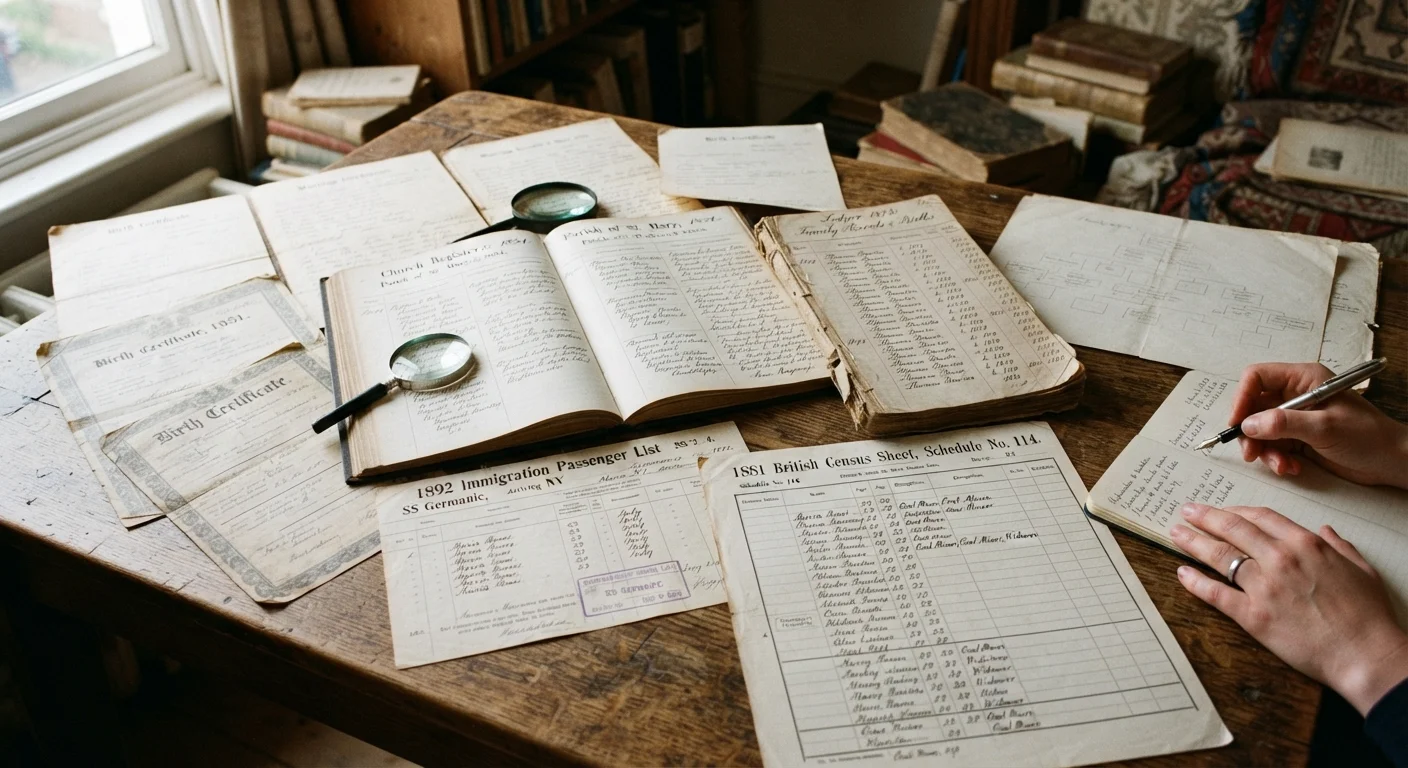
Photo: searchopenrecords editorial
—— In This Article
Key Takeaways
- Birth certificates are an essential starting point but rarely capture the full picture of a person's life.
- Church registers, immigration files, and probate records often document details that official vital records omit.
- Combining multiple record types produces a more reliable and complete family history than relying on any single source.
- Many of these supplementary records are accessible through free government archives, libraries, or established genealogical repositories.
Why Birth Certificates Leave Gaps
Birth certificates are the backbone of genealogical research — but they have real limits. As explained in our guide to vital records in ancestry research, a standard birth certificate captures a snapshot: the child's name, date, location, and parents' names. It rarely tells you where those parents came from, what religion they practiced, who witnessed the birth, or how the family fit into a broader community.
For researchers tracing lines back before the mid-nineteenth century — when civil registration was inconsistent or nonexistent in many U.S. states — the gaps grow larger. Spelling variations, transcription errors, and missing filings mean that a birth record either doesn't exist or can't be found. That's where supplementary sources become indispensable. The eight record types below each fill a distinct void, surfacing information that official vital records routinely overlook.
Church Registers
Before civil registration was mandated in most U.S. states (generally between the 1840s and 1900s), churches were the primary record-keepers for births, baptisms, marriages, and burials. A baptismal register entry often names the infant's parents, godparents, and the officiating minister — details that never appear on a government birth certificate.
Lutheran, Catholic, Methodist, and Presbyterian congregations in particular maintained meticulous registers. Many have been microfilmed and indexed by the Family History Library in Salt Lake City, making them accessible through FamilySearch.org or local Family History Centers. Church and vital records often overlap but each has unique gaps — so comparing both sources almost always pays off.
Baptismal registers routinely name godparents and witnesses — details government certificates never capture.
Immigration and Naturalization Records
Passenger manifests — especially those filed after 1906, when the U.S. standardized immigration paperwork — are extraordinarily rich. Later manifests list the immigrant's hometown in the country of origin, the name and address of a contact in the U.S., physical description, and whether the person had been to America before. Naturalization petitions (Form N-400 predecessors) often add birth dates, names of spouses and children, and the port and date of arrival.
The National Archives holds the bulk of federal immigration records, and large collections are searchable through Ancestry and FamilySearch. Ellis Island records (1892–1957) are freely searchable at libertyellisfoundation.org.
Post-1906 passenger manifests can pinpoint an ancestor's exact village of origin — a breakthrough for overseas research.
Probate and Estate Records
When a person died owning property, their estate usually passed through a county probate court. Wills name heirs by relationship — often specifying "my daughter Mary" or "my son-in-law James" — while estate inventories list every item in the household, from livestock to spinning wheels. Intestate (no-will) files list all legal heirs, which can reveal children not mentioned elsewhere.
Probate records are held at the county level and vary considerably in their accessibility, but many pre-1900 volumes have been digitized. They are especially useful for confirming family relationships that birth records simply don't document.
Wills name heirs by relationship, often revealing children or married daughters absent from all other records.
Census Records
U.S. federal censuses were conducted every ten years beginning in 1790. From 1880 onward, they list every household member by name, age, relationship to the head of household, birthplace, and parents' birthplaces. The 1900 and 1910 censuses additionally ask how many years a couple has been married and how many children a mother has borne versus how many are still living — data that can reveal multiple marriages or children who died young.
The most recent publicly available federal census is 1950 (released in 2022 under the 72-year rule). State censuses, conducted in off-years in many states, can bridge the decade gaps between federal counts.
Census records link siblings, parents, and boarders under one roof — a household snapshot no birth certificate provides.
Military Service and Pension Files
A soldier's compiled military service record documents enlistment, rank, and discharge. But the pension application file — filed by the veteran or a surviving widow — is far richer. Widow's pension applications frequently contain sworn affidavits about the marriage date and location, the names and birth dates of children, and statements from neighbors who knew the family. These files often serve as surrogate vital records when none exist.
The National Archives holds pension files for wars through World War I. Fold3 provides digitized access to many collections, and some files are freely available through NARA's online catalog.
Widow's pension affidavits can function as surrogate marriage and birth records when no official documents survive.
Land Deeds and Property Records
Land transactions were among the most carefully recorded legal acts in early American history. Deeds name the grantor and grantee, describe the property, and are often witnessed and notarized. Crucially, when land passed from a father to multiple heirs after death, the resulting deeds name every child — including daughters, who appear rarely in other male-focused records of the era.
County recorder's offices hold deed books, and many state archives have digitized colonial and territorial land records. Land deeds are among the most overlooked genealogical sources, yet they can confirm family relationships across generations.
Partition deeds after a parent's death routinely name all adult children, including daughters otherwise invisible in records.
Obituaries and Death Notices
A well-written obituary can compress a lifetime into a single column: birthplace, parents' names, surviving children and grandchildren, church membership, occupation, and community affiliations. Even brief death notices in small-town newspapers sometimes reveal a maiden name or a sibling's location that no other record preserved.
Historical newspaper archives are increasingly digitized through the Library of Congress's Chronicling America project (free), state digital newspaper programs, and subscription newspaper archives. For a broader overview of how obituaries support family research, the Obituaries & Family History hub is a practical starting point.
Obituaries frequently name surviving relatives and locations — compressed family history in a single newspaper column.
City Directories and Voter Rolls
Annual city directories, published widely from the mid-nineteenth century onward, listed heads of household by name, occupation, and street address. Tracing a family through consecutive directories reveals moves, occupation changes, the deaths of listed spouses, and the emergence of grown children at separate addresses. Voter registration rolls — public records in most states — add ages and sometimes birthplaces, making them useful for confirming identity across decades.
Many city directories have been digitized through state libraries, Archive.org, or Ancestry. Together with other lesser-known record sources, they help researchers track an ancestor's movements year by year rather than decade by decade.
Consecutive city directory entries can track a family's moves and life changes year by year — far more granular than census data.
Building a More Complete Picture
No single document tells a complete life story. The most reliable family trees are built by triangulating evidence across multiple source types — a method sometimes called the Genealogical Proof Standard. When a church register entry matches an immigration manifest and a probate inventory, the resulting conclusion is far stronger than any one record alone could support.
Start with What You Know, Then Reach Outward
When a birth certificate is missing or uninformative, identify the county and religious denomination of the family first. That will direct you to the most likely surviving supplementary records — a Catholic parish register, a county probate docket, or a local newspaper archive. Working outward from known facts prevents time spent searching records that wouldn't have covered your ancestor in the first place.
For a broader look at the public record types that support this kind of layered research, see the public records every family tree researcher should know about. And if you're working through records that appear to contradict each other, our comparison of vital records vs. church records can help you decide which source to weight more heavily in a given situation.
Patience and source diversity are the twin engines of sound genealogical work. The records listed here won't always yield immediate answers, but together they dramatically expand what's knowable about the people behind the names in your family tree.

Genealogy Search Editorial Team
Genealogy Search Editorial Team is the collective byline for our editorial team and contributor network. Articles published under this byline or an editorial pen name are researched, written, and reviewed according to our editorial standards for clarity, consistency, and independence before publication.
View author profile