
The Public Records Every Family Tree Researcher Should Know About
From birth certificates to census rolls, here are the core public record types used in genealogy and what each one reveals.
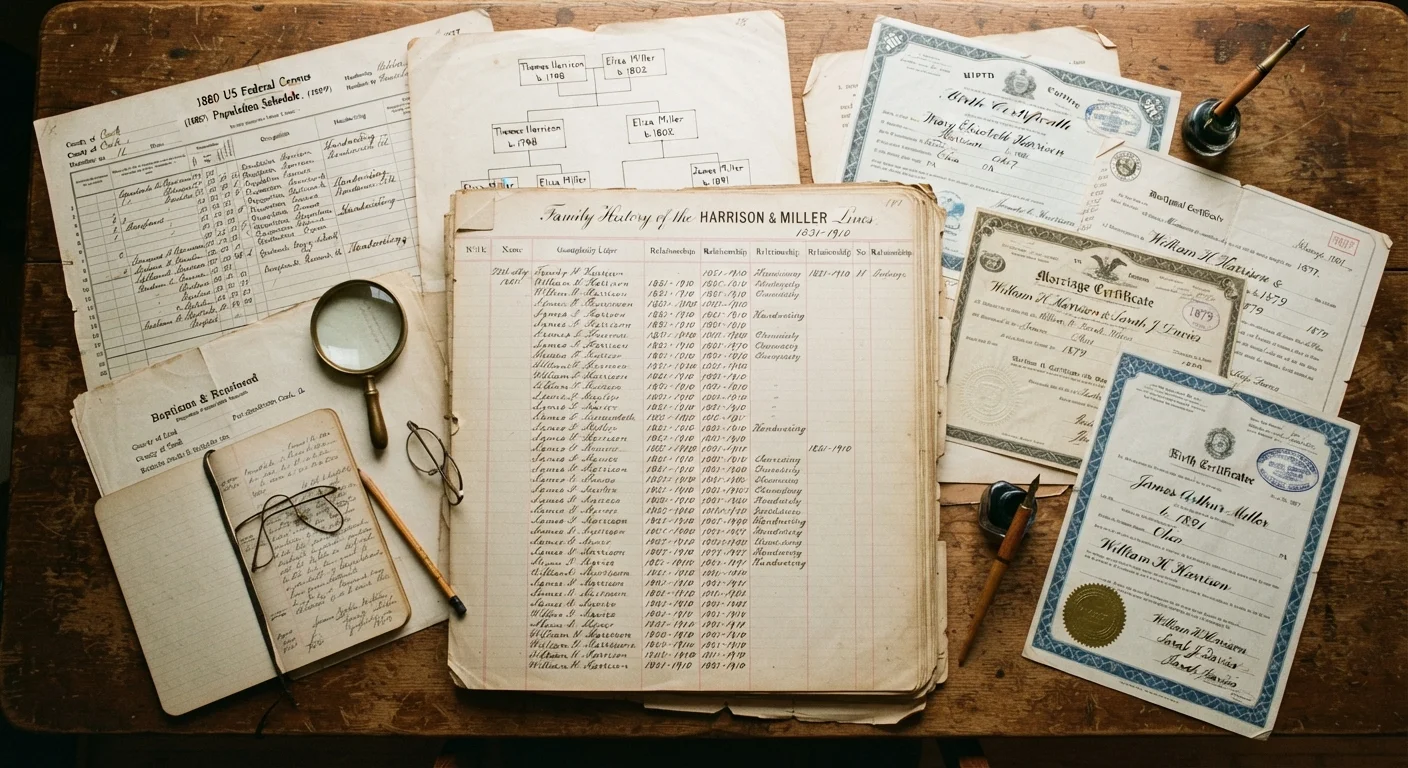
Photo: searchopenrecords editorial
—— In This Article
Why Public Records Are the Backbone of Family Research
Family stories passed down through generations are a meaningful starting point, but oral history alone rarely holds up under scrutiny. Public records created by government authorities, courts, churches, and civic institutions provide the documented evidence that genealogists use to confirm relationships, establish timelines, and fill gaps that memory cannot. Understanding which record types exist — and what each one can actually tell you — is the first practical step toward building an accurate family tree.
For a broader orientation to this process, see our guide to tracing family roots and what public records can actually tell you about your ancestors.
| Statewide birth registration began | Most U.S. states by 1920 (U.S. National Center for Health Statistics) |
| Most recent public U.S. census | 1950 Federal Census (U.S. National Archives) |
| Named individuals in census | Every person, from 1850 onward (U.S. Census Bureau historical methodology) |
| Primary repository for federal records | National Archives and Records Administration (NARA) |
| Military pension files held by NARA | Millions, spanning Revolutionary War to modern era (National Archives, Military Records collection) |
| Land records usefulness | Often predate vital registration by decades |
The Core Record Types and What Each One Reveals
Vital Records
Birth certificates confirm a person's full name, date and place of birth, and typically the parents' names and sometimes their birthplaces. These are foundational documents — each one anchors an individual within a specific family unit and location. Note that statewide registration of births in the United States was not uniform until the early twentieth century; earlier records may exist only at the county or church level. See records that fill in what birth certificates miss for strategies when these documents are absent.
Death certificates capture the date, place, and cause of death, the deceased's age, occupation, and often the names of surviving relatives or informants. The informant's accuracy matters — a grieving spouse may not know a parent's exact birthplace, so treat secondary details as leads, not confirmed facts.
Marriage records — licenses, certificates, and banns — establish the legal union between two individuals and frequently include the parties' ages, parents' names, and witnesses. They also help you identify maiden names, which are essential for tracing a wife's ancestry.
Census Records
Federal census records, taken every ten years, list household members by name along with ages, relationships to the head of household, birthplaces, occupations, and citizenship status. Earlier censuses (pre-1850) list only the head of household with age-group tallies; after 1850, every individual is named. The U.S. National Archives holds census records, and the most recent publicly available set covers 1950. Census data is particularly useful for locating families between vital events and for spotting children who died before formal records were created.
Land and Property Records
Deeds, grants, tax rolls, and plat maps document land ownership and transfers. Beyond confirming residence in a particular county or township, they often reveal neighbors — sometimes relatives — and can date a family's arrival in or departure from a region. Many land records predate official vital registration by decades, making them essential for research before 1900.
Probate Records
Wills, inventories, and letters of administration are filed when an estate is settled. A will may name every child, grandchild, and in-law, providing a snapshot of the family network at the time of death. Intestate (no-will) probate files often list heirs as part of the legal process, which can surface relatives not found in other records.
Military Records
Draft registrations, pension files, and service records span conflicts from the Revolutionary War through the twentieth century. Pension applications in particular are genealogically rich — a widow applying for benefits often submitted proof of marriage and a family history. The National Archives and the National Personnel Records Center hold the bulk of federal military records.
For lesser-known record types that can fill critical gaps, see records genealogists often overlook.
Accessing and Interpreting These Records Effectively
Most public records are maintained at the county or state level and can be requested directly from the issuing agency. Digitized collections held by the National Archives, state archives, and public libraries have made remote access far more practical than it was a generation ago. The Historical Records Access hub offers guidance on navigating specific repositories.
When interpreting any record, consider the source's reliability. A document created close in time to the event by someone with direct knowledge carries more weight than one filed years later by a distant informant. Name spellings were inconsistent, ages were sometimes rounded or misremembered, and clerical errors were common. Cross-referencing multiple record types — rather than relying on any single document — is the standard genealogical practice for establishing a fact with confidence. For practical strategies on keeping this evidence organized, see organizing your research so each branch stays clear.
Finally, be realistic about gaps. Digitization is incomplete, records were lost to fires and floods, and some communities were systematically excluded from official documentation. Understanding these limitations is part of doing this work honestly. See the honest trade-offs of building a family tree through public records alone for a candid look at where this approach succeeds and where it falls short.

Genealogy Search Editorial Team
Genealogy Search Editorial Team is the collective byline for our editorial team and contributor network. Articles published under this byline or an editorial pen name are researched, written, and reviewed according to our editorial standards for clarity, consistency, and independence before publication.
View author profile