
Birth, Marriage, and Death Certificates: The Backbone of Ancestry Research
Vital records hold the clearest proof of family relationships. Understand what information they contain and how to obtain historical copies.
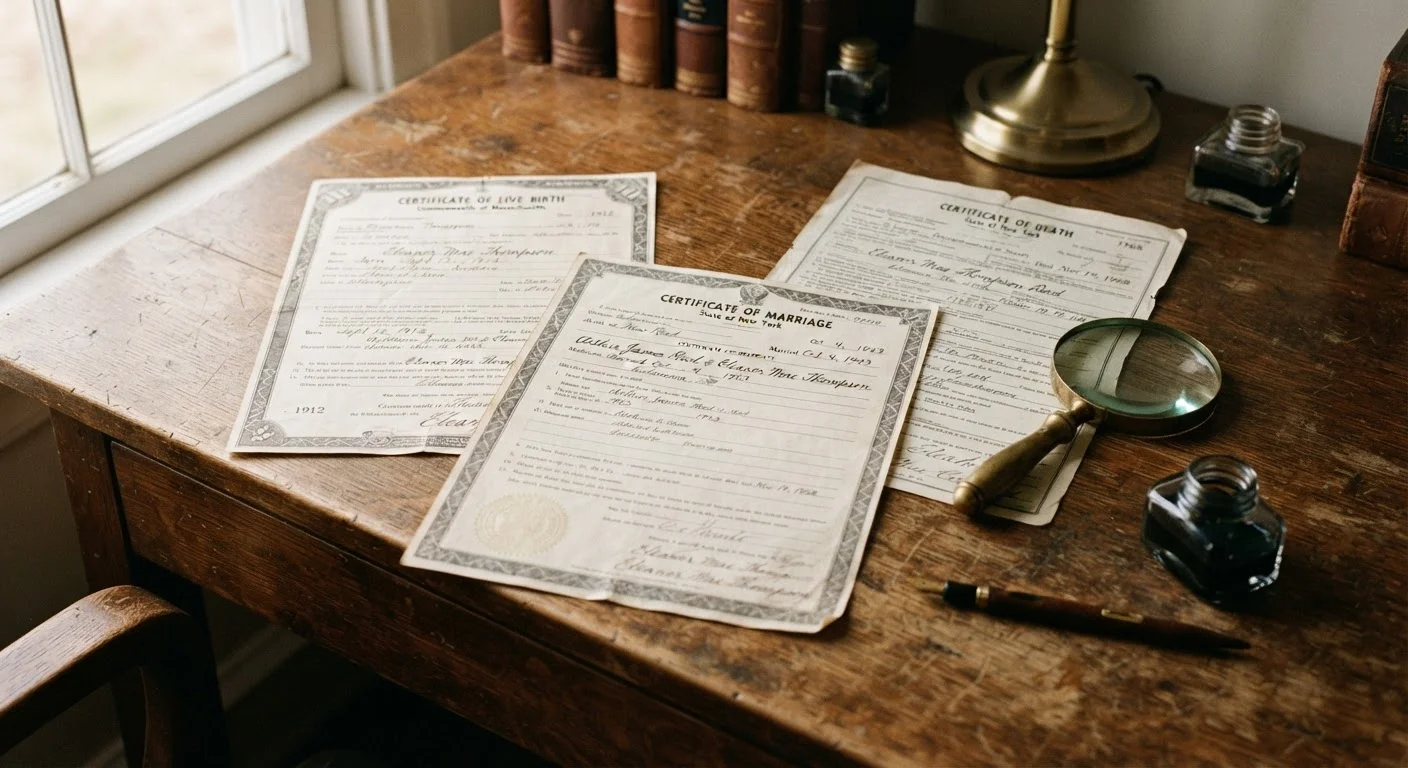
Photo: searchopenrecords editorial
—— In This Article
Key Takeaways
- Birth certificates typically record full name, date, place, and names of both parents including the mother's maiden name.
- Marriage records often capture the ages, birthplaces, and parents of both spouses — extending your family tree two generations at once.
- Death certificates can reveal previously unknown birthplaces, occupations, and the informant who supplied the information.
- Statewide vital registration in the U.S. began at different times by state, generally between the 1880s and 1920s.
- Historical vital records are accessible through state archives, county courthouses, and digitized collections at repositories like FamilySearch.
- Record quality varies significantly; cross-referencing multiple sources reduces the risk of relying on inaccurate data.
Why Vital Records Are the Starting Point for Any Family Tree
When building a family tree, researchers need documents that directly state who a person is, who their parents were, and when and where key life events occurred. Vital records — birth, marriage, and death certificates — do exactly that. Unlike census entries or land records, which capture a moment in time, vital records are created to officially register a specific legal event, making them uniquely authoritative as genealogical evidence.
As part of the broader landscape of public records most useful for tracing family roots, vital records stand out because they were designed to identify individuals precisely. This makes them the natural anchor around which other record types — census rolls, immigration files, probate documents — are organized.
What Each Type of Vital Record Contains
Birth certificates are among the richest single-document sources in genealogy. A standard 20th-century U.S. birth certificate typically records the child's full name, sex, date and exact place of birth, and the full names of both parents — critically, including the mother's maiden name. Some states also recorded the parents' ages, birthplaces, occupations, and the number of previous children born to the mother.
Marriage records are especially valuable because they simultaneously document two individuals and can extend your research by two full generations. A marriage certificate or license application commonly includes each party's full name, age or birth date, birthplace, place of residence, and the names of each person's parents. In earlier records, a clergyman's registry may also note witnesses — often close family members.
Death certificates provide a different kind of evidence. In addition to the date, time, and place of death, and cause of death as certified by a physician, they typically include the deceased's birthplace, occupation, usual residence, and — most importantly for genealogists — the names of the person's parents. However, this information was provided by an informant present at the time, whose knowledge of family history may have been incomplete or secondhand.
Always Record the Informant on Death Certificates
When you photograph or transcribe a death certificate, make sure to note who served as the informant — the person who supplied biographical details about the deceased. This person's relationship to the deceased directly affects how much weight you should give to fields like birthplace and parents' names. A spouse or child is a stronger informant than a physician or funeral director who did not know the family personally.
Understanding the Timeline: When States Began Keeping Records
One of the most common points of confusion for new researchers is discovering that a vital record simply does not exist — not because it was lost, but because statewide registration had not yet begun. The United States did not adopt a uniform national vital registration system; instead, each state enacted its own laws at different times.
New England states generally led the way, with Massachusetts beginning statewide registration in 1842. Most Midwestern states followed between the 1870s and 1890s. Many Southern and Western states did not establish reliable statewide systems until the 1900s to 1920s. The federal government began requiring standardized birth and death certificates for statistical purposes in 1915, which accelerated compliance.
Before statewide registration, researchers must turn to earlier local systems: county clerk records, church registers, Bible records, and published newspaper notices of births, marriages, and deaths. These are explained in depth in our guide to records that fill in what birth certificates miss.
1915
Year federal standardized vital registration began
The U.S. Census Bureau established a model registration area for births and deaths in 1915, encouraging consistent statewide record-keeping across the country.
1842
Massachusetts vital registration start date
Massachusetts was among the first U.S. states to mandate statewide vital registration, making its records some of the oldest continuously maintained official birth and death records in the nation.
3+
Generations documented by one marriage record
A single marriage license application can name both spouses and all four of their parents, effectively documenting three generations of family relationships in a single document.
How to Obtain Historical Vital Records
Access to vital records depends on the age of the record and the state in which it was created. For historical genealogical research, the primary channels are:
- State vital records offices — Each state maintains an official repository for records from the date statewide registration began. Most states have tiered access: older records are open to the public or available with a genealogical request form, while records within recent decades require proof of direct family relationship.
- County courthouses and clerk offices — For records predating statewide registration, county-level civil records are often the oldest surviving official source.
- FamilySearch.org — Operated by The Church of Jesus Christ of Latter-day Saints, this free platform has digitized millions of U.S. and international vital records and makes many searchable online without charge.
- State and regional archives — Many states have transferred older vital records to their state library or archive, where they may be viewed in person or through microfilm lending programs.
Understanding these sources in context is easier with a broader framework. Our overview of what ancestry records are and where they come from provides that foundation.
Interpreting What You Find: Common Pitfalls
Finding a record is only the first step. Interpreting it accurately requires understanding how and why errors occur. Name spellings were frequently inconsistent before standardized spelling was widespread, and clerks often recorded names phonetically. Ages were routinely approximated, especially for women and older individuals. Foreign-born individuals' names were often anglicized by the recording clerk.
On death certificates in particular, the informant's relationship to the deceased affects the reliability of the biographical data. A surviving spouse is more likely to know accurate parental details than a neighbor or hospital administrator. Always note who the informant was — this is usually recorded on the document itself.
When records conflict, the genealogical standard is to weigh each source by its proximity to the event and the likely knowledge of the person who provided the information. A birth certificate created within days of birth is more reliable for date and parentage than a death certificate created 70 years later. See our detailed guide on using vital records reliably for a structured approach to resolving conflicts.
Frequently Asked Questions

Genealogy Search Editorial Team
Genealogy Search Editorial Team is the collective byline for our editorial team and contributor network. Articles published under this byline or an editorial pen name are researched, written, and reviewed according to our editorial standards for clarity, consistency, and independence before publication.
View author profile