
The Hidden Trade-offs of Relying Solely on Digitised Historical Records
Digital archives are convenient but incomplete. A balanced look at what online access gets right — and what it quietly leaves out for family researchers.
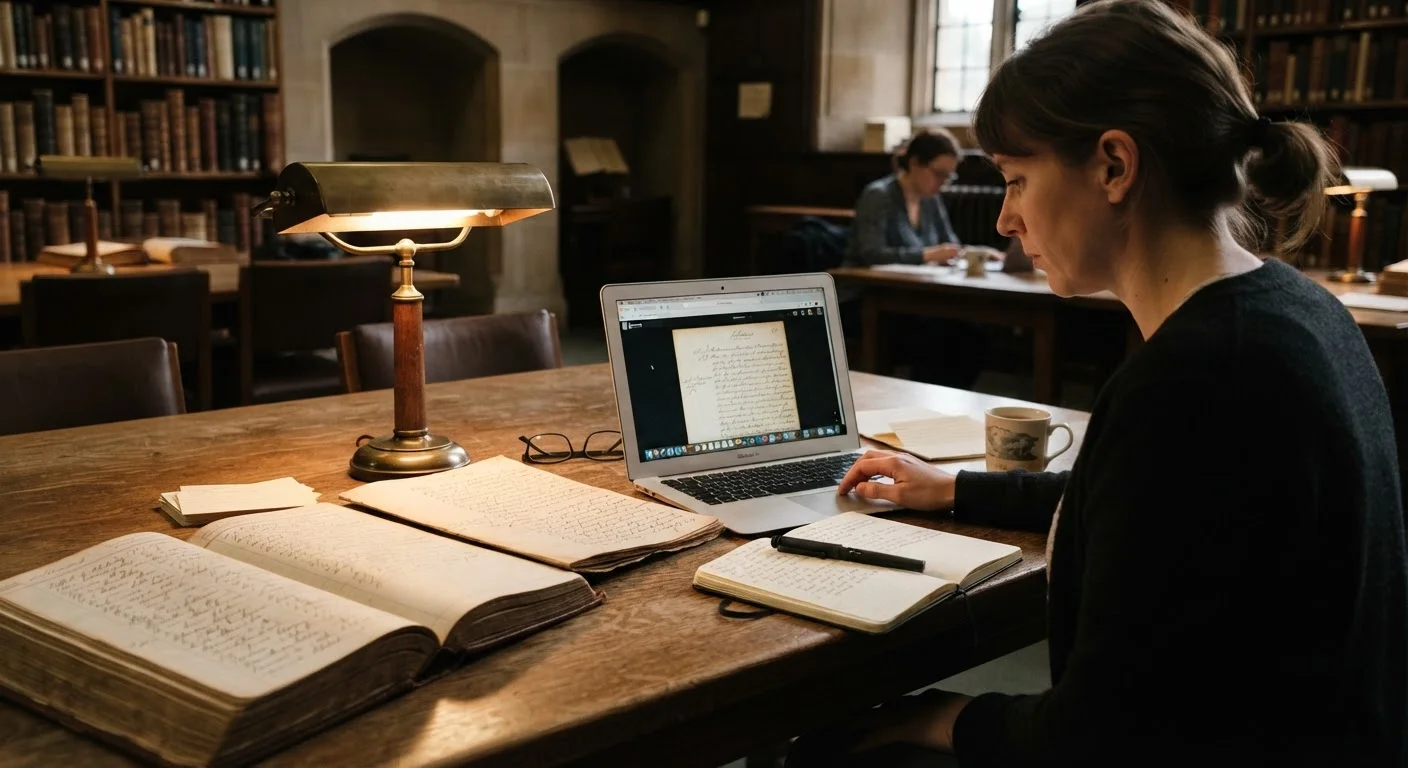
Photo: searchopenrecords editorial
—— In This Article
Key Takeaways
- Digitised records dramatically expand access but capture only a fraction of what archives actually hold.
- Indexing errors and OCR misreadings can make genuine records effectively invisible in keyword searches.
- Some record types — fragile, restricted, or locally held — may never be digitised.
- A hybrid research approach, combining online databases with repository visits, is typically most reliable.
- Understanding what was digitised — and why — helps researchers interpret gaps rather than mistake them for absence.
Broad access from any location, at any time
Researchers no longer need to travel to distant courthouses or archives to view records. A 1900 census page held by the National Archives can be reviewed from a home computer in minutes.
Full-text search across millions of records
Keyword and name searches let researchers scan collections that would take years to review page by page. This dramatically accelerates the identification of relevant documents.
Preservation of fragile originals
Digitisation reduces physical handling of deteriorating documents, helping protect original materials from further damage. Researchers benefit from viewing stable digital surrogates without risking the source.
Cross-collection linking and hints
Many platforms connect records across databases, surfacing related documents a researcher might not have searched for directly. This serendipitous discovery is genuinely useful in breaking through brick walls.
Lower cost compared to travel and reproduction fees
Subscription or free access to digitised collections is typically far cheaper than funding multiple repository visits, paying for certified copies, or hiring local researchers.
Large portions of the historical record remain undigitised
Estimates from archival studies suggest that the majority of historical records held by state and county repositories have not been digitised. Local probate files, church registers, and pre-twentieth-century deed books are common gaps.
OCR and indexing errors obscure genuine records
Optical character recognition (OCR) software frequently misreads old handwriting or damaged print — turning 'Mueller' into 'Muell' or 'Henriksen' into 'Henrihsen'. A record may exist but remain unfindable under the expected name.
Digitisation choices reflect institutional priorities, not comprehensive coverage
Archives and platforms prioritise high-demand or well-funded collections. Records of marginalised communities, rural counties, or non-English-speaking immigrants are often digitised later or not at all.
Access restrictions limit what can be viewed online
Privacy laws, donor conditions, and licensing agreements mean some collections are restricted even when digitised. A record may appear in a catalogue but be viewable only on-site at the holding institution.
Context and physical details are lost in scanning
Pencil annotations, paper watermarks, seal impressions, and attached loose documents often do not reproduce clearly or are excluded from scans entirely, removing evidence that can be crucial to interpretation.
Researchers may stop searching too early
When an online search returns no results, it is tempting to conclude the record does not exist. In practice, the record may be undigitised, misfiled, or indexed under an unexpected spelling variant.
Why Researchers Default to Digital — and What That Costs
Online access to historical records has transformed genealogy. Collections once requiring cross-country travel are now searchable from a kitchen table. For many families, this convenience is sufficient to trace several generations without leaving home. But convenience shapes behaviour — and researchers who work exclusively in digital environments routinely encounter a specific set of problems that are invisible until they matter.
The core issue is not that digitised archives are unreliable. It is that they are partial. What has been digitised reflects decisions made by institutions, grant funders, and commercial platforms — decisions driven by demand, budget, and technical capacity, not by the goal of complete coverage. Understanding those decisions is the first step to working around them.
Broad access from any location, at any time
Researchers no longer need to travel to distant courthouses or archives to view records. A 1900 census page held by the National Archives can be reviewed from a home computer in minutes.
Full-text search across millions of records
Keyword and name searches let researchers scan collections that would take years to review page by page. This dramatically accelerates the identification of relevant documents.
Preservation of fragile originals
Digitisation reduces physical handling of deteriorating documents, helping protect original materials from further damage. Researchers benefit from viewing stable digital surrogates without risking the source.
Cross-collection linking and hints
Many platforms connect records across databases, surfacing related documents a researcher might not have searched for directly. This serendipitous discovery is genuinely useful in breaking through brick walls.
Lower cost compared to travel and reproduction fees
Subscription or free access to digitised collections is typically far cheaper than funding multiple repository visits, paying for certified copies, or hiring local researchers.
Where Digital Access Falls Short
The gaps in digital archives follow predictable patterns. County-level records — deeds, probate files, local court minutes — are frequently absent because digitisation at that scale requires local funding and coordination that many jurisdictions lack. Pre-1900 records from smaller states, rural regions, and immigrant communities with non-Latin scripts face similar barriers.
Large portions of the historical record remain undigitised
Estimates from archival studies suggest that the majority of historical records held by state and county repositories have not been digitised. Local probate files, church registers, and pre-twentieth-century deed books are common gaps.
OCR and indexing errors obscure genuine records
Optical character recognition (OCR) software frequently misreads old handwriting or damaged print — turning 'Mueller' into 'Muell' or 'Henriksen' into 'Henrihsen'. A record may exist but remain unfindable under the expected name.
Digitisation choices reflect institutional priorities, not comprehensive coverage
Archives and platforms prioritise high-demand or well-funded collections. Records of marginalised communities, rural counties, or non-English-speaking immigrants are often digitised later or not at all.
Access restrictions limit what can be viewed online
Privacy laws, donor conditions, and licensing agreements mean some collections are restricted even when digitised. A record may appear in a catalogue but be viewable only on-site at the holding institution.
Context and physical details are lost in scanning
Pencil annotations, paper watermarks, seal impressions, and attached loose documents often do not reproduce clearly or are excluded from scans entirely, removing evidence that can be crucial to interpretation.
Researchers may stop searching too early
When an online search returns no results, it is tempting to conclude the record does not exist. In practice, the record may be undigitised, misfiled, or indexed under an unexpected spelling variant.
Indexing quality also varies significantly across collections. A record transcribed by a volunteer unfamiliar with nineteenth-century German script may render a surname so inaccurately that no standard search will surface it. Experienced researchers learn to search phonetically, try alternative spellings, and browse image by image when keyword searches fail — skills that become essential precisely because of these limitations. For a broader perspective on what falls through the cracks, see what digitization actually delivered for government records generally.
Practical Strategies for a More Complete Search
Why 'Not Found Online' Rarely Means 'Doesn't Exist'
A null result in a digital archive search should be treated as a signal to investigate further, not a conclusion. Records may be held by a county courthouse, a church archive, a historical society, or a private collection — none of which may have a digital presence. Cross-referencing the real limitations of online public record searches helps set realistic expectations before declaring a line untraceable.
When online searches stall, the next step is identifying which physical repositories would hold the record type you need. State archives, county clerks, historical societies, and religious institutions each hold distinct collections. Contacting them directly — by phone, email, or in person — often reveals materials that have never appeared in any catalogue.
~10%
Estimated share of US local records digitised
Archivists and records professionals have long noted that only a small fraction of county-level and municipal records have been converted to digital formats, though precise figures vary by region.
1 in 4
Genealogists who report hitting an undigitised wall
Surveys of genealogical society members regularly find that a significant minority encounter a research dead end attributable to records that are not available online.
30–40%
OCR error rate for 19th-century handwritten records
Studies of automated transcription accuracy on historical handwritten documents — particularly cursive script — consistently show substantial error rates that can affect searchability.
A hybrid approach is consistently more productive than either digital-only or physical-only research. Online databases provide an efficient first pass; repository visits fill the gaps that remain. For a structured comparison of when each approach is most appropriate, weighing your options between digitised archives and physical visits offers a detailed framework. Researchers building out a family tree should also consider how public records as a whole complement and complicate this process — see the honest trade-offs of building a family tree through public records alone for a fuller picture.

Genealogy Search Editorial Team
Genealogy Search Editorial Team is the collective byline for our editorial team and contributor network. Articles published under this byline or an editorial pen name are researched, written, and reviewed according to our editorial standards for clarity, consistency, and independence before publication.
View author profile