
Digitization of Public Records: What Changed and What Didn't
Moving government records online expanded access in some ways—and created new barriers in others. A balanced look at what digitization actually delivered.
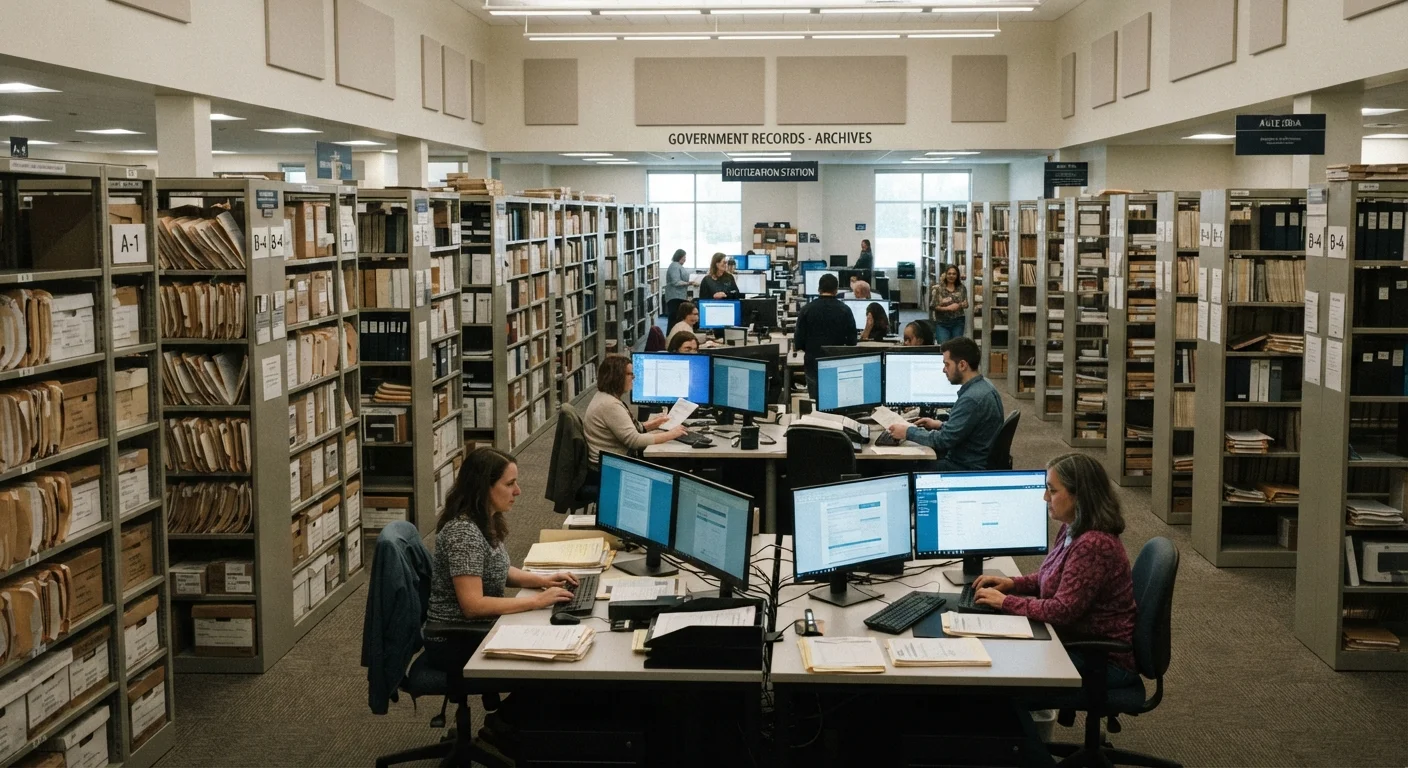
Photo: searchopenrecords editorial
—— In This Article
Key Takeaways
- Digitization expanded geographic access, letting people search records without visiting government offices in person.
- Many older, damaged, or low-priority records were never scanned and remain available only on-site.
- Online portals vary widely by jurisdiction — some are free and comprehensive, others charge fees or show partial data.
- Privacy law exceptions and redaction practices mean some digitized records are less complete than their paper counterparts.
- A hybrid research strategy — combining digital searches with physical repository visits — often yields the most complete results.
Geographic barriers to access significantly reduced
Researchers no longer need to travel to a specific county courthouse or archive to view many public records. This benefit is particularly significant for individuals researching records held in distant states or rural jurisdictions.
Search speed and efficiency improved dramatically
Keyword and index-based digital searches can locate a specific record in seconds that would have taken hours of manual file review in a physical repository. This reduces both researcher time and agency staff burden.
Proactive disclosure increased under open government frameworks
FOIA and state equivalents now require many agencies to publish frequently requested documents online without individual requests, making baseline government information more readily available to the public.
Physical preservation concerns partially addressed
Digital copies protect information against physical deterioration, fire, flooding, or other damage to original documents — a genuine archival benefit for fragile or aging records.
Cross-jurisdictional research became more feasible
Researchers tracking records across multiple states or counties can now conduct preliminary work online before deciding where to invest time in physical visits, making complex multi-jurisdiction projects more manageable.
Large digitization backlogs remain unresolved
Even major federal institutions like NARA acknowledge significant unscanned holdings. State and local agencies face even larger backlogs, often without dedicated funding to address them.
Older and fragile records are frequently excluded
Handwritten historical documents, oversized maps, bound volumes, and deteriorating paper records are often the last to be scanned — meaning the oldest records most needed by genealogists are often the least likely to be online.
Jurisdiction-by-jurisdiction inconsistency creates confusion
With thousands of independent records custodians across the country, there is no standardized approach to what gets digitized, how it's indexed, or whether it's made freely available — making systematic research unpredictable.
Fees and paywalls have migrated online
Some government portals and third-party aggregators charge subscription or per-record fees for digital access that was previously available for free in person, raising equity concerns for cost-sensitive researchers.
Online records may be more redacted than originals
Digitized versions published on public-facing portals often reflect stricter privacy filters than paper originals held on-site, meaning researchers may see incomplete information without realizing it.
Optical character recognition errors affect searchability
Automated text recognition used to index scanned documents produces errors — particularly with old handwriting, faded ink, or non-standard formatting — causing records to be misfiled or unsearchable by name.
What Digitization Actually Promised — and Delivered
Starting in the 1990s and accelerating through federal initiatives like the Government Paperwork Elimination Act of 1998, U.S. agencies at all levels began converting physical records into digital formats. The goal was straightforward: reduce storage costs, improve retrieval speed, and make government information more accessible to the public.
In measurable ways, it worked. Court dockets that once required a courthouse visit are now searchable through systems like PACER (Public Access to Court Electronic Records). Many vital records offices publish searchable indexes online. State archives have digitized property records, historical census data, and legislative documents. For researchers in the historical records access space, the shift has been transformative — records once requiring travel to a specific county seat can now be browsed from home.
The Freedom of Information Act (FOIA) framework also benefited: agencies increasingly publish frequently requested documents in online reading rooms, reducing repetitive individual requests and improving proactive disclosure.
Geographic barriers to access significantly reduced
Researchers no longer need to travel to a specific county courthouse or archive to view many public records. This benefit is particularly significant for individuals researching records held in distant states or rural jurisdictions.
Search speed and efficiency improved dramatically
Keyword and index-based digital searches can locate a specific record in seconds that would have taken hours of manual file review in a physical repository. This reduces both researcher time and agency staff burden.
Proactive disclosure increased under open government frameworks
FOIA and state equivalents now require many agencies to publish frequently requested documents online without individual requests, making baseline government information more readily available to the public.
Physical preservation concerns partially addressed
Digital copies protect information against physical deterioration, fire, flooding, or other damage to original documents — a genuine archival benefit for fragile or aging records.
Cross-jurisdictional research became more feasible
Researchers tracking records across multiple states or counties can now conduct preliminary work online before deciding where to invest time in physical visits, making complex multi-jurisdiction projects more manageable.
Where the Digital Transition Falls Short
Despite real progress, the digitization of public records is incomplete — and unevenly distributed. Several structural gaps affect what researchers actually find when they search online.
Coverage is patchy by design. Scanning projects are funded on a record-by-record basis. Low-demand record categories, older handwritten documents, and records in poor physical condition are frequently deprioritized. A 2023 report from the National Archives and Records Administration (NARA) acknowledged substantial backlogs in digitizing its own holdings, let alone guiding state and local agencies.
Jurisdiction fragmentation persists. The United States has over 3,000 counties and thousands of independent municipalities, each managing its own records systems. There is no single national database of, say, property deeds or probate files. What's digitized in one county may not exist online in an adjacent one.
Fees and access walls have moved online. Physical records were sometimes free to review in person, with fees applied only for copies. Some digitized portals now require paid subscriptions for the same information, effectively shifting the cost of access without improving equity.
For a deeper look at these structural gaps, see the real limitations of online public record searches.
Large digitization backlogs remain unresolved
Even major federal institutions like NARA acknowledge significant unscanned holdings. State and local agencies face even larger backlogs, often without dedicated funding to address them.
Older and fragile records are frequently excluded
Handwritten historical documents, oversized maps, bound volumes, and deteriorating paper records are often the last to be scanned — meaning the oldest records most needed by genealogists are often the least likely to be online.
Jurisdiction-by-jurisdiction inconsistency creates confusion
With thousands of independent records custodians across the country, there is no standardized approach to what gets digitized, how it's indexed, or whether it's made freely available — making systematic research unpredictable.
Fees and paywalls have migrated online
Some government portals and third-party aggregators charge subscription or per-record fees for digital access that was previously available for free in person, raising equity concerns for cost-sensitive researchers.
Online records may be more redacted than originals
Digitized versions published on public-facing portals often reflect stricter privacy filters than paper originals held on-site, meaning researchers may see incomplete information without realizing it.
Optical character recognition errors affect searchability
Automated text recognition used to index scanned documents produces errors — particularly with old handwriting, faded ink, or non-standard formatting — causing records to be misfiled or unsearchable by name.
Privacy, Redaction, and the Completeness Question
Digital publishing introduced a new layer of complexity: redaction at scale. When records are digitized, agencies apply privacy exemptions — under FOIA, state sunshine laws, or specific statutory protections — that may result in online versions being more redacted than paper originals held on-site.
For example, birth certificates digitized for public access may have parental information withheld; original paper records held at a state archive may be accessible in fuller form under different rules. This means a digital result showing partial information isn't always the complete record — it may reflect a policy decision about what to publish online versus what requires a formal request.
Online Record vs. Complete Record: Know the Difference
A digitized record published on a government portal is not always an unaltered image of the original document. It may be a data extract, a redacted scan, or an index entry pointing to a physical file. Before drawing conclusions from a digital search result, confirm what format the record is in and whether a more complete version exists in the physical repository. Many agencies will clarify this distinction if you contact them directly.
Understanding which version of a record you're accessing — a public-facing digital summary, a scanned image of the original, or a data extract from a government database — matters for research accuracy. When completeness is essential, comparing digitized archives with physical repository visits is a worthwhile step before drawing conclusions.
Building a Realistic Research Strategy
A practical approach to public records research treats digitization as a first filter, not a definitive answer. Start with online portals and indexes to establish what's available digitally and to identify the specific record identifiers — case numbers, deed book and page numbers, filing dates — that will make any subsequent physical search faster and more targeted.
When digital searches return no results, resist the assumption that a record doesn't exist. It may simply predate scanning, fall into an unfunded category, or sit in a local repository that hasn't yet published an online index. Direct outreach to the custodian agency — a county clerk's office, a state archives reference desk, or a federal records center — remains the most reliable fallback.
For genealogical research in particular, the trade-offs between convenience and completeness are especially pronounced. Resources on the hidden trade-offs of relying solely on digitized historical records outline where online-only approaches can quietly mislead family researchers.
The finding records online hub offers additional guidance on navigating digital government databases across multiple record types.

Public Records 101 Editorial Team
Public Records 101 Editorial Team is the collective byline for our editorial team and contributor network. Articles published under this byline or an editorial pen name are researched, written, and reviewed according to our editorial standards for clarity, consistency, and independence before publication.
View author profile