
Why Family Stories Don't Always Match the Records — and What to Do About It
Oral histories are valuable but imperfect. Understand why discrepancies occur between family lore and documented records, and how to resolve them.
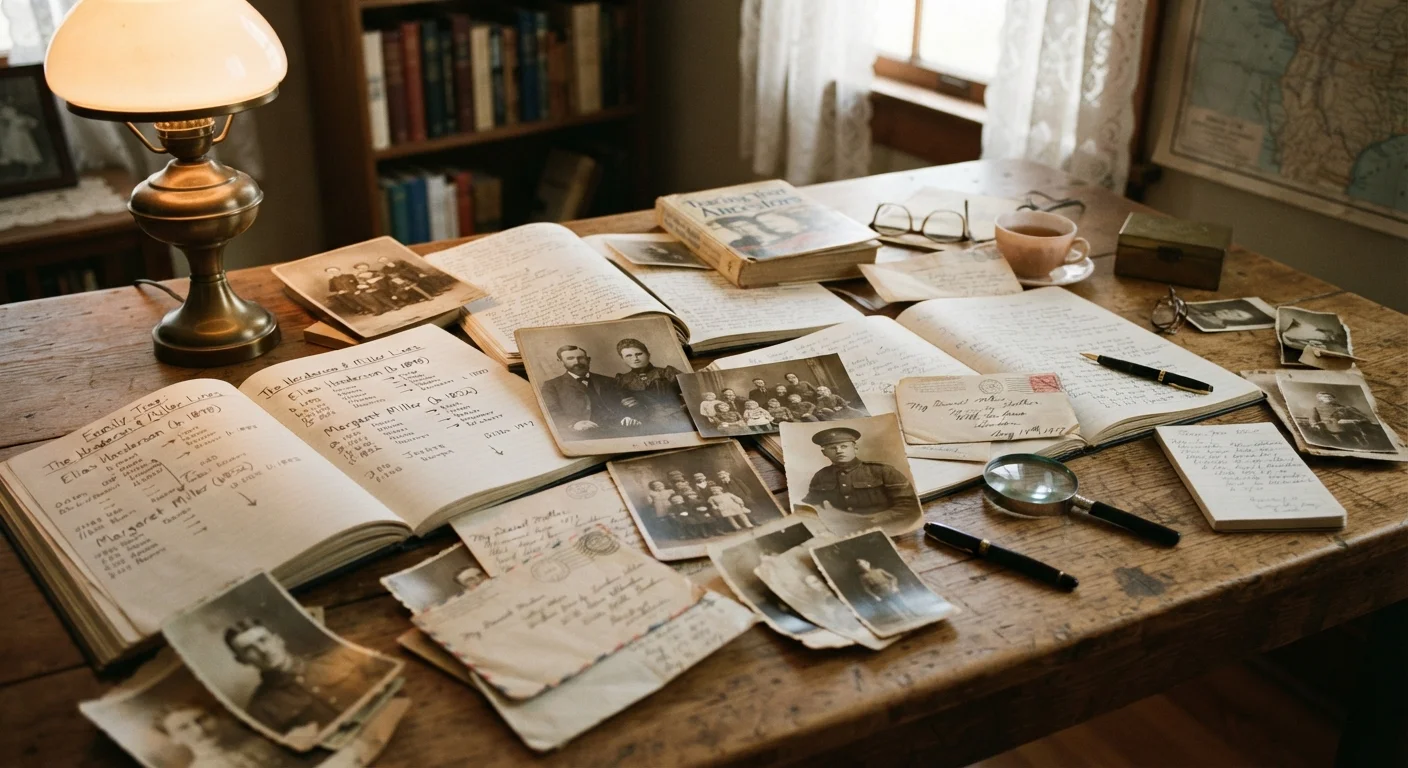
Photo: searchopenrecords editorial
—— In This Article
Key Takeaways
- Oral family histories are valuable starting points but frequently contain inaccuracies that official records can clarify.
- Discrepancies between family lore and documents usually stem from memory, stigma, or deliberate omission — not deception.
- Cross-referencing multiple primary sources is the most reliable method for resolving conflicting family accounts.
- Name variations, age rounding, and immigration-era changes are among the most common sources of record mismatches.
- Treating family stories as hypotheses rather than facts helps you research more effectively and without frustration.
Why the Gap Between Story and Record Exists
Nearly every family tree researcher eventually encounters the same jarring moment: a birth year that's off by a decade, an ancestor who supposedly emigrated from the wrong country, or a great-grandparent who appears in no record at all. These gaps between oral history and documented evidence are not anomalies — they are the norm.
Family stories are transmitted through imperfect human memory, shaped by grief, pride, shame, and the natural tendency to simplify complex realities for each new generation. Records, meanwhile, were created by clerks, census takers, and ship manifests officials who misspelled names, misheard accents, and recorded what they were told — not necessarily what was true. Both sources carry error. Neither is automatically authoritative.
Understanding why discrepancies occur is the first step to resolving them. The Historical Records Access hub is a strong starting point for locating the primary documents that let you test family accounts against verifiable evidence.
Common Myths About Family Stories and Records
Researchers new to genealogy often arrive with assumptions that slow their progress. The myth-and-fact pairs below address the most persistent misconceptions — and offer a more productive framework for each.
Myth
If a family story has been repeated for generations, it must be basically accurate.
Fact
Repetition reinforces memory but does not verify it. Errors and embellishments compound across generations.
Psychologists who study memory transmission have long documented how narratives shift with each retelling. Details that seem peripheral get dropped; emotionally resonant details get amplified. A story told by a great-grandparent may bear only a structural resemblance to what that person's grandchild repeats 80 years later. Longevity of a story is not evidence of its accuracy — it is evidence only that the story was worth repeating.
Myth
A discrepancy between a family story and an official record means someone was lying.
Fact
Most discrepancies stem from memory limitations, social stigma, language barriers, or record-keeper error — not deliberate deception.
Ancestors had many practical reasons to give imprecise information: avoiding military conscription, concealing an out-of-wedlock birth, or simply not knowing their own birth date because no record existed in their home village. Clerks frequently misheard names spoken with unfamiliar accents and recorded phonetic approximations. Obituary details often contradict other family records for similar structural reasons — the informant simply didn't know every fact. Assuming dishonesty closes off lines of inquiry; assuming complexity opens them.
Myth
If my ancestor isn't in a particular database, they didn't exist in that record.
Fact
Absence from a database usually reflects indexing gaps, digitization limits, or name variation — not an actual absence from historical records.
Significant portions of the historical record have not been digitized, and large indexes rely on volunteer or automated transcription that introduces errors. An ancestor recorded as "Kowalczyk" may be indexed as "Kawalchik" or simply missed. Researchers should search on name variants, use wildcard searches where available, and consult microfilm or original documents when a digital search returns nothing. The Historical Records Access hub outlines strategies for finding records beyond major online indexes.
Myth
Family stories about ethnic or national origin are usually reliable.
Fact
National borders, naming conventions, and political circumstances mean that the country an ancestor "came from" is often more complicated than a single label.
Borders shifted dramatically across Europe and elsewhere during the nineteenth and early twentieth centuries. An ancestor described as "Russian" may have been ethnically Polish, Jewish, Ukrainian, or Lithuanian — depending on which political entity controlled their village at the time of emigration. Similarly, families sometimes simplified or changed their ethnic identity for social acceptance after arrival. Records from the origin country, where accessible, provide the most granular picture of actual place of birth and ethnicity.
Myth
Ages recorded on official documents are more reliable than family memory.
Fact
Ages on historical documents were frequently estimated, rounded, or deliberately altered for legal or social reasons.
Census takers often rounded ages to the nearest five. Women sometimes subtracted years; men occasionally added them for labor eligibility. Immigrants sometimes adjusted ages on naturalization paperwork. A birth year that shifts by one or two years across multiple census records is unremarkable; a shift of five to ten years warrants deeper investigation. Cross-referencing birth records, baptismal registers, and death certificates gives the most reliable age estimate. Researchers who rely on a single document's age field are building on an unstable foundation.
Practical Steps for Resolving Conflicts
When a family story and a document contradict each other, resist the urge to immediately discard one. Instead, treat each as a clue that points toward a fuller explanation.
- Document the discrepancy precisely. Note exactly what the family account claims, what the record shows, and the source of each. Vague impressions are harder to resolve than specific, cited contradictions.
- Seek a third source. Two conflicting accounts often dissolve when a third independent record — a church register, a city directory, or a death certificate — provides corroborating context. Learn how conflicting public records arise and how to evaluate them.
- Consider the record creator's perspective. Who filled out this document, and what did they know? An informant listed on a death certificate may be a surviving spouse who didn't know the deceased's exact birthplace. The common misreading mistakes genealogists make often trace back to misunderstanding who created a record and why.
- Interview living relatives strategically. Ask open-ended questions rather than leading ones. Record conversations with permission. Even contradictory accounts among siblings can reveal important context about what information was actively suppressed or forgotten.
Obituaries are another frequent source of conflict with official records — grief and deadline pressure introduce errors that trained researchers learn to spot. See why obituaries sometimes get the facts wrong for a detailed breakdown of the warning signs.
Treating Family Lore as a Research Asset
The goal is not to prove family stories wrong — it is to understand what they preserve and what they distort. Many oral accounts contain kernels of accurate geography, occupation, or cultural identity even when dates and names have drifted. A story about an ancestor who "came over during the famine" may be imprecise about year, but it points a researcher toward the right emigration window and port records.
Public records routinely disprove common genealogy beliefs — but they also regularly confirm the emotional core of a family narrative even when the specifics need correction. Approach every discrepancy with curiosity rather than frustration, and you will find that the tension between story and record is often where the most revealing history lives.
For researchers who use obituaries as a starting point, the Obituaries & Family History hub provides guidance on integrating these sources responsibly into a broader research strategy.

Genealogy Search Editorial Team
Genealogy Search Editorial Team is the collective byline for our editorial team and contributor network. Articles published under this byline or an editorial pen name are researched, written, and reviewed according to our editorial standards for clarity, consistency, and independence before publication.
View author profile