
What Obituaries Can and Cannot Tell You About a Person's Life
Obituaries are useful but limited. Understand what details they reliably capture and where you'll need to turn to other public records to fill in the gaps.
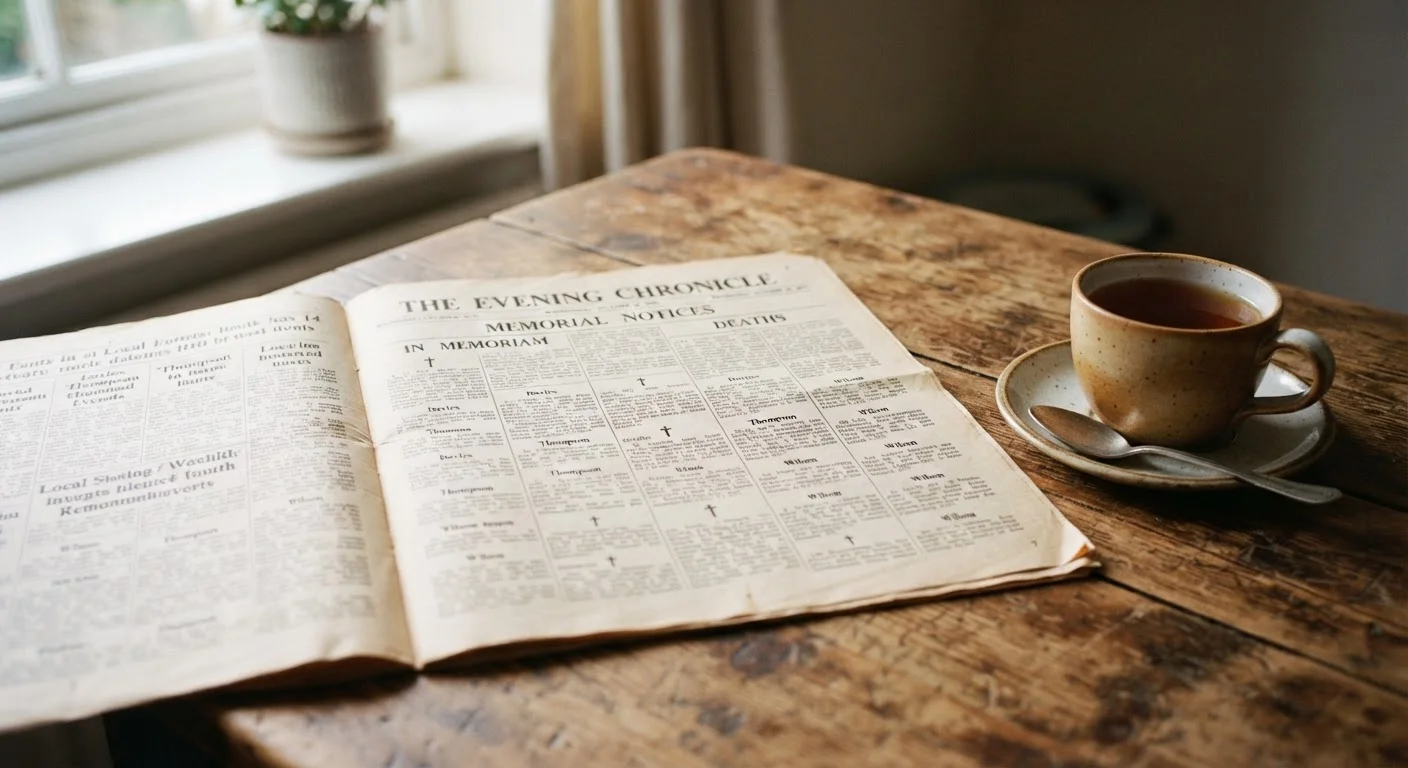
Photo: searchopenrecords editorial
—— In This Article
Key Takeaways
- Obituaries are written by families or funeral homes, not government officials, so details are unverified.
- They reliably capture names, dates, and surviving family relationships but often omit causes of death and financial details.
- Gaps in obituaries can be filled by pairing them with vital records, census data, and court filings.
- No legal requirement exists specifying what an obituary must include in the United States.
- Understanding what obituaries cannot tell you prevents research errors and misplaced assumptions.
Captures biographical milestones in one place
Birth dates, marriage references, career highlights, and places of residence are often summarised in a single document, saving researchers significant time in early-stage fact-gathering.
Names living and deceased relatives
Survivor lists and predeceased family sections frequently identify multiple generations, providing genealogists with named relatives that may not appear in other easily searchable public records.
Documents community and religious affiliations
Church memberships, fraternal organisations, and volunteer roles mentioned in obituaries can point researchers toward additional archives — such as church registers or veterans' records — that hold verified data.
Preserves informal biographical narrative
Unlike vital records, obituaries may describe personality, values, hobbies, and significant relationships, providing cultural and social context that official documents never capture.
Provides geographic anchors for further research
References to towns, counties, or states of birth and residence give researchers a starting point for locating county-level records, land deeds, and local newspaper archives.
Not verified by any government authority
Because families or funeral homes write and submit obituaries, factual errors — incorrect birth years, misspelled names, wrong hometowns — can and do appear without any editorial correction process.
Cause of death is frequently omitted
Families often choose not to disclose cause of death, particularly for stigmatised illnesses or circumstances. Researchers should not assume absence of this detail means it was unknown.
Family conflicts and estrangements go unrecorded
Obituaries reflect the perspective of whoever wrote them. Estranged children, former spouses, and complicated family dynamics are routinely excluded, creating gaps in the relational record.
Dates and ages are often approximated or wrong
Grieving families frequently work from memory rather than documents, leading to birth years and marriage dates that may be off by one or more years — errors that compound in genealogical research.
Coverage is uneven across time and geography
Older obituaries, particularly for rural communities or lower-income families, may never have been published or may be held only in fragile, uncatalogued newspaper archives not yet digitised.
No legal standing as proof of death
Obituaries cannot substitute for a death certificate in legal, financial, or probate proceedings — they are commemorative notices, not official documentation of a vital event.
What Obituaries Are — and Aren't
An obituary is a notice of death, typically written by a family member or funeral home staff, and published in a newspaper, on a funeral home website, or through an online memorial platform. Despite how official they can feel, obituaries are not legal documents. No government agency verifies their contents before publication, and no federal or state law in the United States mandates what information they must include.
This distinction matters enormously for researchers. Unlike a death certificate — which is an official vital record generated by a licensed physician and registered with a state — an obituary reflects what the family chose to share, remembered accurately, and was able to afford to print. Understanding this framing is the essential first step before drawing any conclusions from what you read. For a broader look at how obituary records fit into the public records landscape, see Obituary Records Explained.
What Obituaries Do Well
Within their natural scope, obituaries can be rich and revealing documents. They often serve as the most human account of a person's life that any public source will ever offer.
Captures biographical milestones in one place
Birth dates, marriage references, career highlights, and places of residence are often summarised in a single document, saving researchers significant time in early-stage fact-gathering.
Names living and deceased relatives
Survivor lists and predeceased family sections frequently identify multiple generations, providing genealogists with named relatives that may not appear in other easily searchable public records.
Documents community and religious affiliations
Church memberships, fraternal organisations, and volunteer roles mentioned in obituaries can point researchers toward additional archives — such as church registers or veterans' records — that hold verified data.
Preserves informal biographical narrative
Unlike vital records, obituaries may describe personality, values, hobbies, and significant relationships, providing cultural and social context that official documents never capture.
Provides geographic anchors for further research
References to towns, counties, or states of birth and residence give researchers a starting point for locating county-level records, land deeds, and local newspaper archives.
For family historians, the survivor list alone — naming children, grandchildren, siblings, and sometimes cousins — can map out an entire branch of a family tree in a single paragraph. Community affiliations, church memberships, and military service are frequently mentioned and provide threads worth pulling in further research. Explore how these details connect to other sources in our guide on cross-referencing obituary details with other public records.
Where Obituaries Fall Short
Knowing what obituaries routinely leave out — or get wrong — is just as important as knowing what they contain. Researchers who treat them as complete or authoritative records often find themselves chasing inaccurate leads.
Not verified by any government authority
Because families or funeral homes write and submit obituaries, factual errors — incorrect birth years, misspelled names, wrong hometowns — can and do appear without any editorial correction process.
Cause of death is frequently omitted
Families often choose not to disclose cause of death, particularly for stigmatised illnesses or circumstances. Researchers should not assume absence of this detail means it was unknown.
Family conflicts and estrangements go unrecorded
Obituaries reflect the perspective of whoever wrote them. Estranged children, former spouses, and complicated family dynamics are routinely excluded, creating gaps in the relational record.
Dates and ages are often approximated or wrong
Grieving families frequently work from memory rather than documents, leading to birth years and marriage dates that may be off by one or more years — errors that compound in genealogical research.
Coverage is uneven across time and geography
Older obituaries, particularly for rural communities or lower-income families, may never have been published or may be held only in fragile, uncatalogued newspaper archives not yet digitised.
No legal standing as proof of death
Obituaries cannot substitute for a death certificate in legal, financial, or probate proceedings — they are commemorative notices, not official documentation of a vital event.
Many of these gaps are not accidental. Families may omit estranged relatives, second marriages, or sensitive causes of death out of privacy or grief. Dates are frequently misremembered. For a deeper look at why these patterns exist, What an Obituary Actually Records — and What It Leaves Out examines the structural reasons obituaries are incomplete by nature.
A Note on Obituary Myths
A common assumption is that information published in a newspaper must have been fact-checked. In practice, most newspapers publish obituaries as submitted by funeral homes or families, with minimal editorial review of the biographical details. This means a plausible-sounding but incorrect date or name can enter public archives unchallenged. For more on widely held misconceptions, see Obituary Search Myths That Send Researchers Down Dead Ends.
Filling the Gaps with Public Records
The most effective approach treats an obituary as a compass, not a map. Once you have names, approximate dates, and locations from an obituary, you can verify and expand that information through official public records:
- Death certificates — filed with state vital records offices, these confirm date, place, and cause of death, and list the informant (often a family member whose name may be new to your research).
- Census records — decennial US Census records available through the National Archives can confirm household composition, ages, and birthplaces across multiple decades.
- Probate and court records — these can surface financial relationships, legal disputes, and relatives not mentioned in the obituary.
- Social Security Death Index (SSDI) — a publicly searchable database confirming death dates and last known ZIP codes for many Americans who died after 1936.
This layered approach is especially important when an obituary contains the only known reference to a person. Also worth reading: Common Misconceptions About What Obituaries Are Required to Include, which addresses frequent misunderstandings researchers carry into their searches.
For those building a broader family history, the Obituaries & Family History hub offers guidance on using obituary records as a genealogical foundation alongside other primary sources.

Obituary Search Editorial Team
Obituary Search Editorial Team is the collective byline for our editorial team and contributor network. Articles published under this byline or an editorial pen name are researched, written, and reviewed according to our editorial standards for clarity, consistency, and independence before publication.
View author profile