
Common Myths About Obituaries as Historical Sources
Many researchers assume obituaries are always accurate or comprehensive. This article examines the most widespread misconceptions and what the evidence actually shows.
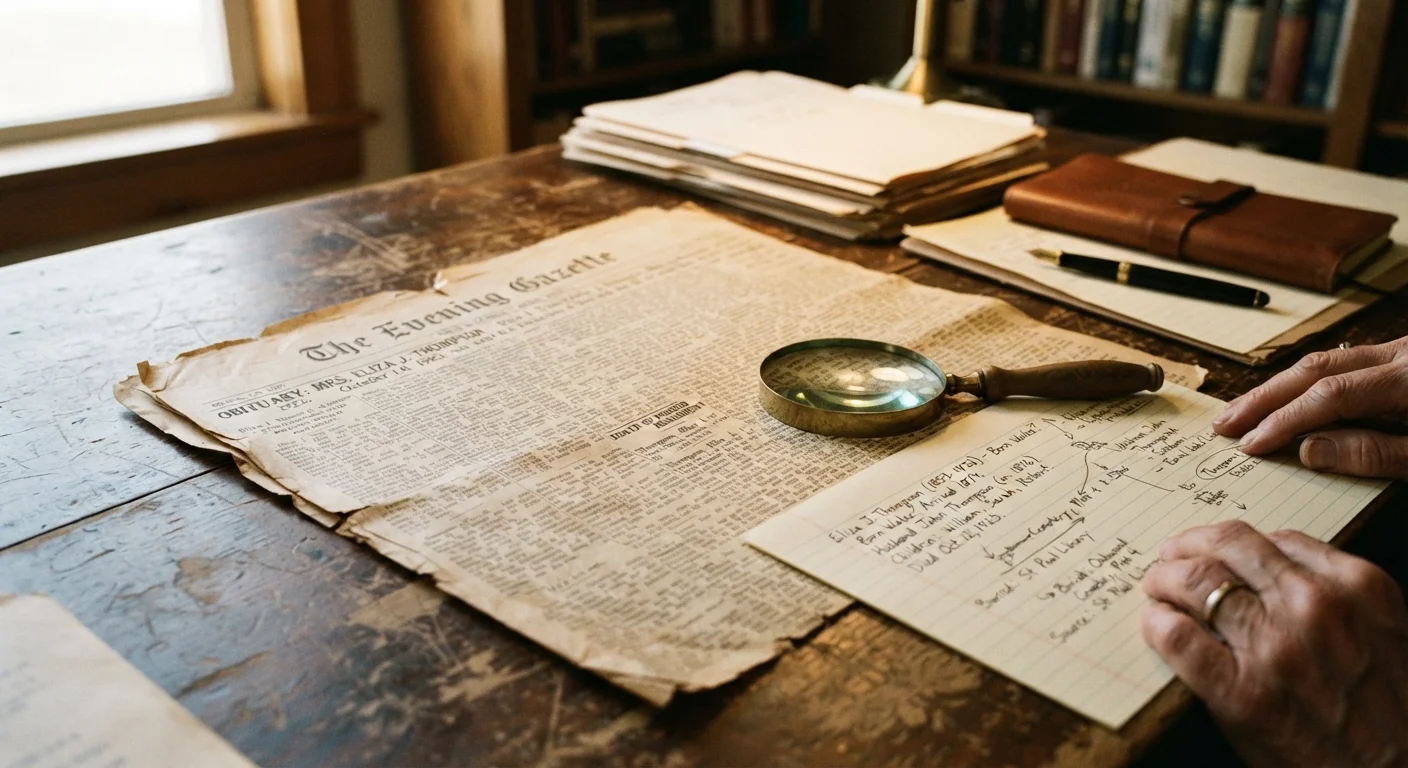
Photo: searchopenrecords editorial
—— In This Article
Key Takeaways
- Obituaries are family-written tributes, not official legal records verified by any government authority.
- Significant factual errors — including wrong birth dates and misspelled names — are more common than most researchers expect.
- The absence of an obituary does not mean a death went unrecorded; many people simply had none published.
- Older obituaries often reflected social biases, omitting entire branches of family or marginalizing certain relatives.
- Cross-referencing obituaries with death certificates, census records, and vital statistics always strengthens research.
Why Obituary Myths Matter for Researchers
When you're tracing a family line or verifying a public record, obituaries can feel like a gift — a narrative account that names relatives, places, and life events in one document. That appeal is real. But treating obituaries as authoritative historical sources without understanding their limitations can lead researchers down costly wrong turns.
Misconceptions about what obituaries are, who writes them, and what they're required to contain are surprisingly widespread. They persist partly because obituaries look official — printed in newspapers, preserved in archives — and partly because most of us encounter them during grief, when critical scrutiny feels inappropriate. Understanding the truth behind common myths doesn't diminish the value of obituaries; it makes you a sharper, more effective researcher. See our guide to reading obituaries for a broader foundation before diving in.
The Myths — and What the Evidence Actually Shows
The following myth-and-fact pairs address the most common misunderstandings researchers encounter when working with obituary records.
Myth
Obituaries are official government records, so the information in them has been verified.
Fact
Obituaries are privately written tributes, typically composed by family members or funeral homes, and published by newspapers with no independent verification of the facts.
Unlike a death certificate — which is a legal document completed by a physician and registered with a state vital records office — an obituary carries no official standing whatsoever. No government agency reviews, approves, or certifies the information it contains. Dates, spellings, survivor lists, and biographical claims all come from whoever submitted the text, often under significant emotional and time pressure. This distinction is foundational: obituaries are historical artifacts, not historical records in the legal sense. Our article on common misconceptions about what obituaries are required to include explores this distinction further.
Myth
If no obituary exists, the person's death wasn't documented anywhere.
Fact
Death records, death certificates, burial permits, and probate filings exist independently of obituaries. Many deaths were fully documented by the state but never received a published obituary.
Publishing an obituary in a newspaper has always been optional and often costly. Historically, rural families, those without financial means, and individuals who died with few surviving relatives were far less likely to have obituaries printed. Immigrant communities, people who died in institutions, and those in isolated regions are especially underrepresented in obituary archives. If your search comes up empty, pivot to death certificates at the state vital records office, county courthouse records, cemetery registers, and Social Security Death Index entries — all of which exist separately from any newspaper publication.
Myth
The birth date listed in an obituary is reliable enough to use as a primary source.
Fact
Birth dates in obituaries are among the most frequently incorrect details, often off by one to several years, because they depend entirely on family memory rather than source documents.
Genealogists routinely discover discrepancies between birth years cited in obituaries and those found in birth certificates, census records, or immigration documents. The person who supplied the obituary information may have been uncertain of the exact year, may have recalled a rounded age, or may have been given incorrect information themselves. Obituary birth dates are best treated as a starting point for further verification rather than a confirmed fact. Cross-referencing against at least one primary source — ideally the original birth registration — is standard practice in serious genealogical research.
Myth
All surviving family members will be named in an obituary.
Fact
Families routinely omit estranged relatives, children from earlier relationships, or members the immediate family chose not to acknowledge — sometimes deliberately, sometimes through oversight.
Obituaries reflect the family dynamics and social norms of the moment they were written. Estrangements, adoptions, children born outside of marriage, and blended family complexities have long influenced who appears and who doesn't. In earlier historical periods, certain racial or ethnic relatives were sometimes omitted entirely due to prevailing social pressures. The absence of a name from an obituary is evidence of editorial choice, not definitive proof that a person did not exist or was not a relative. Researchers reconstructing family trees should never rely solely on survivor lists.
Myth
Obituaries published in major newspapers are more accurate than those in small local papers.
Fact
Accuracy depends on who supplied the information, not on the size or prestige of the publication. All newspapers rely on the submitting family or funeral home for content.
Large metropolitan newspapers may have had editorial staff who caught obvious inconsistencies, but their fact-checking resources for obituaries have historically been minimal — and today are essentially nonexistent at most outlets. Small community papers, by contrast, sometimes had editors personally familiar with local families who could catch errors. Publication size is not a meaningful proxy for accuracy. Evaluate each obituary on its internal consistency and by comparing it against independent documentary evidence, regardless of where it appeared.
Myth
Digitized obituary archives contain a comprehensive record of published obituaries.
Fact
Digitization has been uneven and incomplete. Significant gaps exist across time periods, regions, and publication types, and many obituaries remain accessible only in physical archives.
While large-scale newspaper digitization projects have expanded access considerably, the coverage is far from uniform. Papers from rural areas, non-English-language publications, African American community newspapers, and publications from before the mid-twentieth century are often underrepresented or entirely absent from online databases. Assuming a digital search is exhaustive can cause researchers to miss obituaries that do exist — just in microfilm collections, library archives, or funeral home records that have never been scanned. See obituary search myths that send researchers down dead ends for a fuller treatment of search gaps and overlooked sources.
For a deeper look at why factual errors slip through so frequently, our article on why obituaries sometimes get the facts wrong walks through the mechanisms behind inaccuracies and how to catch them.
Putting Obituaries in Their Proper Place
None of these corrections mean obituaries are unreliable in a blanket sense — they remain one of the richest narrative sources available for family history research. The key is understanding exactly what kind of source they are: a family-authored memorial, filtered through grief, deadline pressure, and social convention, and published without independent fact-checking.
Used alongside death certificates, census data, church records, and probate documents, obituaries can illuminate details no other source provides. Used alone, as a single point of truth, they can mislead. Our companion piece on what an obituary actually records and what it leaves out offers a detailed breakdown of typical content and common omissions worth bookmarking for any research project.
If you're struggling to locate an obituary at all — a more common problem than many expect — see why obituaries are harder to find than you'd expect for strategies that go beyond the obvious databases. And if broader historical record access is part of your research, common myths about historical records access addresses digitization gaps and archive availability that affect the wider public records landscape.

Obituary Search Editorial Team
Obituary Search Editorial Team is the collective byline for our editorial team and contributor network. Articles published under this byline or an editorial pen name are researched, written, and reviewed according to our editorial standards for clarity, consistency, and independence before publication.
View author profile