
Building a Family Timeline Using Obituary Records
Obituaries gathered across generations can form a coherent family narrative. Here's how to organise and sequence them into a reliable timeline.
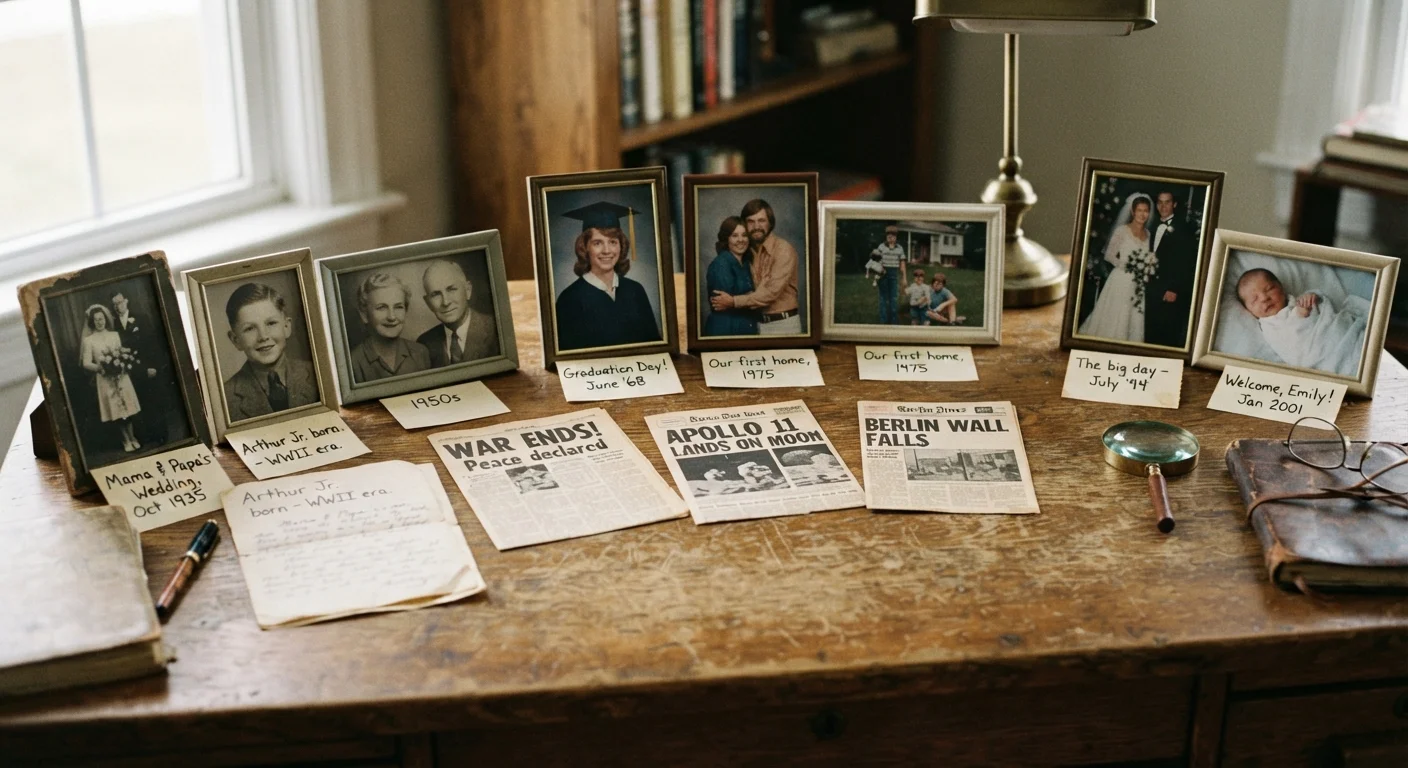
Photo: searchopenrecords editorial
—— In This Article
Key Takeaways
- Obituaries contain structured biographical data — dates, locations, and relationships — that anchor a family timeline.
- Sequencing records by birth year rather than death year reveals generational patterns more clearly.
- Gaps in your timeline often signal missing records worth searching for in public archives.
- Cross-referencing obituary dates with census data and vital records strengthens reliability.
- A simple spreadsheet or dedicated genealogy tool can serve as your timeline's foundation.
Why Obituaries Are Ideal Timeline Anchors
Every obituary, even a brief one, tends to compress a life into a handful of verifiable facts: a birth date, a hometown, a spouse's name, surviving children, and a date of death. That compression is precisely what makes obituaries so useful when building a family timeline. Unlike a single census record or a marriage certificate, an obituary often bridges two or three generations in a single paragraph.
When you layer obituaries from grandparents, parents, and siblings side by side, dates start connecting in ways that pure vital records sometimes don't. A grandmother's obituary may name a son who died young — a branch of the family tree you didn't know existed. A great-uncle's notice may list a birthplace that finally explains a gap in the census trail.
If you're new to extracting genealogical value from these documents, our practical field guide to reading obituaries for genealogy walks through exactly which details to record and verify. That foundation is worth building before you begin sequencing records into a timeline.
What You'll Need Before You Start
Gathering materials in advance prevents the common frustration of building a partial timeline and realising midway that key anchors are missing. Before you begin sequencing, assemble as many of the following as possible.
What you will need
Spreadsheet software (e.g. a standard grid application)
Used to enter, sort, and filter family events chronologically across multiple individuals.
Genealogy database software
Provides structured fields for births, deaths, and relationships, and can auto-generate timeline views.
Physical or digital copies of obituaries
Primary source documents from which biographical data is extracted and entered into the timeline.
Citation tracker or reference notebook
Records where each piece of information came from, so entries can be verified or disputed later.
Once you have obituaries in hand, our checklist of key details to gather before searching for an obituary can help you identify which family members still need records located before your timeline can be considered reasonably complete.
Step-by-Step: Building Your Timeline
Work through these steps in order. Each builds on the previous, so skipping ahead tends to create structural gaps you'll need to revisit.
Sort obituaries by the subject's birth year
Arrange every obituary you have by the birth year of the person it describes — not by the date of death or publication. This immediately reveals the generational structure of your family and shows you which branches overlap in time.
If a birth year isn't stated directly in the obituary, look for clues: age at death is usually mentioned, and subtracting from the death date gives a reliable estimate. Note any estimated dates clearly so you can revisit them.
Extract and log every named date and place
Work through each obituary methodically and record every explicit date and location mentioned: birth, marriage, military service, immigration, and death. Enter each as a separate row in your spreadsheet, linked to the individual and the source obituary.
Don't overlook indirect dates. Phrases like "after 40 years of marriage" or "a longtime resident of" can generate approximate anchor points worth recording alongside your confirmed dates.
Map family relationships across entries
Using the names listed in each obituary — survivors, predeceased relatives, and pallbearers — build a relationship column that links individuals to one another. A child listed as a survivor in a parent's obituary can be cross-referenced with that child's own obituary if you have it.
This cross-referencing often reveals individuals who appear in multiple obituaries under slightly different name spellings — a common source of duplication errors in family timelines.
Identify and flag timeline gaps
Once your entries are sorted chronologically, scan for gaps — periods of more than a generation where no records appear, or family branches that stop without explanation. List each gap explicitly as an open research question rather than leaving it blank.
Common gap causes include unpublished obituaries, records in non-digitised regional newspapers, name changes, and family members who relocated across state or country lines.
Add supporting records to strengthen anchor points
An obituary date becomes significantly more reliable when a second source — a census record, a death certificate, or a marriage license — confirms it. Go back through your timeline's most important anchor points and add at least one corroborating source per entry where possible.
Where sources conflict, document both versions and note which you consider more reliable and why. Transparency in your timeline protects future researchers who build on your work.
Review the completed timeline for internal consistency
Do a final pass checking for logical inconsistencies: a child born before a parent's listed marriage date, a death date preceding a birth date, or a person listed as a survivor in a later obituary who appears to have died earlier in your records. These inconsistencies usually indicate a data entry error, a name confusion, or a genuine historical anomaly worth investigating.
A clean, internally consistent timeline is not only more accurate — it forms a far stronger foundation if you later decide to write a fuller family narrative.
Interpreting Gaps and Inconsistencies
No family timeline built from obituaries will be perfectly continuous — and that's expected. Obituaries weren't written with future researchers in mind. Some family members received no published notice. Others were published in newspapers that haven't been digitised. Dates occasionally conflict between records.
When you encounter a gap, treat it as a research prompt rather than a failure. A missing sibling in one obituary but mentioned in another often means a death occurred young — and a corresponding death certificate may fill that space. Date discrepancies between an obituary and a birth certificate are common and worth noting explicitly in your timeline rather than silently correcting.
Pairing obituary data with census records, marriage licenses, and court filings dramatically reduces these uncertainties. Our guide on cross-referencing obituary details with other public records explains how to connect these sources systematically.
Once your timeline feels structurally sound, you may be ready to move toward narrative writing — transforming a column of dates into a readable family history. That next step is covered in detail in our article on turning raw obituary data into a coherent family history.

Obituary Search Editorial Team
Obituary Search Editorial Team is the collective byline for our editorial team and contributor network. Articles published under this byline or an editorial pen name are researched, written, and reviewed according to our editorial standards for clarity, consistency, and independence before publication.
View author profile