
The Anatomy of an Obituary: What Each Section Actually Tells You
From the lede to the survivors list, learn how obituaries are structured and what genealogical clues each part contains.
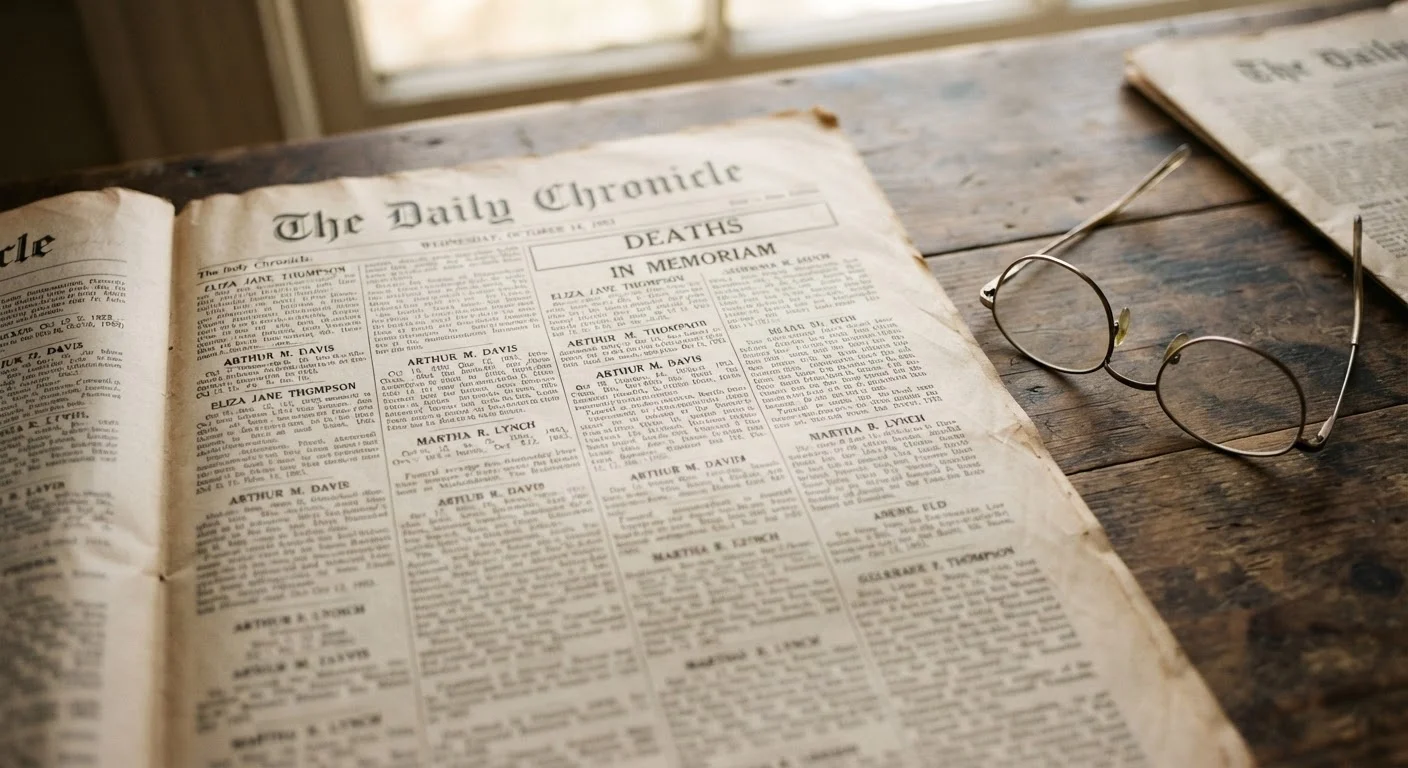
Photo: searchopenrecords editorial
—— In This Article
Key Takeaways
- The opening lede names the deceased and typically anchors the death to a place and date.
- Biographical narratives often reveal birthplaces, maiden names, migration histories, and occupations.
- The survivors list is a structured genealogical record of immediate and sometimes extended family.
- Service details — funeral homes, cemeteries, clergy — point to community affiliations and burial records.
- Obituaries reflect the choices of those who wrote them, so gaps and omissions are meaningful too.
The Opening Lede: Name, Date, and Place
Every obituary begins with an anchor statement that establishes who died, when, and where. This opening — sometimes called the lede — is the most standardized part of the format. It typically reads something like: ", , of , passed away on at ."
For researchers, this sentence alone can confirm a death date, link a name to a specific community, and sometimes reveal the cause or circumstances of death. The location of death — a hospital, a hospice, a family home — can hint at health history or family geography. If the lede mentions a hometown that differs from where the person lived, it may signal migration patterns worth tracing through census or vital records.
Pay attention to how names are rendered. Women's obituaries in older publications often list a married name in the headline with a maiden name parenthetically — a detail that can unlock an entire prior family branch. See our guide to hidden genealogical data in obituaries for more on this.
The Biographical Narrative: A Life in Compressed Form
The biographical section is where an obituary moves from announcement to story. Here, families describe the arc of a person's life — birthplace, education, career, military service, religious affiliation, community involvement, and personal passions. This is the richest genealogical terrain in the entire document.
Record Every Place Name You Encounter
Geographic details — birthplaces, hometowns, counties, even the names of hospitals or churches — are research coordinates. Each location in an obituary's biographical section can point you toward a specific archive, vital records office, or historical society. Keep a running list as you read, even if you're not sure how to use every place name yet.
Birthplace details are particularly significant. A phrase like "born in County Cork, Ireland, before immigrating to Chicago" gives you a geographic origin, a likely immigration window, and a destination — three coordinates that can guide research into ship manifests, naturalization records, and city directories. Occupation mentions may connect to trade union records or employer archives. Military service references can lead to service records held at the National Archives.
This section is also where family origin stories, ethnic heritage, and religious tradition often surface — details that help contextualize where to search next. For a deeper look at how obituaries interact with the broader public records ecosystem, the Obituary Records Explained article provides useful background.
The Survivors List and 'Preceded in Death' Section
The survivors list is effectively a snapshot of a family tree at the moment of death. It names the people left behind — typically in a conventional order: spouse, children (with spouses), grandchildren, siblings, and sometimes nieces, nephews, or close friends. Relationships are stated explicitly, which makes this section unusually direct as a genealogical source.
Its counterpart, the "preceded in death by" clause, names relatives who died earlier. Together, these two elements can map two or three generations of a family in a single paragraph. Note maiden names listed for daughters or sisters — these frequently appear here and nowhere else in the public record.
Be aware that survivors lists reflect the choices of whoever wrote the obituary. Estranged relatives, children placed for adoption, or family members from a previous marriage may be omitted entirely. The What an Obituary Actually Records — and What It Leaves Out article explores why these gaps matter and how to work around them.
Service Details and Institutional Affiliations
The closing section of most obituaries lists practical information: funeral home, visitation hours, memorial service location, officiant's name, and burial site. For readers grieving in the present, this is logistical. For researchers working in the past, it's a directory of institutions that may hold additional records.
The name of the funeral home points to an establishment that likely holds an internal death register. The cemetery name leads to burial records and potentially a findable grave marker — both of which can confirm dates and family relationships. The name of a clergy member or congregation links the deceased to a specific church or religious community, which may have maintained its own baptismal, marriage, and burial registers.
Charitable donation requests — "in lieu of flowers, donate to..." — can also indicate the cause of death or a deeply held community commitment, both of which add texture to a family narrative. Once you've studied the structure, our practical field guide to reading obituaries for genealogy can help you apply these skills systematically to your own research.
Frequently Asked Questions

Obituary Search Editorial Team
Obituary Search Editorial Team is the collective byline for our editorial team and contributor network. Articles published under this byline or an editorial pen name are researched, written, and reviewed according to our editorial standards for clarity, consistency, and independence before publication.
View author profile