
Phone Scam Red Flags Every Caller Should Know
From wire transfer demands to "do not tell anyone" warnings, these are the clearest signals that a call is not what it claims to be.
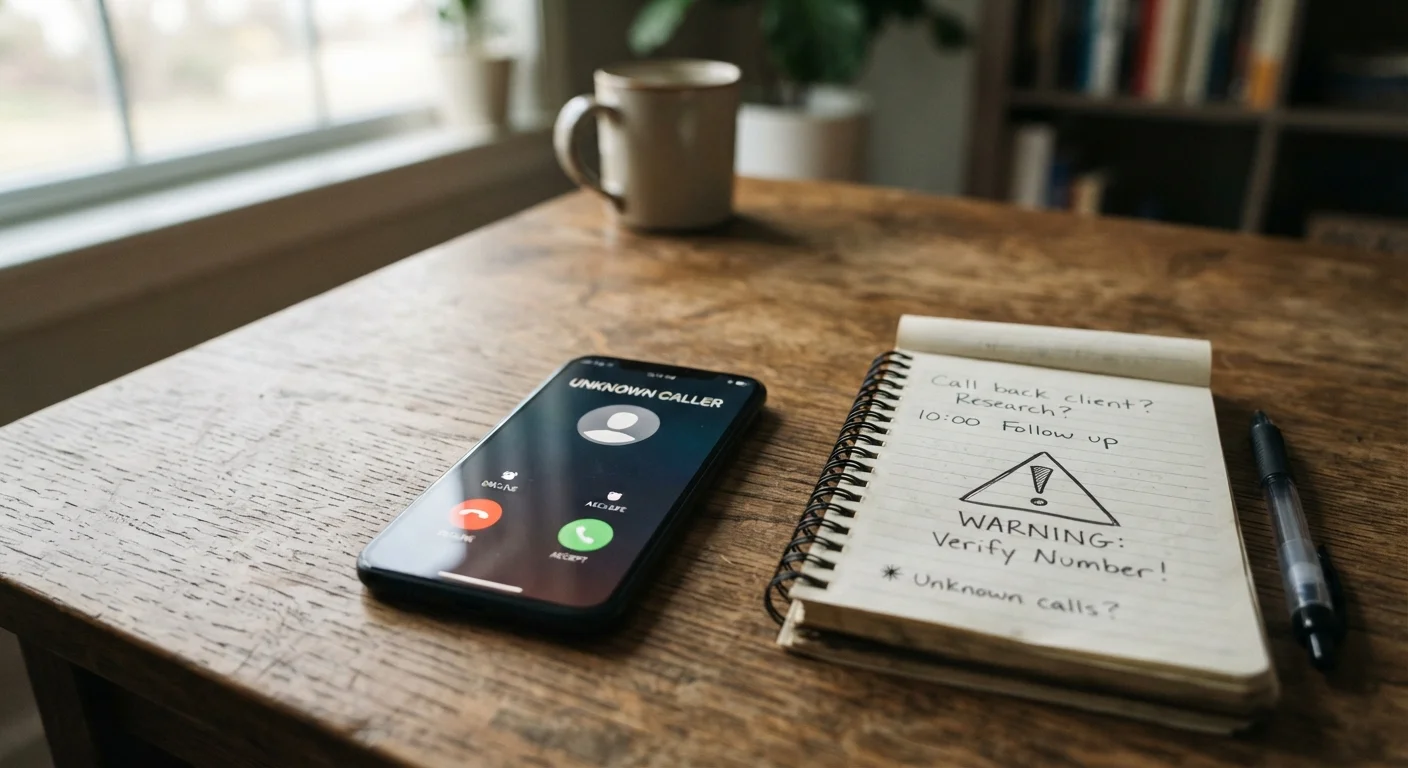
Photo: searchopenrecords editorial
—— In This Article
Key Takeaways
- Legitimate organizations never demand wire transfers, gift cards, or cryptocurrency as payment.
- Urgent secrecy demands — 'don't tell anyone' — are a hallmark scam manipulation tactic.
- Caller ID can be spoofed; a familiar or official-looking number is not proof of identity.
- Unsolicited calls claiming you've won a prize or owe an immediate debt are almost always fraudulent.
- Reverse phone lookup tools can help verify an unknown number before you engage.
Why Phone Scams Still Work
Phone scammers don't succeed because their targets are naive — they succeed because the tactics are engineered to overwhelm judgment. Scam calls are designed to create a narrow window in which the victim acts before thinking. Understanding how that window is manufactured is the first step to keeping it closed.
The red flags below are not random quirks of bad actors. They are deliberate, repeatable techniques that appear across virtually every major phone fraud scheme documented by the Federal Trade Commission (FTC) and the Consumer Financial Protection Bureau (CFPB). Recognizing even one of them mid-call is enough to stop a scam in its tracks.
For broader context on how scammers manipulate caller identity itself, see how fraudsters use your own number against you.
Demands for wire transfer, gift cards, or cryptocurrency
No legitimate business, government agency, or court will ever instruct you to pay a debt or fee using a wire transfer, prepaid gift card, or cryptocurrency. These payment methods are favored by scammers specifically because they are difficult or impossible to reverse once completed. If a caller specifies an unusual payment method, treat it as an immediate disqualifier regardless of how official the call sounds.
Gift cards and wire transfers are irreversible — that's exactly why scammers demand them.
Instructions to keep the call secret
A caller who tells you not to discuss the situation with a family member, friend, or attorney is attempting to isolate you from the people most likely to recognize the scam. Phrases like "this is a confidential matter" or "do not tell anyone until this is resolved" are deliberate manipulation designed to prevent outside perspective from interrupting the fraud. Legitimate institutions do not operate this way.
Isolation is a tactic; any caller demanding secrecy is removing your safety net on purpose.
Artificial urgency and countdown pressure
Scammers manufacture time pressure to prevent you from pausing to think or verify. You may be told that a warrant will be issued within the hour, that an account will be frozen by end of day, or that a prize expires immediately. Real legal and financial processes have defined timelines and written notices — they do not hinge on a phone call made right now. The scripted pressure tactics behind this urgency follow a predictable pattern once you know what to look for.
Manufactured deadlines are designed to bypass rational thinking — slow down instead of speeding up.
Caller ID that appears official or local
Caller ID spoofing allows a scammer to display any number they choose — including numbers that appear to belong to the IRS, a local police department, or even your own bank. A number that looks familiar or official is not evidence that the call is legitimate. This technique is well-documented and widely used. Evaluating the content of the call — not the displayed number — is the only reliable filter.
A caller ID showing a government or bank number proves nothing; spoofing is trivially easy for bad actors.
Unsolicited prize or refund notifications
If you receive an unexpected call notifying you that you've won a lottery, sweepstakes, or are owed a refund from a company — especially one you never contacted — skepticism is warranted. Legitimate prize notifications come through verifiable, documented channels. Scammers use this framing to build goodwill before pivoting to a "processing fee" or request for personal information. Contests that require payment to claim winnings are unlawful in the United States.
You cannot win a contest you never entered — unsolicited prize calls almost always lead to a payment demand.
Requests for Social Security numbers or account credentials
Requests for your Social Security number, bank account number, or online login credentials during an unsolicited call should always be refused. Even if a caller correctly states some of your personal information — which may be obtained from data breaches or public records — that does not verify their identity or authority. Providing these details gives a scammer the raw material for identity theft. The Social Security Administration has stated publicly that it will not ask for your SSN over the phone in most circumstances.
Knowing some of your personal details does not make an unknown caller trustworthy or legitimate.
Threats of arrest, deportation, or legal action
Fear of law enforcement is one of the most reliable levers scammers use to force compliance. Callers may claim to be federal agents, sheriff's deputies, or immigration officials and threaten immediate arrest if payment is not made. In reality, law enforcement agencies do not call individuals to demand payments over the phone — criminal proceedings involve in-person contact and written legal documentation. This tactic is especially common in government impersonation schemes targeting older adults; resources for families can help address this specific vulnerability.
Real law enforcement does not call to demand payment — threats of immediate arrest are a classic scam script.
What to Do When You Spot a Red Flag
The most effective response to any suspicious call is the same: hang up and independently verify. Do not use a callback number provided during the call. Instead, look up the official number for the agency or company through its verified website or a printed statement.
If the caller claimed to represent a government agency, remember that the IRS, SSA, and Medicare all have documented policies about how they initiate contact. Government impersonation scams are among the most reported fraud categories in the US, and knowing what real agencies actually do — and don't do — is a reliable filter.
For unknown numbers you want to investigate before or after a call, reverse phone lookup tools can surface publicly available data about a number's registration, carrier, and reported activity. You can also review signals that a phone number may be linked to a scam to understand what data patterns are commonly associated with fraudulent numbers.
Finally, habits matter as much as knowledge. Certain common habits — like engaging with automated prompts or answering every call — make scammers measurably more effective. Reducing your exposure is a practical, ongoing form of protection.

Phone Lookup Editorial Team
Phone Lookup Editorial Team is the collective byline for our editorial team and contributor network. Articles published under this byline or an editorial pen name are researched, written, and reviewed according to our editorial standards for clarity, consistency, and independence before publication.
View author profile