
Tracing a Document Back to Its Official Source
Learn how to verify that a public record you found online originates from an authoritative government source rather than an unverified copy.
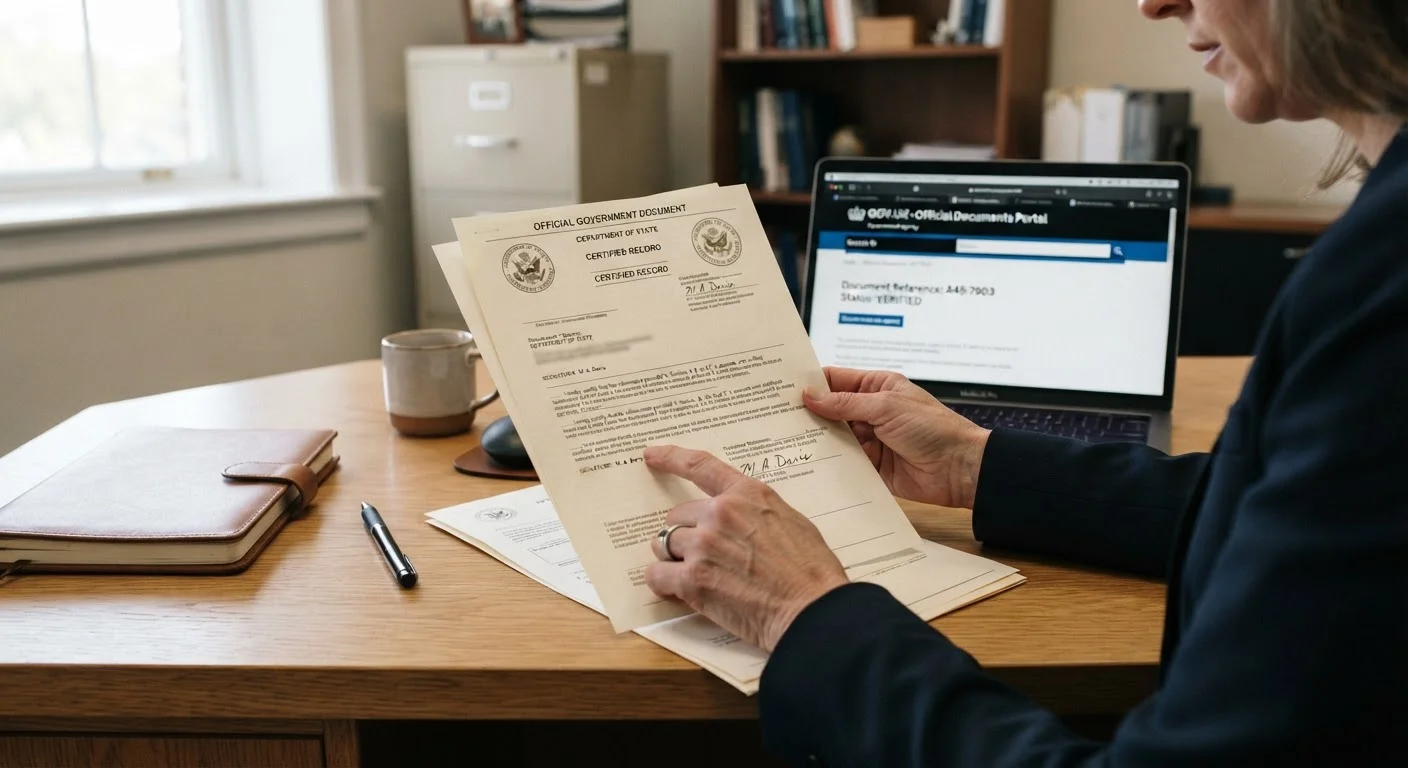
Photo: searchopenrecords editorial
—— In This Article
Key Takeaways
- Every legitimate public record has an originating government agency — finding it is the cornerstone of verification.
- Government-hosted portals and official .gov domains are the most reliable starting points for source confirmation.
- Third-party aggregator sites may display accurate data but are not authoritative sources on their own.
- Comparing document details such as case numbers, filing dates, and agency stamps helps confirm authenticity.
- FOIA requests and direct agency contact remain valid fallback options when online access is limited.
Why Source Verification Matters
Finding a public record online is easy. Knowing whether what you found is accurate, complete, and genuinely government-issued is a different skill entirely. Data aggregators, genealogy platforms, and background check services all pull from public record repositories — but they are intermediaries, not authorities. A copied or reformatted document can contain transcription errors, outdated entries, or data merged incorrectly from multiple individuals.
Before relying on any record for a legal, financial, or genealogical purpose, you need to trace it back to the agency that created it. This is the only way to confirm it hasn't been altered, misattributed, or pulled from a stale snapshot. For a broader look at how background check data flows through these intermediary layers, see our article on where background check data actually comes from.
Start With the Government Source, Not the Aggregator
It can be tempting to accept what a third-party records site shows — especially when the presentation looks polished and official. However, the most efficient verification path is to go directly to the government custodian first and only use aggregator results as a pointer, not as confirmation. This single habit eliminates most source credibility problems before they start.
What You'll Need Before You Start
Gathering the right starting information saves significant time. Before beginning your source trace, have the following on hand:
What you will need
Step-by-Step: Tracing a Document to Its Official Source
Follow these steps in order. Each one narrows the gap between an unverified copy and a confirmed government record.
Identify the Record Type and Its Custodial Agency
Every public record belongs to a specific category — court filing, vital record, property deed, voter registration, and so on — and each category has a legally designated custodian. Determine which type of record you have, then identify the government body responsible for maintaining it in the relevant jurisdiction.
- Court records: clerk of the relevant court (federal, state, county, or municipal)
- Birth, death, and marriage certificates: state or county vital records office
- Property records: county assessor or recorder of deeds
- Business filings: state secretary of state office
Locate the Agency's Official Website
Search for the agency directly using a reliable search engine, then confirm the domain. Official U.S. government sites use .gov domains. State agency sites may use .state.[abbreviation].us formats, though many now redirect to .gov. Avoid clicking through to aggregator results; type the agency name and look for the verified government URL.
Search the Agency's Own Database or Portal
Most custodial agencies provide at least a basic online search tool. Enter the identifying details from your document — full name, case or document number, filing date, or jurisdiction — and compare the results with what you already have. Key fields to cross-reference include:
- Case or document number
- Filing or recording date
- Parties named on the record
- Issuing agency name and any seal or stamp
An exact match across these fields is a strong indicator that the copy you found reflects the official record.
Note Any Discrepancies Between the Copy and the Official Record
If the document you found differs from what the agency's portal shows — even in minor details like a middle initial, address, or date — treat that as a red flag. Small discrepancies can indicate data entry errors at the aggregator level, merged records from different individuals, or an outdated snapshot. Document the differences in writing before drawing conclusions.
Cross-Reference With a Second Independent Source
Where possible, confirm your findings using a second government source that would logically reference the same event. For example, a death record might be corroborated by a probate court filing or a Social Security Death Index entry. A property deed can be cross-referenced against tax assessment records from the same county. This triangulation approach significantly increases confidence in the record's authenticity. For guidance on applying this method to address data specifically, see our address verification checklist.
When a Document Cannot Be Found Online
Not every public record is digitized or freely accessible through a government portal. Older records, records from smaller jurisdictions, and certain court filings may exist only in physical archives. In these cases, two paths remain open to you.
Direct agency contact: Call or write to the custodial agency — the clerk of court, vital records office, or county recorder — and request a certified copy or confirmation of the document's existence. Certified copies carry an official seal and are legally recognized as authentic.
Formal information requests: At the federal level, the Freedom of Information Act (FOIA) gives the public the right to request agency records. Most states have equivalent sunshine laws governing state and local agencies. These processes take time — federal agencies have up to 20 business days to acknowledge a request — but they produce authoritative responses directly from the source. Understanding these frameworks is foundational to navigating public records responsibly, as explained in our complete online records workflow guide.
If an online source you're currently relying on shows signs of poor sourcing — vague update schedules, no agency attribution, or data that conflicts with what you find elsewhere — review our guidance on signs that an online records source may not be trustworthy before proceeding.

Public Records 101 Editorial Team
Public Records 101 Editorial Team is the collective byline for our editorial team and contributor network. Articles published under this byline or an editorial pen name are researched, written, and reviewed according to our editorial standards for clarity, consistency, and independence before publication.
View author profile