
Open Records vs. Open Meetings: Two Pillars of Government Transparency
Open records and open meetings laws are related but distinct. See how each one works and together how they hold government accountable.
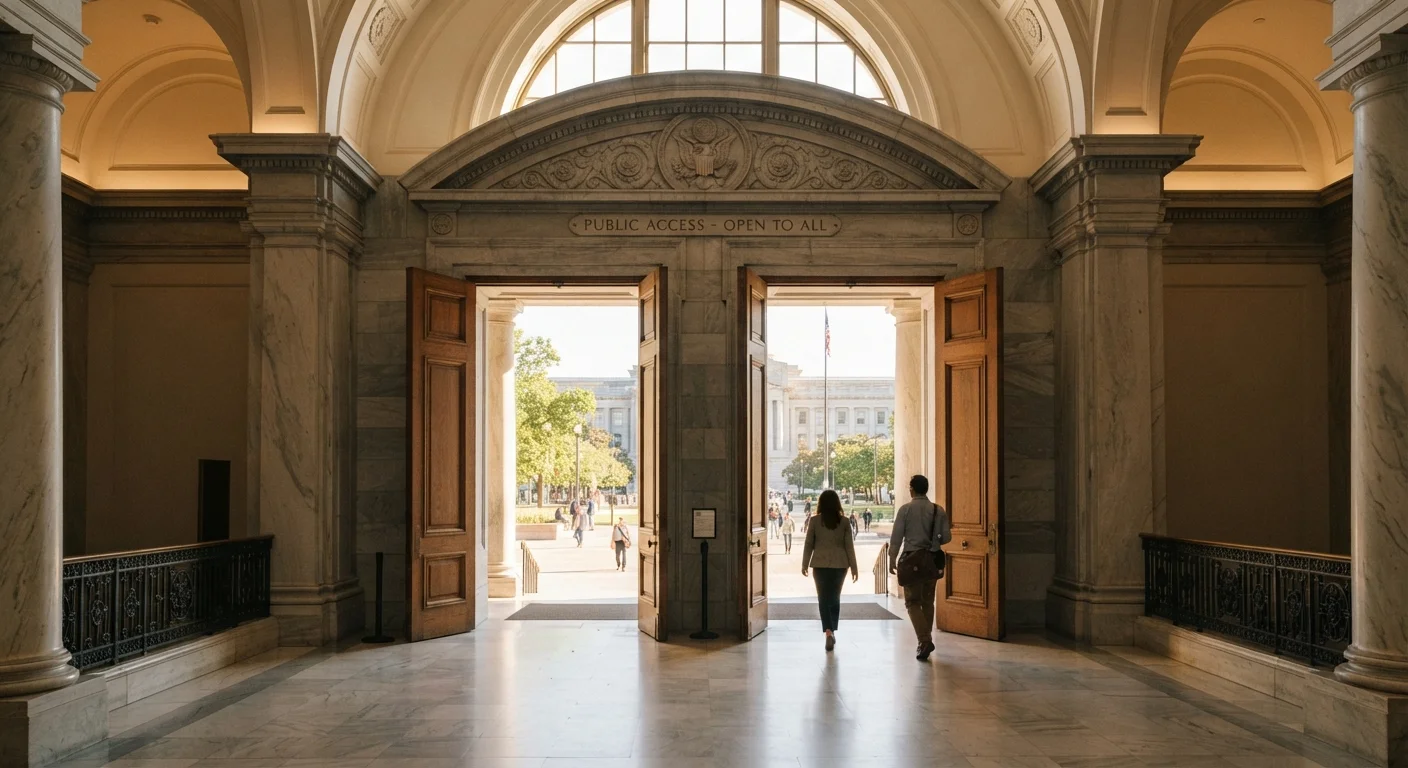
Photo: searchopenrecords editorial
—— In This Article
Key Takeaways
- Open records laws grant access to existing government documents; open meetings laws guarantee the right to observe government deliberations as they happen.
- Both frameworks exist at the federal and state level, and state-level rules vary significantly in scope and exemptions.
- Violations of either law can often be challenged through administrative complaints or civil litigation.
- Neither law is absolute — both include defined exemptions protecting privacy, security, and ongoing investigations.
- Understanding which law applies to your situation determines how and where you file your request or access claim.
Two Laws, One Goal
Government transparency in the United States rests on two distinct legal pillars: open records laws and open meetings laws. Both exist to prevent government from operating in secrecy, but they target different aspects of that goal. Understanding how they differ — and how they complement each other — is essential for anyone who wants to exercise their rights as a member of the public.
Open records laws (often called FOIA at the federal level, or sunshine laws or public records acts at the state level) give you the right to request and obtain existing documents held by government agencies. Open meetings laws, by contrast, give you the right to witness government deliberations as they occur — before decisions are finalized.
For a broader look at how these frameworks fit into the overall transparency landscape, see our plain-language guide to sunshine laws. For a deeper dive into how federal and state rules diverge, federal vs. state public records laws is a useful companion read.
How Open Records Laws Work
Open records laws operate on a straightforward principle: government documents belong, in a meaningful sense, to the public. The federal Freedom of Information Act (enacted in 1966) requires most executive branch agencies to release records upon written request unless a specific statutory exemption applies. Every U.S. state has its own equivalent statute — names vary ("Public Records Act," "Government Data Practices Act," "Sunshine Law") but the core mechanism is the same.
A requester submits a written demand to the agency that holds the records, describes what they are seeking, and the agency must respond within a legally prescribed timeframe — typically 10 to 20 business days at the federal level, with state deadlines varying widely. Agencies may charge reasonable fees for search and duplication. They may also withhold records that fall under recognized exemptions, such as classified national security information, ongoing law enforcement investigations, or personal medical records protected under privacy statutes.
Importantly, open records laws are reactive: they apply to documents that already exist. An agency is not required to create new records, compile custom analyses, or answer questions in narrative form. What qualifies as a public record is itself a nuanced question worth understanding before filing a request.
| Criterion | Open Records Laws | Open Meetings Laws |
|---|---|---|
| Primary right granted | Access to existing government documents | Right to observe government deliberations live |
| Federal framework | Freedom of Information Act (FOIA, 1966) | Government in the Sunshine Act (1976) |
| How you exercise the right | Submit a written records request to an agency | Attend a publicly noticed government meeting |
| Timing | Reactive — applies to records already created | Proactive — occurs before decisions are finalized |
| Common exemptions | National security, privacy, ongoing investigations | Litigation strategy, personnel matters, real estate negotiations |
| Who is covered | Executive agencies holding government records | Multi-member deliberative bodies (councils, boards, commissions) |
| State variation | High — deadlines, fees, and scope differ by state | High — notice periods and closed-session rules differ by state |
How Open Meetings Laws Work
Open meetings laws — sometimes called "sunshine laws" in their meeting-specific application — require government bodies that make decisions on behalf of the public to do so in public view. At the federal level, the Government in the Sunshine Act of 1976 covers certain multi-member federal agencies. State-level equivalents govern city councils, county commissions, school boards, zoning boards, and many other deliberative bodies.
The core requirement is that official meetings be announced in advance (typically with 24 to 72 hours' public notice), held in accessible locations, and open to observation by any member of the public. Meeting agendas, votes, and minutes are generally required to be preserved and made available afterward — which is where open records and open meetings laws begin to overlap.
Open meetings laws also address executive sessions — private closed-door deliberations that are permitted only for specific reasons defined by statute, such as discussing pending litigation, negotiating real estate acquisitions, or reviewing individual personnel matters. A body that improperly retreats into executive session may be subject to legal challenge.
It's worth noting that the line between what's public and what's protected isn't always obvious. For nuance on where privacy protections begin, the Privacy & Limits hub is a helpful resource.
Where the Two Laws Intersect
Open records and open meetings laws reinforce each other in practice. When a public body holds a meeting, it typically generates records — agendas, minutes, audio recordings, and written resolutions. Those records then become subject to open records laws, meaning you can request them even if you were unable to attend in person.
Conversely, open meetings laws create accountability for what open records later reveal. If agency documents show that a significant policy decision was finalized outside a properly noticed public meeting, that is itself a potential legal violation.
Courts and attorneys general offices across the country regularly interpret the interaction of both frameworks. If you believe either law has been violated, most states have an oversight mechanism — often the state attorney general's office or a dedicated ombudsman — where complaints can be filed without hiring an attorney. Civil litigation is also an avenue, and some statutes allow prevailing plaintiffs to recover attorney fees.
For context on how court records themselves fit into the public access picture, see common misconceptions about public access to court records. And for a full overview of your rights under U.S. transparency law, your rights under U.S. public records law is the logical next step.

Public Records 101 Editorial Team
Public Records 101 Editorial Team is the collective byline for our editorial team and contributor network. Articles published under this byline or an editorial pen name are researched, written, and reviewed according to our editorial standards for clarity, consistency, and independence before publication.
View author profile