
Federal vs. State Public Records Laws: Key Differences
Federal and state governments follow different transparency rules. Here's how those frameworks diverge and what that means for records access.
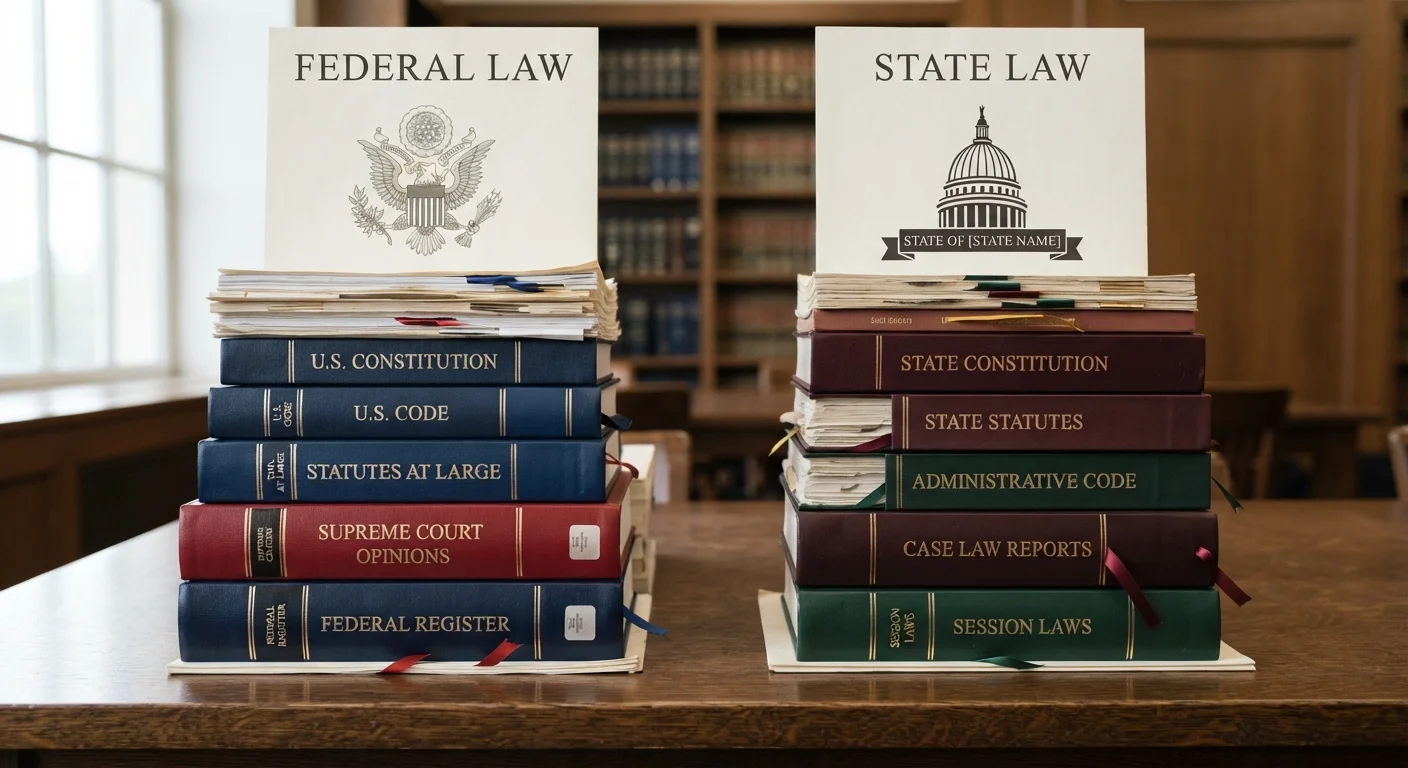
Photo: searchopenrecords editorial
—— In This Article
Key Takeaways
- FOIA governs federal agency records; each state has its own separate open-records statute.
- Response timelines, fees, and exemptions differ significantly between federal and state frameworks.
- State laws often cover a broader range of government bodies than FOIA does.
- Federal privacy laws like HIPAA and FERPA apply nationwide and limit access at both levels.
- Knowing which government tier holds the record you need determines which law to invoke.
The Two Frameworks at a Glance
Public records access in the United States runs on two parallel but legally distinct tracks. At the federal level, the Freedom of Information Act (FOIA), enacted in 1966, gives any person the right to request records from executive branch agencies. At the state level, each of the 50 states has enacted its own open-records statute — variously called sunshine laws, public records acts, or freedom of information laws — that apply to state and local government bodies.
These frameworks do not overlap. FOIA cannot compel a city police department to release a report, and a state sunshine law has no authority over the U.S. Department of Justice. Understanding which tier of government holds the record you need is therefore the essential first step. See our guide to which government level holds which record for a practical breakdown by document type.
| Criterion | Federal FOIA | State Sunshine Laws |
|---|---|---|
| Governing statute | Freedom of Information Act (5 U.S.C. § 552) | 50 separate state statutes |
| Agencies covered | Federal executive branch agencies | State, county, and local government bodies |
| Standard response window | 20 business days | 3–10+ business days (varies by state) |
| Number of exemptions | 9 enumerated exemptions | Varies widely; often more numerous |
| Fee structure | Standardized; fee waivers available | Set by each state; highly variable |
| Appeal mechanism | Administrative appeal, then federal court | State administrative or judicial process |
| Who may request | Any person (including non-citizens) | Varies; some states limit to residents |
How Response Rules and Exemptions Diverge
FOIA sets a 20-business-day standard response window for federal agencies, though complex requests or agency backlogs routinely extend that timeline. Agencies may charge fees for search, duplication, and review — though fee waivers are available for journalists, educators, and others who qualify under the statute.
State timelines vary considerably more. Some states require a response within 3 to 5 business days; others allow 10 days or more. A handful of states impose no firm statutory deadline at all. Fee schedules are equally inconsistent — a document that costs cents per page in one state may cost several dollars in another. Our state-by-state differences in public records access reference details those variables by jurisdiction.
Exemptions also diverge. FOIA contains nine enumerated exemptions covering areas such as national security, internal personnel rules, trade secrets, and law-enforcement investigations. State exemptions are often more numerous and more specific — some states exempt certain categories of records that federal law would require to be disclosed, and vice versa. This is a key reason why the same record can be public in one state and sealed in another.
Federal Privacy Laws That Cut Across Both Levels
Several federal statutes impose privacy limits that apply regardless of whether the underlying records are held by a federal or state agency. These laws do not grant access — they restrict it:
- HIPAA (Health Insurance Portability and Accountability Act): Protects individually identifiable health information held by covered entities, including state public hospitals.
- FERPA (Family Educational Rights and Privacy Act): Restricts access to student education records at federally funded institutions, including state universities and public schools.
- DPPA (Driver's Privacy Protection Act): Limits who may obtain personal data from state motor vehicle records.
These statutes create a federal floor of privacy protection that state open-records laws cannot override. A state may choose to be more restrictive, but it cannot use its sunshine law to compel disclosure of records protected by a federal privacy statute. For a plain-language breakdown, see federal privacy laws that shape what you can access.
FOIA Does Not Cover Every Federal Body
FOIA applies specifically to the federal executive branch. The U.S. Congress, federal courts, and the Executive Office of the President (in most capacities) are not subject to FOIA. Records from those bodies may be accessible through separate statutory mechanisms or official publication requirements, but the FOIA request process does not apply to them.
Practical Implications for Records Seekers
For most everyday requests — property records, local court filings, police incident reports, county health department documents — a state sunshine law request is the correct mechanism. FOIA is specifically for federal executive-branch agencies; it does not apply to Congress, federal courts, or the President's immediate staff, and it has no reach over state or local governments.
When a matter involves both levels — for example, a federally funded state program or a joint law-enforcement task force — requesters may need to file separately under both frameworks. Federal and state court records illustrate this split well: federal court filings live in the PACER system, while state court records are managed by individual state judiciaries under their own access rules.
Transparency at either level is also shaped by open-meetings laws, which govern government deliberations rather than documents. Those rules operate alongside — not instead of — open-records statutes. Our open records vs. open meetings explainer covers how the two pillars interact. Knowing both frameworks, and which tier of government you are dealing with, is what separates a successful records request from a frustrating dead end.

Public Records 101 Editorial Team
Public Records 101 Editorial Team is the collective byline for our editorial team and contributor network. Articles published under this byline or an editorial pen name are researched, written, and reviewed according to our editorial standards for clarity, consistency, and independence before publication.
View author profile