
Federal, State, and County: Which Level Holds the Record You Need
Public records are distributed across multiple government tiers. This reference guide explains which jurisdiction maintains which type of document.
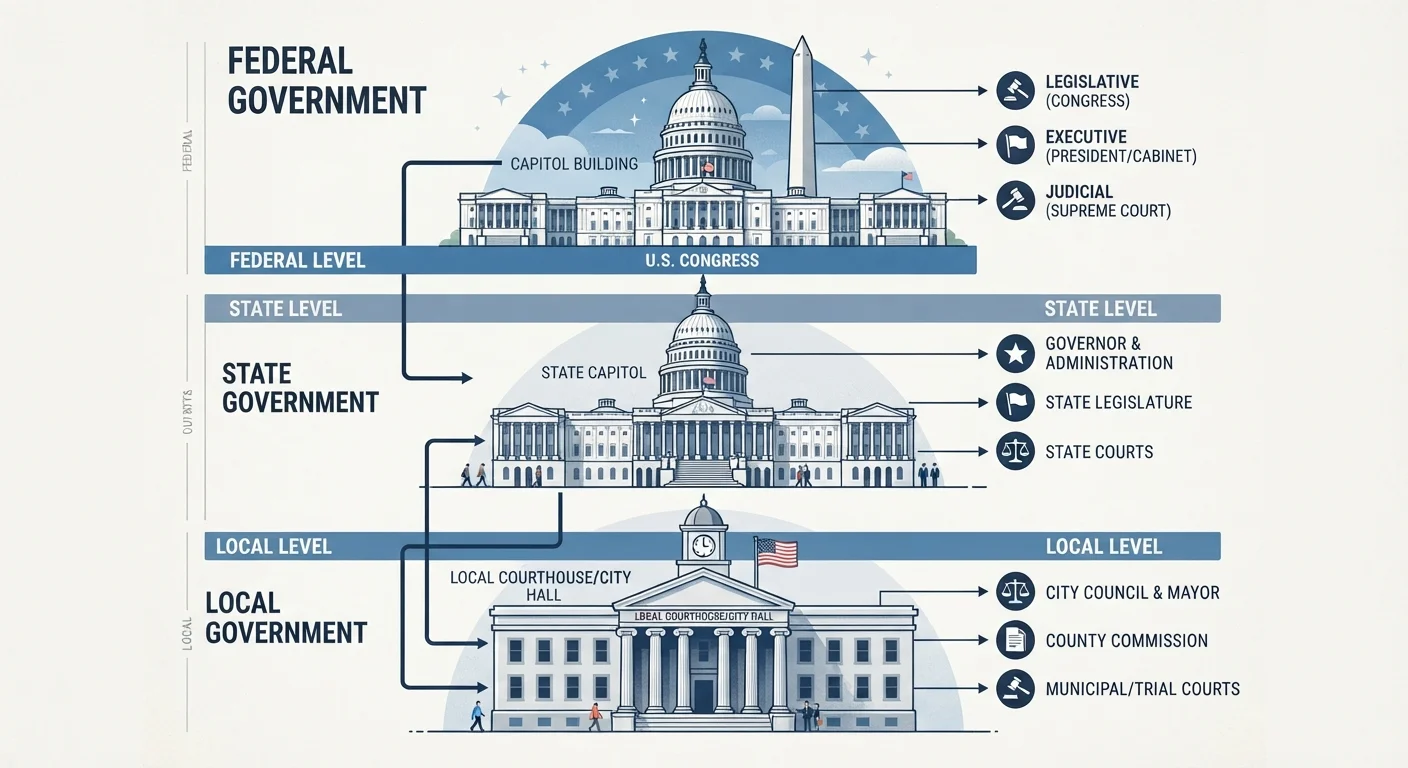
Photo: searchopenrecords editorial
—— In This Article
Why Government Level Matters for Record Searches
When you need a public record — whether it's a court filing, a property deed, or a vital record — the single most practical question is: which level of government created and maintains it? Searching at the wrong level wastes time and can lead you to conclude a record doesn't exist when it simply lives elsewhere.
The U.S. public records system is deliberately decentralized. Authority flows from the federal government down through fifty state systems, each of which delegates further authority to counties, parishes, or municipalities. Understanding that structure is the starting point for any effective search. See our overview of how records work for the legal framework behind these divisions.
What the Federal Government Holds
Federal agencies generate and maintain records tied to matters of national jurisdiction. These include:
- Immigration and naturalization records — U.S. Citizenship and Immigration Services (USCIS) holds naturalization petitions, alien registration files, and related documents.
- Federal court records — Cases heard in U.S. District Courts, Courts of Appeal, and Bankruptcy Courts are indexed through PACER (Public Access to Court Electronic Records).
- Military service records — The National Personnel Records Center (NPRC) maintains separation documents such as the DD-214.
- Patent and trademark filings — The U.S. Patent and Trademark Office (USPTO) maintains these as public records.
- Federal agency records under FOIA — The Freedom of Information Act requires most executive branch agencies to release non-exempt records upon request.
Federal records generally follow uniform national rules, but response timelines and exemptions vary by agency. For a side-by-side look at federal versus state transparency frameworks, see our article on federal vs. state public records laws.
What State Governments Hold
State-level agencies serve as the primary custodians for a broad category of records that require centralized oversight but apply only within a single state's borders. Common examples include:
- Vital records — Birth and death certificates are filed with the state's vital statistics office. Marriage and divorce records may be split between the state and the county where the event occurred.
- Professional licenses — Licensing boards for physicians, attorneys, contractors, and other regulated professions maintain disciplinary and credential records at the state level.
- Statewide criminal history repositories — Most states operate a central criminal history database aggregated from local law enforcement and courts.
- Corporate and business filings — Secretaries of state maintain incorporation documents, registered agent information, and annual reports.
- Sex offender registries — Required under federal law but administered at the state level.
Access rules differ significantly from state to state. State-by-state differences in public records access covers the key variables — fees, timelines, and exemptions — that affect your search.
What County and Local Governments Hold
Counties and municipalities are the custodians of the most granular, property- and event-specific records. These are often the first stop for genealogy research, real estate due diligence, or civil court matters.
- Property and land records — Deeds, mortgages, liens, and title transfers are recorded with the county recorder or register of deeds.
- Probate and estate records — Wills, estate inventories, and letters of administration are filed in county probate or surrogate courts.
- Local court records — Traffic violations, small claims, misdemeanor cases, and some felony proceedings originate at the county or municipal court level.
- Property tax assessments — County assessors maintain valuation records and tax rolls, which are almost universally public.
- Local permits and zoning records — Building permits, zoning variances, and inspection records are held by city or county planning departments.
Because county offices are autonomous, formats and online availability vary widely. Many smaller counties have not fully digitized older records. For a deeper look at how jurisdiction affects background check results specifically, see background check records across government levels.
Understanding how records are originally created and where they land is foundational. Our article on how public records are created, stored, and maintained walks through that lifecycle in detail.

Public Records 101 Editorial Team
Public Records 101 Editorial Team is the collective byline for our editorial team and contributor network. Articles published under this byline or an editorial pen name are researched, written, and reviewed according to our editorial standards for clarity, consistency, and independence before publication.
View author profile