
Claiming Funds Across Multiple States at Once
Property can be held by more than one state. Learn how to manage parallel claims without duplicating effort or missing deadlines.
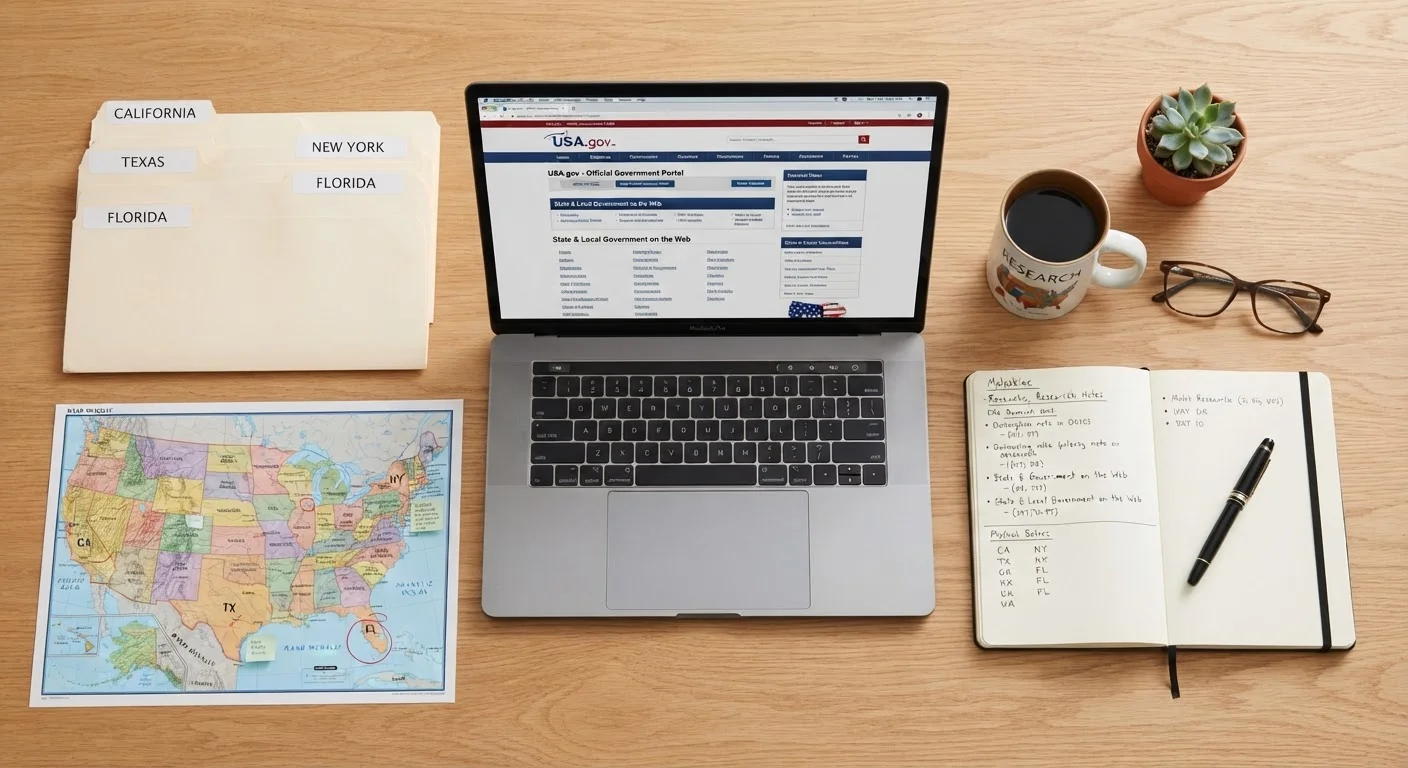
Photo: searchopenrecords editorial
—— In This Article
Key Takeaways
- Unclaimed property can be held by more than one state simultaneously, depending on where you lived or worked.
- Each state maintains its own portal and claim process — there is no single universal filing system.
- MissingMoney.com allows multi-state searches from one interface, reducing duplicated effort.
- Tracking deadlines and documentation requirements separately for each state is essential.
- Submitting claims in parallel — rather than sequentially — saves significant time.
Why Your Unclaimed Property May Be Spread Across States
When people move, change jobs, or hold accounts in different states, unclaimed property can accumulate in multiple state treasuries at once. A forgotten bank account from a college town, an uncashed paycheck from a former employer in another state, or a life insurance policy linked to a previous address can each land with a different state's unclaimed property program.
Under the Uniform Unclaimed Property Act — the model law most states have adopted in some form — funds are generally remitted to the state of the owner's last known address. If that address was in Pennsylvania, the property goes to Pennsylvania. If a second asset had a Texas billing address on file, Texas holds it. Neither state notifies the other, and neither notifies you automatically. As a result, it is entirely normal for one person to have legitimate claims pending in three or four states simultaneously.
To understand how state programs differ in dormancy periods and claimable asset types, see our guide on how unclaimed property laws vary across U.S. states. Being aware of those differences before you begin will help you set realistic expectations for each claim.
What You Need Before You Start
Gathering your materials upfront prevents delays once you begin submitting claims. Because each state has its own documentation checklist, assembling a complete personal history first gives you a single source of truth to draw from.
What you will need
MissingMoney.com
NAUPA-endorsed multi-state search portal that queries participating state databases simultaneously, reducing duplicate search effort.
Individual State Treasurer Portals
Official portals where claims are submitted directly; some states are not on MissingMoney.com and must be searched separately.
Personal Records Spreadsheet
A self-maintained log tracking each state claim's reference number, submission date, documents sent, and follow-up deadlines.
Document Scanner or Scanning App
Creates digital copies of identity and address documents required for claim submissions, many of which accept digital uploads.
Notary Service
Some states require notarized claim forms; a notary at a bank branch or UPS Store can fulfill this requirement.
Step-by-Step: Filing Claims Across Multiple States
The process below is designed to minimize redundant work. By searching broadly first, then organizing by state, you avoid the common mistake of filing piecemeal and losing track of what has been submitted where.
Run a Broad Multi-State Search First
Begin at MissingMoney.com, the NAUPA-endorsed portal that searches multiple state databases at once. Enter your full legal name and last known zip code. Then repeat the search using any prior surnames, maiden names, or name variations. Note every result, regardless of dollar amount, along with the holding state for each.
For states not covered by MissingMoney.com — notably California, New York, and Texas, which maintain their own standalone portals — visit each state treasurer's website directly. Our hub on searching state databases lists official portals for all 50 states.
Organize Results by State
Create a row in your tracking spreadsheet for each result. Group rows by state. For each state, note the official claim portal URL, any stated processing time listed on the site, and whether the state accepts online submissions or requires paper forms.
This grouping step prevents you from confusing one state's requirements with another's and makes it easy to batch your document preparation.
Gather Documentation for Each State
Review the documentation checklist on each state's official claim portal — requirements vary. Most states ask for:
- Government-issued photo ID
- Proof of your Social Security number
- Proof of your connection to the address on file for the property (utility bill, lease, or tax return)
If the property belonged to a deceased relative, you will also need estate documents such as a death certificate and letters testamentary. Prepare separate document packets for each state rather than assuming one set of copies will suffice for all.
Submit All Claims in Parallel
Once your document packets are ready, submit claims to all states at the same time rather than waiting for one to resolve before starting the next. Most states process claims independently, and there is no regulatory rule preventing simultaneous filings. Parallel submission compresses your total wait time significantly.
For online submissions, save or screenshot the confirmation page and record the assigned claim reference number in your spreadsheet. For paper submissions, use certified mail with a return receipt to confirm delivery.
Track Status and Follow Up Individually
Most state portals offer a claim status lookup tool. Check each claim's status individually after the state's published processing window has passed — typically 30 to 90 days, though it varies. If a claim is flagged as incomplete, respond promptly with the requested documentation to avoid restarting the process.
Update your spreadsheet with each status change. Close out completed claims and archive the confirmation documentation in case questions arise later.
For a deeper look at the distinction between what state programs cover versus federal-level holdings (such as IRS refunds or FHA insurance), see state vs. federal unclaimed property programs.
Staying Organized and Avoiding Common Pitfalls
Multi-state claiming is an exercise in project management as much as paperwork. Each state operates independently: a claim approved in Ohio does not accelerate or influence your claim in Nevada. Processing times vary from a few weeks to several months, and some states require notarized forms while others accept digital submissions.
One of the most frequent missteps is searching only under your current legal name and current state — an approach that leaves prior-address holdings invisible. Our article on search habits that lead to missed unclaimed property covers the full range of name variations, maiden names, and address histories worth checking.
Keep a simple log — even a spreadsheet — recording the state, the claim reference number, the date submitted, required documents sent, and expected response timeframe. Follow up individually with each state if you have not received a status update within their published processing window. Most state treasurer portals include a claim status lookup tool for this purpose.
Check for Federal Holdings Too
State programs do not capture everything. Federal agencies — including the IRS, HUD, and the FDIC — hold separate pools of unclaimed funds under their own processes. Once your state claims are underway, it is worth checking federal sources in parallel. Our article on federal vs. state unclaimed property searches explains what each covers and how to search both without duplicating effort.
This article is for general informational purposes only and does not constitute legal, tax, or financial advice. Consult a qualified professional for guidance specific to your situation.

Unclaimed Money Editorial Team
Unclaimed Money Editorial Team is the collective byline for our editorial team and contributor network. Articles published under this byline or an editorial pen name are researched, written, and reviewed according to our editorial standards for clarity, consistency, and independence before publication.
View author profile